Google Pixel 11 Pro Camera Review: Hardware Sensor Upgrades Pair with Tensor G6 AI Processing
Tensor G6 chip and enlarged sensors accelerate Night Sight performance
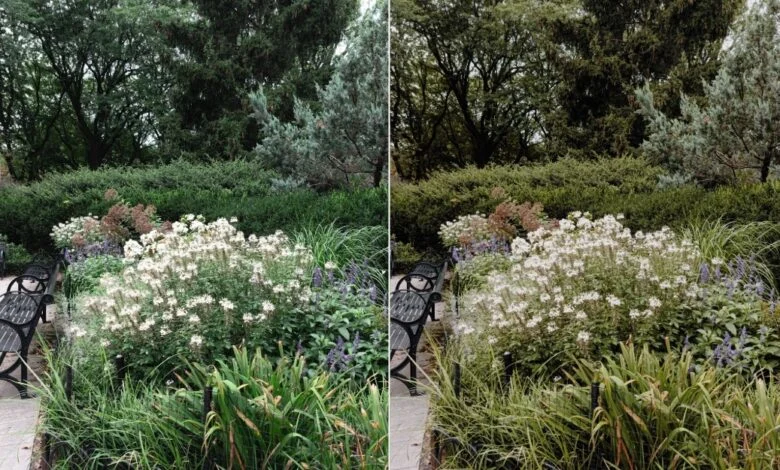
Hardware modifications on the Pixel 11 Pro feature a moderately enlarged 50-megapixel primary sensor alongside a larger half-inch sensor on the telephoto camera, while the front-facing setup keeps the previous model’s 42-megapixel sensor. However, the majority of Google’s flagship smartphone enhancements this generation concentrate heavily on software capabilities.
Key software features introduced in the release comprise Magic Capture, Instant Night Sight, Camera Looks, Creator Suite, and Pro Stable Video, along with an expanded Pro Zoom mode reaching 120x magnification, up from the prior 100x ceiling.
Before examining each new tool, practical testing indicates Google maintains a functional edge over Apple in Portrait mode performance. Google’s implementation operates more intuitively across broader scenarios, whereas Apple’s iPhone requires users to maintain specific subject distances while awaiting camera prompt readiness before applying background blur.
Camera Looks
Conversely, Apple holds an advantage in integrated color filtration. Google introduced Camera Looks as a direct counter to the Photographic Styles debuted on Apple’s iPhone 13 series, which Apple subsequently refined with the release of the iPhone 16 lineup to deliver higher aesthetic polish.
The Camera Looks interface on the Pixel 11 Pro closely mirrors Apple’s initial iteration. Users select from four persistent settings—Original, Natural, Shadows, and Vanilla—which remain active across camera restarts. A carousel menu provides six temporary filters for individual shooting sessions before resetting to the primary selection: Default, Editorial, Velvet, Classic, Digi, Black Tie, and Minimal.
Visual distinction across these preset options remains subtle regardless of permanence. Although individual looks allow customization, Google appears to process filters without utilizing depth map data in the manner Apple does, yielding flatter adjustments. By comparison, cycling through Apple settings like Luminous or Ethereal produces pronounced shifts in skin tones, background hues, highlights, and contrast levels.
Cherlynn Low for Engadget
While color profiles are often set once and rarely altered by average users, the dynamic highlights a rare operational area where Google trails Apple’s imaging system.
Instant Night Sight
Building upon its established low-light imaging capabilities, Google integrated its Tensor G6 processor and enlarged physical sensors to accelerate night capture speeds. The larger sensors collect greater ambient light per frame, decreasing the total frame sequence necessary for data compilation and effectively reducing exposure durations.
Mobile camera sensors traditionally rely on multi-frame exposure stacking in low-light environments, merging multiple long-exposure captures into a single sharp photograph. By offloading computational calculations to dedicated neural architecture on the Tensor G6, processing overhead drops significantly, enabling real-time image compilation while suppressing the motion blur inherent to extended handheld shooting.
Hands-on testing confirmed Night Sight execution was faster than the iPhone 17 Pro Max. In pitch-black conditions, the Pixel systematically completed image processing in shorter intervals than Apple’s device, while moderate low-light scenarios required under two seconds to execute the full capture sequence.
120x Pro Zoom is a bit too much
Generative artificial intelligence integration within Google’s 120x Pro Zoom presents practical limitations despite its technical ambition. High-magnification capture offers specific utility for distant targets, yet real-world applications remain narrow. During field testing along the Delaware River targeting a stationary heron on a tree branch, the 120x focal level proved counterproductive, introducing awkward framing relative to the previous generation’s 100x limit.
Beyond composition issues, the primary shortcoming of 120x Pro Zoom stems from synthetic visual artifacts in subject rendering. While structural line reconstruction works adequately on architecture, biological subjects reveal unnatural smoothing. Close-up rendering of the river heron produced unnaturally ordered plumage and altered facial structures driven by Gemini AI processing, imparting an artificial appearance.
 Cherlynn Low for Engadget
Third-party observers immediately identified the resulting image as synthetic, an assessment corroborated by embedded photo metadata indicating generative AI insertion. While the mechanism achieves distant clarity, its utility for daily photography remains questionable due to the over-processed finish.
Generative modifications alter the core documentation role of personal photography. Photographs traditionally serve as authentic records of moments or locations, functions that artificial synthesis can dilute by raising authenticity doubts among viewers who question whether subject details were captured or generated.
Beyond image output, physical handling at 120x magnification introduces operational hurdles. Maintaining frame stability requires considerable manual effort, while automated viewfinder tracking repeatedly locked onto adjacent background elements rather than the intended target, requiring manual override.
Had the subject been a fast-moving animal or live performer rather than a stationary bird, the delays caused by framing lock adjustments would likely result in missed photographs.
Comparable wildlife captures attempted on the iPhone 17 Pro Max yielded similarly flawed results. While Google maintains a technical lead in computational imaging, extreme digital magnification illustrates diminishing returns for consumer photography.
 Cherlynn Low for Engadget
Performance improved when applying 120x Pro Zoom to inorganic subjects, such as distant structural elements on a large public art installation, where edge reconstruction rendered sharp outlines without eerie visual distortion.
Magic Capture
To simplify candid recording, Google added Magic Capture, designed to record continuous video while algorithmically isolating noteworthy still frames without requiring manual shutter timing.
The feature caps continuous recording at two minutes, automatically saving selected still captures to the device gallery alongside the full video file in Google Photos, allowing manual frame extraction if algorithmic selections miss key moments.
During test executions of physical box jumps, Magic Capture parsed six distinct frames from a 43-second recording: two peak jumps with arms outstretched, one simulated fall, a side plank leg lift, a mid-pushup position, and a stylized pose with flexed limbs.
Although functional, the selection algorithm prioritizes pronounced motion changes and distinct body poses over subtle facial expressions or micro-interactions.
Positioned primarily for athletic activity, domestic animals, and children, trial runs on park wildlife yielded roughly three static captures per 30-second video segment, none of which yielded high photographic value.
While automated selection reduces immediate sorting time, relying on automated frame selection requires trusting system evaluation; reviewing source video manually cancels out intended efficiency gains.
Creator Suite, Pro Stable Video and Circle to Search in camera
Supplemental tools include Creator Suite, incorporating an on-screen teleprompter and content management features targeted primarily at social media video producers.
Google also integrated Circle to Search directly within the camera viewfinder, enabling live visual queries. In testing during a vehicle diagnostic event involving a Mini Cooper dashboard alert, interface activation required long-pressing the bottom navigation bar—a gesture implementation that follows existing visual search standards like Google Lens and Apple’s Visual Intelligence.
Video capabilities were tested via Pro Stable Video, which requires activating Video Boost and maintaining the primary 1x lens view. Initial playback recorded visible motion judder during motion, but background offloading to cloud servers subsequently processed the footage to stabilize shake and improve exposure levels hours later.
Processed Video Boost outputs demonstrated reduced vertical impact distortion, though horizontal sway persisted in stabilized clips. Despite cloud-based processing improvements, active capture in high-motion environments like running or water sports presents physical handling constraints that limit real-world deployment.