SpaceX Pairs First Public Earnings With Bold Plan for Lunar AI Satellite Factories
Inaugural Q2 results reveal 92% revenue growth as Elon Musk details plans for off-world manufacturing and electromagnetic launchers.
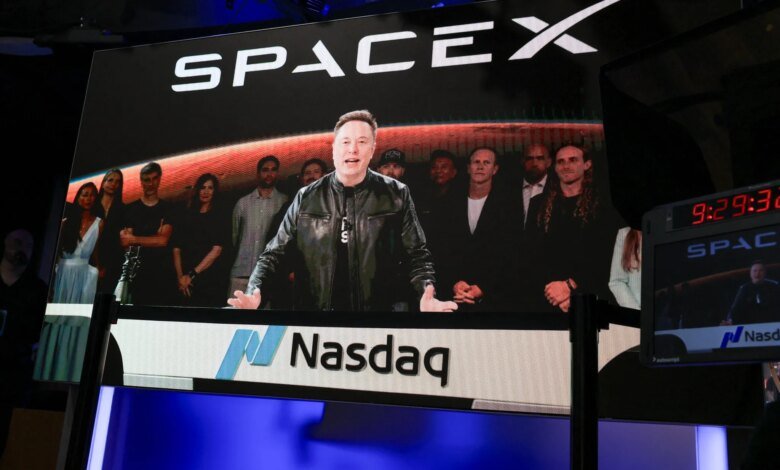
SpaceX reported a 92 percent year-over-year revenue surge to $7.8 billion in its first earnings report as a public company, while Chief Executive Officer Elon Musk outlined an off-world industrial strategy to build artificial intelligence compute satellites directly on the surface of the moon.
The plan, disclosed during the company’s Q2 financial call following its record-breaking initial public offering in June, positions lunar manufacturing as the primary catalyst for scaling SpaceX’s revenue toward a projected $1 trillion by 2030. According to regulatory filings and executive comments, the company intends to deploy autonomous robotic workforces to extract minerals from the moon’s surface, construct AI satellites in situ, and launch them into orbit using electromagnetic accelerators.
“I know this sounds totally nuts,” Musk told investors on the call, detailing how the company plans to transport heavy equipment to the lunar regolith layer using its Starship heavy-lift rocket system. “We are going to land a lot of tonnage on the moon. We’re going to build the factories on the moon. The robots will be helpful with that.”
The financial results show a stark division between SpaceX’s core commercial operations and its long-term expansion initiatives. While overall adjusted EBITDA reached $3.5 billion for the quarter, the space segment—comprising launch services, Starship development, and lunar infrastructure—generated $962 million in revenue and recorded an adjusted EBITDA loss of $205 million, driven primarily by heavy capital investment in the Starship vehicle.
SpaceX currently lofts approximately 2,500 tons per year into orbit via its Falcon rocket fleet, accounting for 80 percent to 90 percent of global commercial payload mass. Musk stated that Starship is designed to expand that capacity to 1 million tons annually, with an ultimate target of 10 million tons per year to support off-world industrialization.
The company’s strategic disclosures detail a supply chain reliant on mining regolith—the top layer of lunar dust and rock—to extract raw aluminum, titanium, and silicon. While specialized microchips and select assemblies will originate on Earth, the bulk structural components for AI compute satellites are intended to be manufactured locally. Completed satellites will be launched using a “lunar mass driver,” an electromagnetic system that propels payloads off the moon’s surface without chemical rocket fuel.
Greg Martin, managing director at Rainmaker Securities, noted that shifting capital allocation toward lunar infrastructure offers immediate practical advantages for investors compared to direct Mars initiatives.
“Getting to Mars is a 26-month launch, six-months in transit, versus a two-day trip to the moon,” Martin said. “As an investor, the moon feels much more palatable.”
Martin added that the step-by-step framework of establishing logistics routes before scaling resource extraction and manufacturing represents a structured commercial progression. “He is building the building blocks to pull it off,” Martin said.
From a physics and logistics perspective, launching materials off the moon requires roughly one-twentieth of the energy needed to escape Earth’s gravity well. Because the moon lacks an atmosphere, electromagnetic launching systems face no aerodynamic resistance.
“A high speed train is a good way to think about it,” said Jaret Matthews, chief executive officer of Astrolab and a former SpaceX engineer. “You can huck mass off the moon without burning propellant.”
Matthews, whose company secured a $219 million NASA contract for a lunar rover, emphasized that off-world surface logistics mirror large-scale infrastructure projects in undeveloped terrestrial regions. “I like to tell people the moon is equivalent in surface area to Africa,” Matthews said. “Gaining access to the moon is essentially like gaining access to a whole new continent.”
However, operating on the lunar surface presents severe engineering obstacles. Lunar dust is micro-abrasive and electrostatically charged, causing rapid degradation of solar arrays and mechanical joints, while surface temperatures fluctuate between negative 300 degrees Fahrenheit and well above boiling.
“Everything is trying to kill you on the moon,” Matthews said. “The moon is a harsh mistress and a pretty tough place to operate.”
To survive those environmental conditions, the proposed factories will operate entirely without human personnel. “Anyone who is thinking about doing industrial processes on the moon, they aren’t imagining a workforce of humans wrenching on things there,” Matthews added. “That’s going to be prohibitively expensive and dangerous. But those are the things that robots are good at.”
Jim Cantrell, Arizona space commissioner and CEO of Phantom Space, who served as SpaceX’s first vice president of business development in 2001, indicated that Tesla Inc.’s Optimus humanoid robots are designed to form the baseline labor unit for these facilities.
“Robots just need electricity, solar power, and a little bit of lubrication in the joints,” Cantrell said. “That’s about it.”
Cantrell noted that because the moon experiences 14 consecutive days of sunlight followed by 14 days of complete darkness, continuous factory operations will require surface nuclear power systems. Despite the operational risks, Cantrell views the broader initiative as an unprecedented commercial effort.
“It’s pure insanity,” Cantrell said. “But he’s going to do it, because that’s what Elon does.”
Cantrell stated that the minerals required for satellite construction exist in abundance in the lunar soil. “That stuff is all there, aluminum in the soil, all sorts of rare minerals,” he said. “The idea of setting up factories, all that, it’s very feasible.”
Looking across Musk’s broader portfolio—spanning satellite broadband, artificial intelligence data centers, tunnel boring, and robotics—Cantrell argued that the assets are engineered to converge on planetary expansion. “He’s not building a company,” Cantrell said. “He’s building a nation state—and no other nation states are even competing with him.”
The commercial case for early lunar industrialization is further bolstered by public sector funding. NASA has committed $20 billion over seven years toward lunar base infrastructure under its ongoing exploration programs, creating a baseline commercial customer for off-world transportation and data center services.
Ryan Westerdahl, CEO of Turion Space and a former SpaceX engineer, pointed out that execution timelines under Musk historically stretch beyond initial guidance but generally move in a consistent direction. “He’s usually off by a few years and a little on the optimistic side,” Westerdahl said, describing Musk’s internal benchmark as: “This is what I think we can accomplish, and engineers haven’t convinced me it’s impossible yet.”
Westerdahl noted that establishing lunar factories provides a practical proving ground for autonomous systems before attempting larger-scale expansion to Mars. “By the time we get there, there’s a very real possibility that Optimus robots are doing the vast majority of the heavy lifting and Starship is autonomously depositing cargo,” he said.
Communication latency also favors early development on the moon, where signals take approximately two seconds round-trip compared to light-delay lag of up to 20 minutes for Mars. “Your opportunities to go [to the moon] are much more frequent,” Matthews said. “You don’t have to wait for the planets to literally align.”
For public markets evaluating SpaceX’s Q2 financial performance alongside its off-world balance sheet commitments, investment analysts view the strategy as a high-risk, high-return mandate dependent on execution track record.
“This guy’s lost his mind,” Cantrell recalled thinking during a trip with Musk 25 years ago when the entrepreneur first proposed building private orbital rockets. “Normal people don’t say things like that. But look where we are 25 years later.”
Martin of Rainmaker Securities emphasized that public equity investors in SpaceX are ultimately underwriting Musk’s long-term capability to create new industrial markets. “Scientifically it makes sense,” Martin said. “It does feel very speculative at this point, but he’s looking to grow a space economy and I wouldn’t put it past him to accomplish it.”
“He’s made more investors more money than any entrepreneur in the history of man—he’s earned our trust,” Martin added. “But you have to go along with the ride a little bit.”