SpaceX Rocket Stage Crashes Into Moon, Highlighting Lunar Debris Risks
Telescope observations in Chile detect a debris plume following an unguided 5,400-mph impact near Einstein Crater.
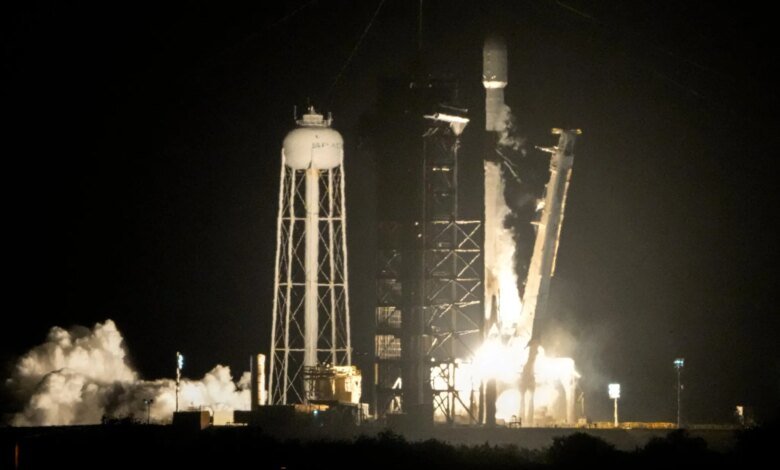
A spent four-ton SpaceX rocket stage collided with the moon at 5,400 mph (8,700 kph), generating a debris plume observed from Earth and bringing renewed scrutiny to orbital litter in deep space.
Astronomers operating the European Southern Observatory’s Very Large Telescope in Chile detected a vaporized stream of sodium and lithium extending for miles into space for five to 10 minutes following the collision. The impact occurred on a barren stretch near Einstein Crater on the moon’s sunlit western limb—a boundary zone between the near and far sides that is technically challenging to observe from Earth.
Boston University’s Carl Schmidt said he is “100% certain” that his team’s observations revealed signs of the lunar crash. “We don’t have images of the impact” but there’s telescope evidence, Schmidt said in an email.
The 40-foot upper stage spent weeks adrift before falling into the moon’s gravity well. Trajectory data on Tuesday night showed the hardware on a direct collision course. “There’s no doubt in my mind” that the rocket “is now in teeny, little pieces scattered over the moon near Einstein Crater,” retired astrophysicist Jonathan McDowell told The Associated Press. “As a physicist, I know that what goes up must come down,” he added.
Ground-based observers faced narrow odds of capturing visual surface reflections during the impact. Dutch scientist Marco Langbroek was among those aiming his telescope at the moon at the appointed time, but he came up empty. “We knew this would be a long shot,” Langbroek said, while agreeing there was “no doubt” the hardware met its doom. Direct high-resolution imaging of the newly formed crater relies on NASA’s Lunar Reconnaissance Orbiter, which is scheduled to pass over the site next week.
The spent Falcon stage originally launched from Cape Canaveral on Jan. 15, 2025, hoisting two commercial payloads bound for the lunar surface: Firefly Aerospace’s Blue Ghost and ispace’s Resilience. While Resilience crashed during its landing attempt, Blue Ghost successfully landed, becoming the first commercial craft to achieve a soft touchdown on the moon. Once the landers separated, orbital mechanics and environmental forces began altering the upper stage’s trajectory.
SpaceX’s Julianna Scheiman said this week that the company is working with NASA to avoid future wrecks, stressing that this projected crash was not deliberate. A combination of solar activity and gravity accidentally put it on a collision course with the moon, she said.
Unintended lunar impacts are becoming more frequent as deep-space activity scales up. A Chinese rocket stage unintentionally struck the moon in 2022, joining multiple historic upper stages scattered across the surface. The incident arrives amidst an escalating push by the U.S. and China to send robotic and human missions back to the moon.
Under NASA’s Artemis program, private aerospace vendors are building massive landers to establish permanent infrastructure on the moon. Elon Musk’s SpaceX is progressing through test flights of its Starship vehicle in Texas, while Jeff Bezos’ Blue Origin continues work on its Blue Moon lander. One or both landers are designated to participate in next year’s Artemis III orbital rehearsal ahead of a planned crewed landing targeted for as early as 2028.
“Things are going to get a lot busier near the moon,” McDowell said. “At that point an impact like this on the lunar surface plowing up huge amounts of dust going for hundreds of miles around is not going to be acceptable.”