Juvenile Tiger Shark Capture in Massachusetts Prompts Investigation Into New England Nursery Habitats
Scientists at the New England Aquarium are investigating whether warming Atlantic waters are turning coastal Massachusetts into a nursery for tropical shark species.
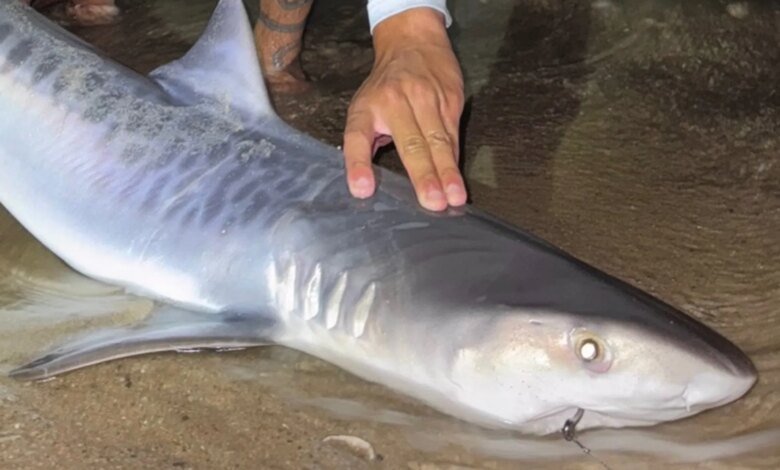
Marine scientists are investigating whether coastal waters off southern New England are becoming a nursery habitat for tropical tiger sharks, following the late-July capture and release of a juvenile specimen off Falmouth, Massachusetts.
The five-foot shark was landed from a beach by sport fisherman Nate Rouette and his brother Nelson during a late-night outing targeting brown sharks. Nate Rouette, social media manager for On The Water magazine, identified the distinct markings of the sub-tropical predator before returning the animal to the sea. “And I saw those horizontal lines, indicating it was a tiger shark, which was super cool,” Nate Rouette said. “Immediately I started yelling to my brother, ‘It’s a tiger, it’s a tiger shark!’ And he was in disbelief.”
While adult tiger sharks occasionally range into northern waters, the presence of young specimens off Cape Cod is historically rare. Researchers are examining whether shifts in ocean temperatures are encouraging young sharks to establish seasonal residency further north. “Maybe they are coming up here because conditions are right. There’s food, there’s warm waters,” said John Chisholm, adjunct scientist at the New England Aquarium’s Anderson Cabot Center for Ocean Life in Boston. “Maybe it’s becoming a nursery — that’s one of the issues that we will investigate.”
The coastal waters off New England and the broader Northwest Atlantic have warmed rapidly in recent decades, driven by climate change. Rising ocean temperatures have altered marine ecosystems across the region, expanding the summer ranges of sub-tropical aquatic life and creating hospitable conditions for vagrant species along the Northeast coast.
Fully grown tiger sharks can reach lengths of more than 15 feet (4.6 meters) and weigh up to 1,400 pounds (635 kilograms). The opportunistic apex predators consume a wide variety of prey, including fish, crustaceans, and birds, and are known for ingesting man-made marine debris such as old license plates and shoes. Though adult tiger sharks are classified among the species more dangerous to humans, unprovoked fatal bites remain rare.
The appearance of juvenile tiger sharks fits a broader pattern of northward marine migration in the Atlantic. Other species, including black sea bass, have shifted their distribution boundaries northward as sea temperatures rise. Concurrently, great white sharks have recorded increasingly frequent sightings off Cape Cod, New Hampshire, and Maine, fueled by warming waters and an abundance of seals.
Reflecting on the shifting environmental conditions along the coast, Nate Rouette noted, “People are definitely seeing more species that indicate that.”