Meta Launches Muse Code Agent with Restart-Safe Architecture for Long-Horizon Engineering Tasks
The terminal coding agent uses a local event log to maintain state across crashes, challenging rival developer tools from Anthropic and OpenAI.
Meta has launched Muse Code (beta), a terminal-based coding agent powered by its new Muse Spark 1.2 model, introducing a fault-tolerant architecture built to sustain multi-hour software engineering tasks across extensive codebases.
“We’re excited to release Muse Code (beta), a terminal coding agent powered by Muse Spark 1.2, our newest model,” the company said in an official announcement, adding that “This marks our next step toward the frontier, with larger and much more capable models on the way.”
Unlike traditional coding assistants that rely on single-prompt operations, the tool is structured around persistent execution. Per Meta, Muse Code “takes on complex software engineering tasks across large repositories: planning changes, writing code, and validating the results. It can coordinate multiple persistent subagents for each task, solving difficult problems faster, more accurately, and with less intervention.”
A core architectural feature of the release is its resilience against runtime failures. Muse Code logs every model call, tool execution, user authorization, and file modification to a local database. “This single source of truth makes the runtime replay-exact and restart-safe: after a crash, the agent can resume precisely where it stopped,” Meta said. The environment also introduces interactive commands, including “/plan” for gated architectural planning, “/grill” for stress-testing task strategies, and “/goal” to guide multi-step execution.
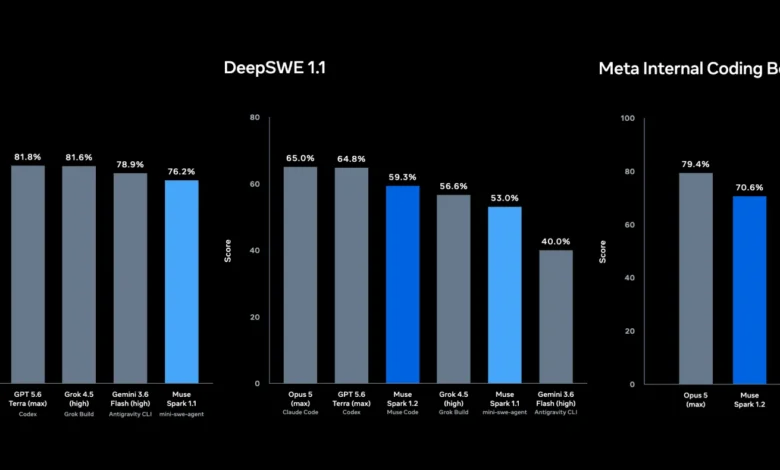
Benchmark results released alongside the software show that Meta “significantly scaled up training compute on coding tasks while expanding training environment diversity, delivering improvements in code generation, complex debugging, and end-to-end developer workflows.” On Terminal-Bench 2.1, Muse Spark 1.2 paired with Muse Code reached 82.9%, trailing Anthropic‘s Claude Code on Opus 5 (86.7%) while outperforming OpenAI‘s GPT-5.6 Terra on Codex (81.8%) and Grok Build (81.6%).
On the DeepSWE 1.1 benchmark, which evaluates complex autonomous software engineering, Muse Spark 1.2 scored 59.3%, compared to 65.0% for Opus 5 and 64.8% for Codex. On Meta’s internal coding evaluations, the model registered 70.6% against Opus 5’s 79.4%.
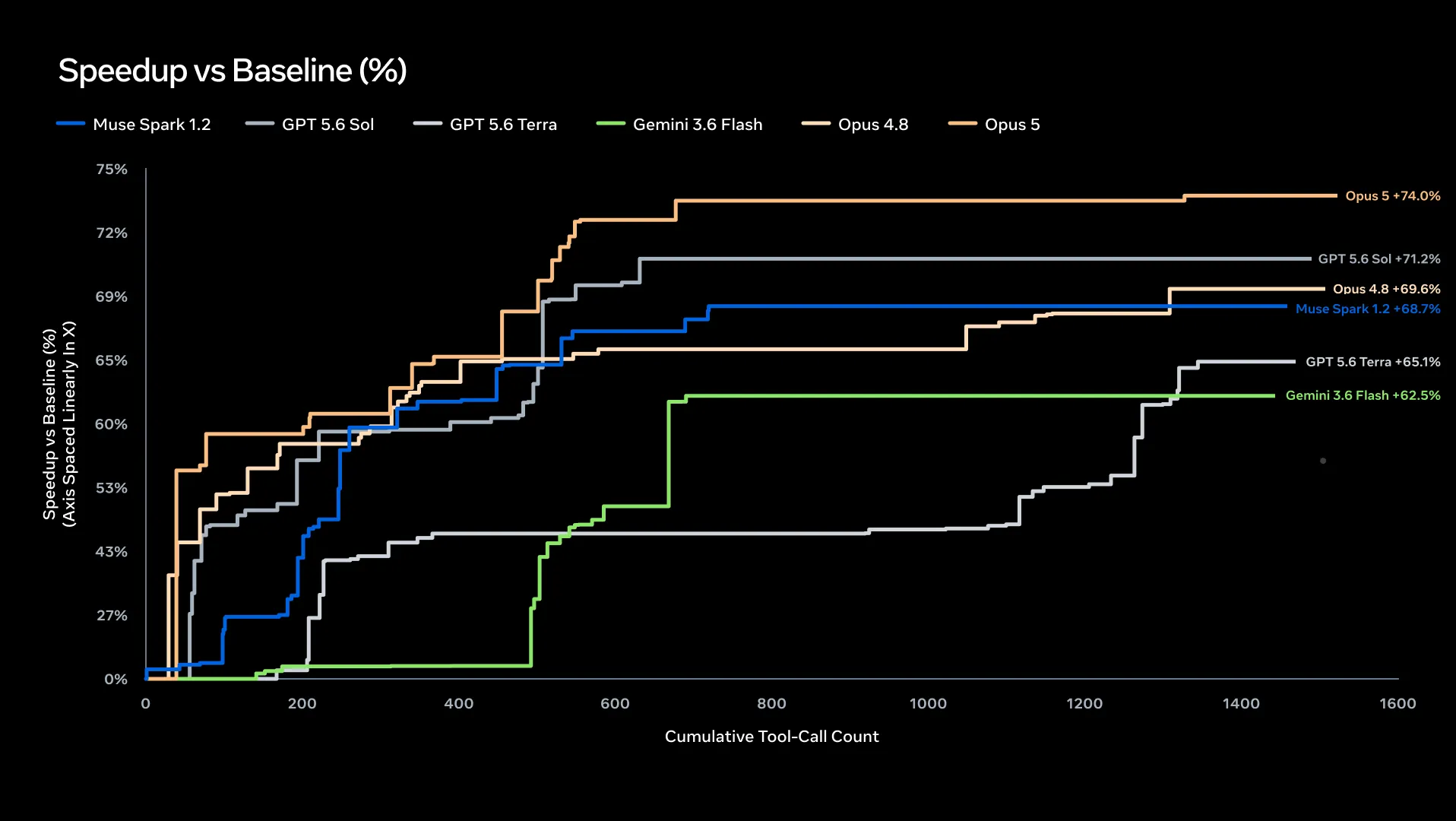
For long-horizon developer operations, Meta reported that Muse Code “iteratively optimized GPU kernels over 1,000+ tool calls (up to 24 hours) on Nvidia Hopper GPUs.” Over extended tool usage cycles exceeding 1,000 calls, Muse Spark 1.2 demonstrated performance gains between 61% and 69% compared to baseline runs, while Opus 5 achieved gains of 74% to 75%.
The agent also integrates multimodal terminal processing. In demonstration tests, Meta showed the software accepting an mp4 video file inside the command line, where it “interprets the video and produces a visually rich website with booking capabilities.” Developers can access the beta tool via Meta’s Model API or install it directly using shell command `curl -fsSL | bash`.