The 1-Bit AI Breakthrough: How PrismML’s Bonsai 27B Squeezes Frontier-Class Intelligence Onto an iPhone
PrismML's highly compressed 27-billion-parameter model runs locally on mobile hardware, sparking early talks with Apple.

The dream of running highly capable, private, and zero-latency artificial intelligence locally on consumer hardware has long been blocked by a physical wall: memory capacity. Large language models (LLMs) are notoriously memory-hungry. A standard 27-billion-parameter AI model—considered a highly capable, medium-sized model by modern industry standards—requires roughly 54 GB of random-access memory (RAM) to run even at half-precision (FP16). This requirement instantly disqualifies almost all consumer laptops, let alone mobile devices.
But a new breakthrough has shattered this memory ceiling. AI research firm PrismML has released Bonsai 27B, a 27-billion-parameter model compressed down to a mere 3.9 GB. For the first time, a model of this scale can clear the strict memory budget of a consumer smartphone, running locally at a steady 11 tokens per second on an iPhone 17 Pro Max.
For power users on desktop hardware, the 5.9 GB ternary variant of the model clocks an impressive 26 tokens per second on an M5 Pro laptop. Both variants have been released to the public for free under the permissive Apache 2.0 open-source license, signaling a massive shift in how high-performance AI can be distributed and executed without relying on expensive cloud infrastructure.
The Technical Magic Behind 1-Bit and Ternary Compression
To understand the magnitude of this achievement, it helps to look at how neural networks store information. Parameters are essentially the internal dials and weights that a model adjusts during training to understand language. Typically, each weight is stored as a high-precision 16-bit floating-point number, which allows for roughly 65,000 different settings per weight.
The compression method utilized by Bonsai 27B, built on intellectual property developed at Caltech, drastically simplifies this structure. It reduces each model weight from 16 bits of floating-point precision down to a single sign. In the binary (1-bit) build, this is represented as either +1 or -1. In the ternary build, it can be one of three values: -1, 0, or +1.
To maintain accuracy, each group of 128 weights shares a single 16-bit scaling factor. This mathematical optimization brings the binary variant down to an average of just 1.125 bits per weight—making it 14 times smaller than the full-precision original. The ternary model, which introduces the “zero” state for slightly more expressive power, settles at 1.71 bits per weight.
What sets this architecture apart from conventional “low-bit” quantized models is its uncompromising end-to-end compression. Standard quantized builds often leave sensitive layers—such as token embeddings, attention layers, and the language model head—at higher precision to prevent the model’s reasoning from collapsing. This “escape hatch” approach keeps the file size high. Bonsai, however, compresses every single layer end-to-end without sacrificing output quality.
This release marks the second major milestone for the model family. In March, the company shipped Bonsai 8B, a 1.15 GB model that proved 1-bit architectures could survive at the 8-billion-parameter scale. However, the jump to 27 billion parameters is where the stakes change. The 27B scale is widely recognized as the threshold where sustained chain-of-thought reasoning, reliable tool use, and multi-step agentic behavior emerge consistently—capabilities that smaller models still frequently fumble.
Benchmark Performance: Defying the Quantization Penalty
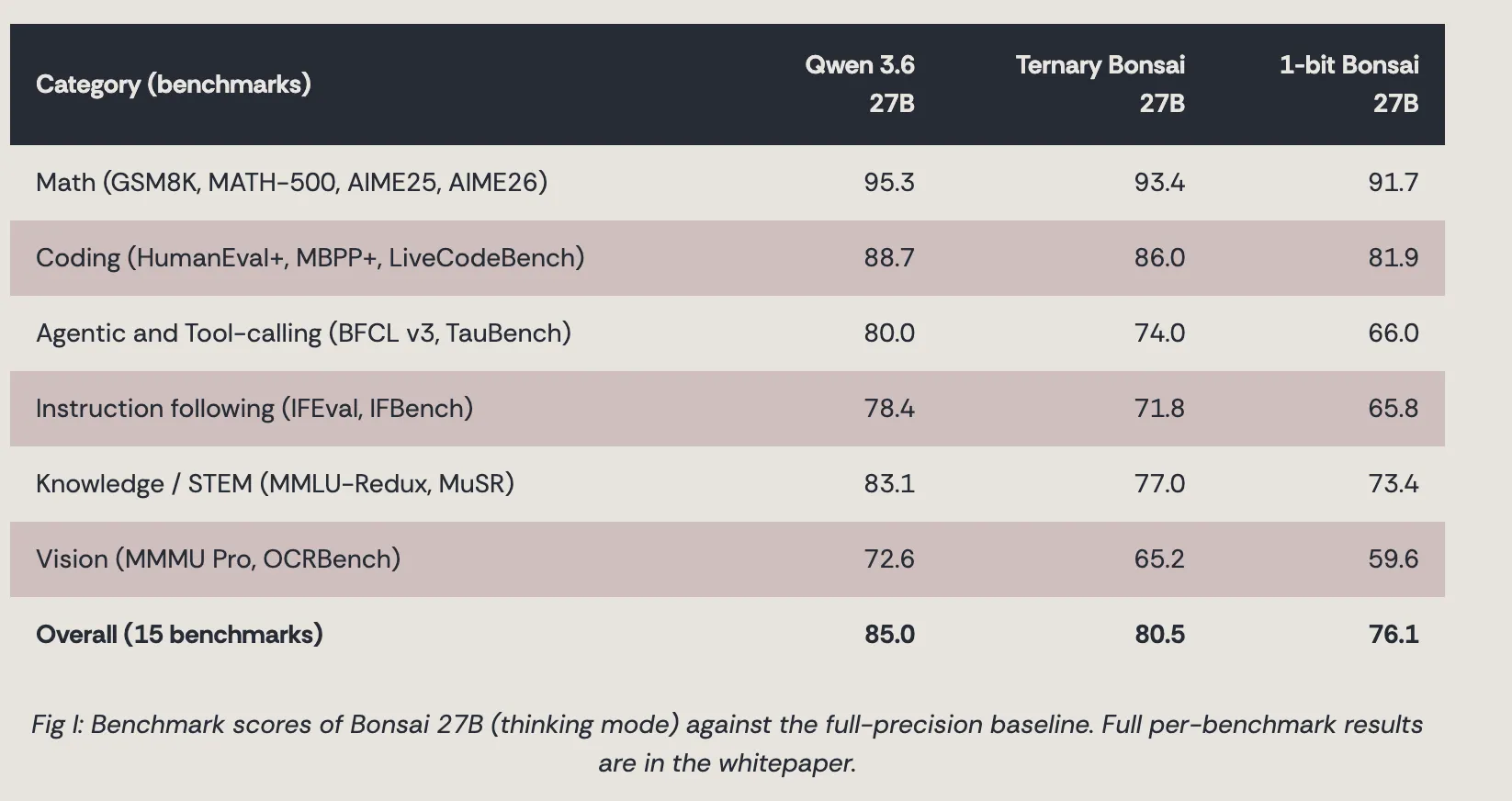
Historically, compressing a model below 4 bits resulted in a catastrophic drop in performance. Yet, across 15 rigorous benchmarks evaluated in thinking mode on NVIDIA H100 GPUs—spanning mathematics, coding, general knowledge, and tool integration—the ternary version of Bonsai 27B averaged a score of 80.49. This represents an astonishing 94.6% of the performance of the uncompressed, full-precision original. The 1-bit binary variant followed closely behind with an average score of 76.11.
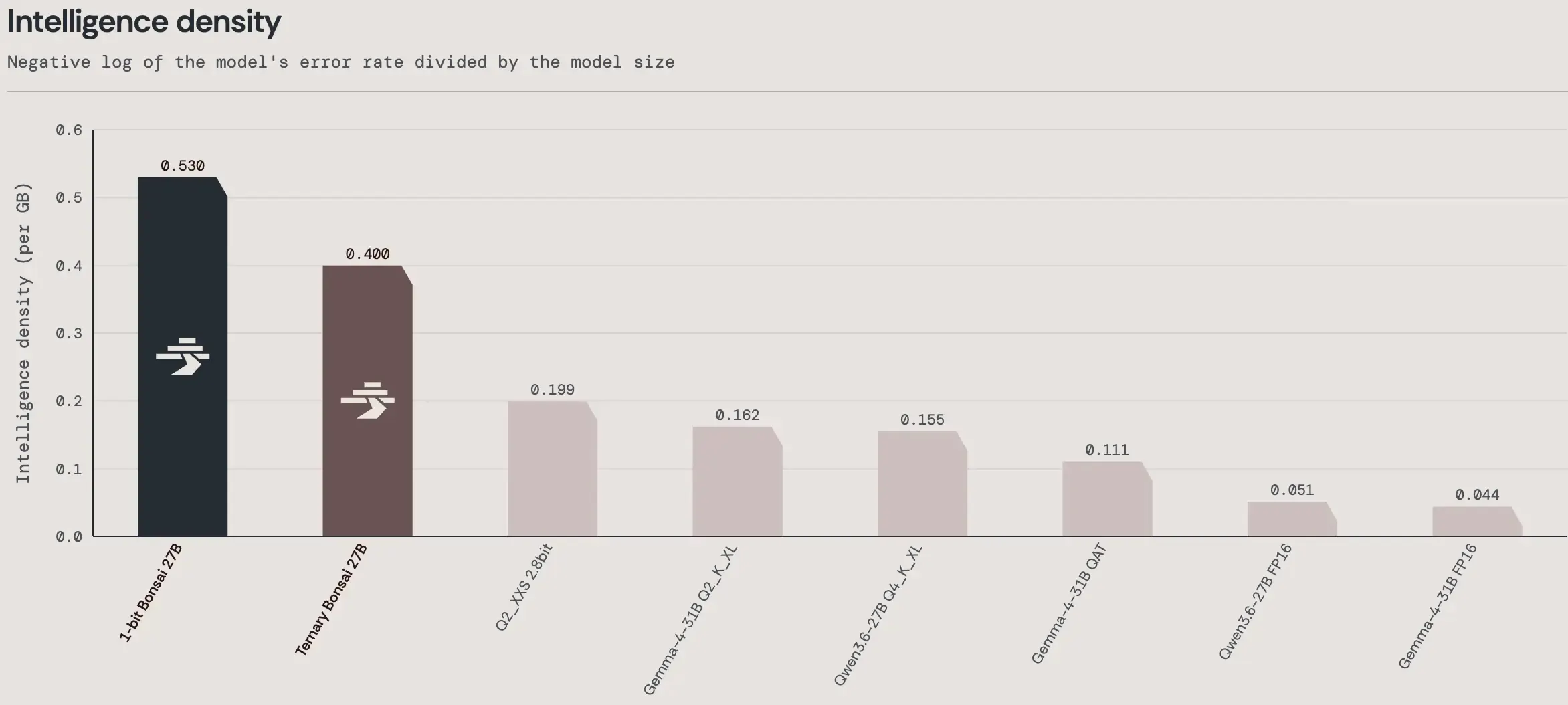
When compared to popular open-weights models like Gemma 4 or Qwen 3.6, the Bonsai models deliver far higher capability relative to their physical size, unlocking unprecedented efficiency on limited hardware.
The mathematical and coding capabilities of the compressed model are particularly notable. On the AIME25 and AIME26 benchmarks (modeled after the prestigious American Invitational Mathematics Examination), the ternary version of Bonsai 27B achieved 93.7% accuracy, compared to 95.3% for the significantly larger Qwen 3.6B. In coding tasks, Bonsai scored 86 points against Qwen’s 88, while maintaining a respectable 77% in general knowledge compared to Qwen’s 83%.
Beyond weight compression, the model utilizes a custom hybrid attention backbone where approximately 75% of the layers are linear rather than standard quadratic attention. This architectural design is what makes a massive 262K-token context window practical on consumer devices. Standard quadratic attention stacks require an exponential amount of memory as context grows, which would quickly overwhelm mobile hardware.
Hands-On Testing: Real-World Capability
To see how these benchmarks translate to real-world usage, we put Bonsai 27B through its paces locally. While complex coding tasks still benefit from iterative prompting—as single-shot prompts cannot yet match massive, cloud-hosted frontier models—the fact that this model runs entirely locally and for free makes iteration trivial.
We tasked the model with building Zombie Type, a first-person typing-horror browser game. Within just two rounds of “vibe coding,” the model produced clean collision detection, proper scoring logic, and functional graphics that held together perfectly. It demonstrated a strong grasp of code structure early in the prompt cycle, using subsequent turns to refine rather than completely rewrite the codebase.
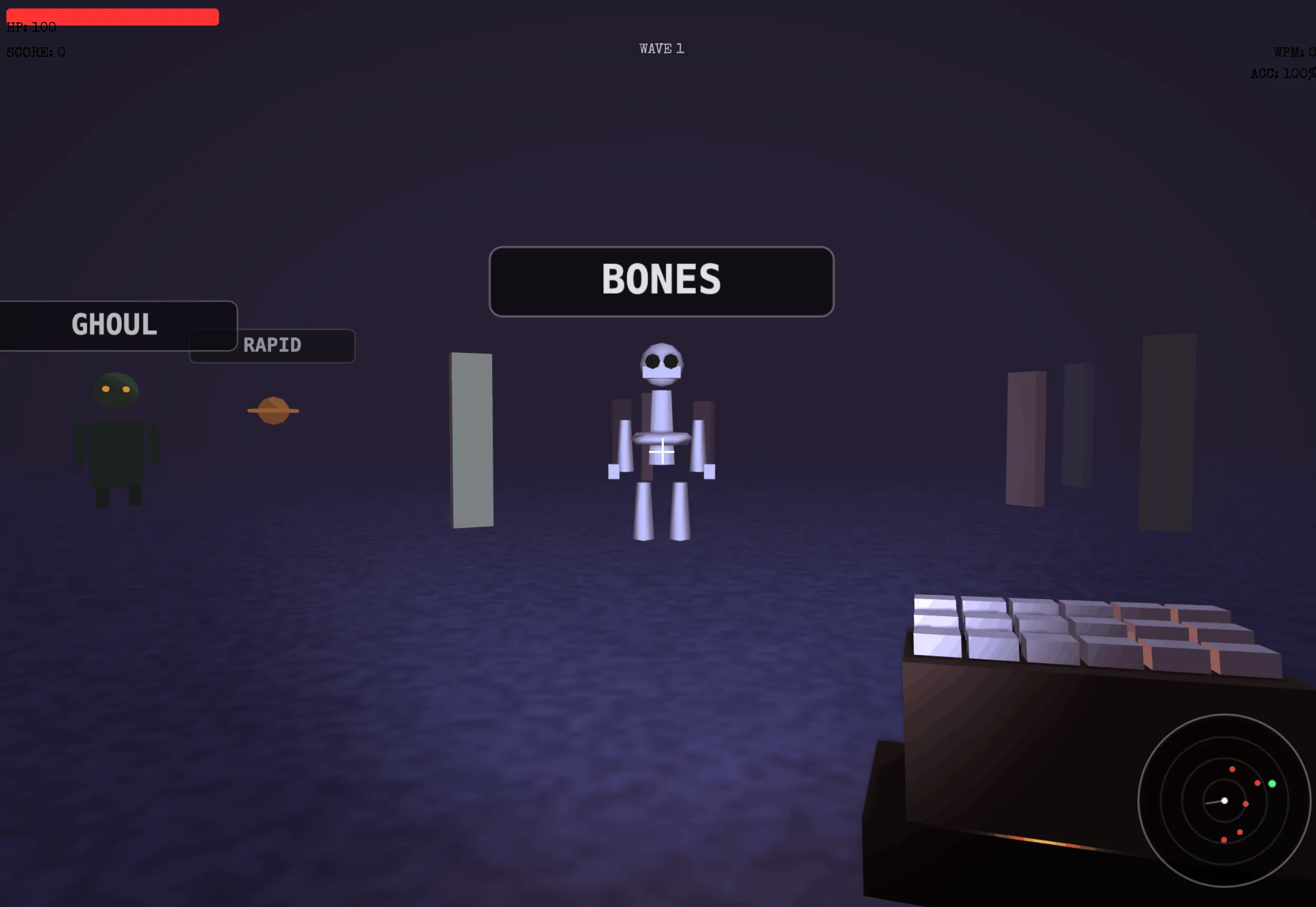
Interestingly, some of the visual assets generated during our testing (such as the character skeletons) actually looked more elaborate and stylistically cohesive than those generated by GPT 5.6 Sol. While this doesn’t mean Bonsai is a superior model overall, it highlights its surprising competence in creative and stylistic tasks.
In creative writing, the model generated narratives with consistent internal logic, natural pacing, and satisfying story arcs. Its output was on par with, and occasionally better than, cloud models like Claude Haiku or even Sonnet under low-effort prompts. For a model running entirely on local silicon with zero API costs, the performance is highly impressive.
To boost performance even further on server-side hardware, the model ships with a DSpark speculative decoding layer. This lightweight drafting mechanism proposes blocks of candidate tokens, which the primary model then verifies in a single forward pass. On an NVIDIA H100 GPU, this technique provides a 1.37x throughput boost with zero loss in output quality. While this feature is not yet enabled by default on Apple Silicon, it represents a major efficiency gain for developers hosting the model on cloud GPUs.
The Apple Connection and the Future of Mobile AI
The ability to run a highly capable 27B model locally has caught the attention of major hardware manufacturers. Speaking to CNBC, PrismML CEO Babak Hassibi confirmed that the company is in early-stage talks with Apple, which is actively evaluating the compression technology for potential integration into its on-device Apple Intelligence ecosystem.
As consumer demand for private, offline, and secure AI features grows, the ability to pack massive models into small memory footprints is becoming the holy grail of mobile software. Hassibi revealed that a compressed version of Google’s Gemma model is next in the company’s pipeline, with plans to apply the same compression techniques to even larger frontier models in the future.