US Banking Groups Urge Senate to Tighten Stablecoin Yield Rules in CLARITY Act
A coalition of 78 banking associations warns that ambiguous language in the CLARITY Act could trigger deposit flight.
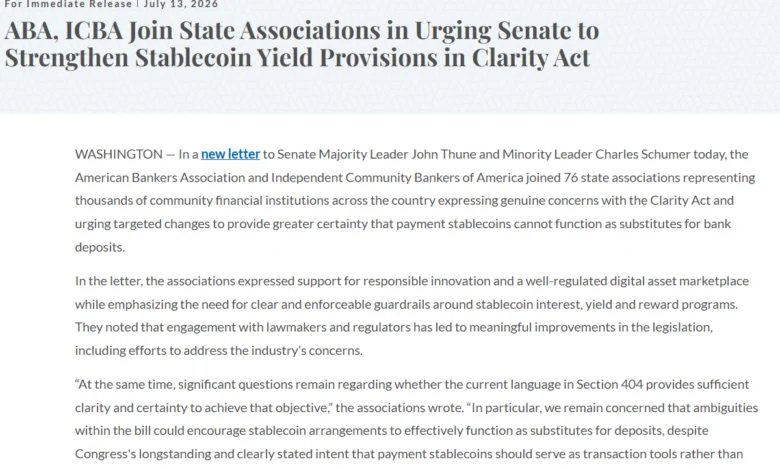
WASHINGTON — A broad coalition of the U.S. banking industry is pressing Senate leaders to revise the stablecoin yield provisions of the pending Digital Asset Market Clarity Act (CLARITY), warning that the current draft could allow digital assets to compete directly with traditional bank deposits.
In a joint letter sent to Senate leaders, the American Bankers Association (ABA), the Independent Community Bankers of America (ICBA), and 76 state banking associations argued that the bill’s current language regarding stablecoin interest, yield, and rewards remains highly ambiguous. While expressing support for the broader legislation, the groups asserted that payment stablecoins must be prevented from acting as deposit substitutes.
According to a press release published on Monday, the ABA expressed concern that these ambiguities “could encourage stablecoin arrangements to effectively function as substitutes for deposits, despite Congress’ longstanding and clearly stated intent that payment stablecoins should serve as transaction tools rather than store-of-value products.”
The banking coalition specifically urged lawmakers to amend section 404 of the bill. This revision, they argued, would clarify the prohibition on interest and yield, ensuring that issuers cannot circumvent these rules through alternative incentive structures to trigger a “deposit flight.”
The pushback comes just days before a scheduled House of Representatives hearing on the bill this Friday. The CLARITY Act represents a major legislative push to establish the first comprehensive regulatory framework for digital assets in the United States.
Legislative Hurdles and Divergent Views
The banking industry’s lobbying efforts align with broader skepticism regarding the bill’s immediate legislative prospects. Galaxy Digital recently reduced its odds of the CLARITY Act passing into law by 2026 to 50 percent. In its June 26 analysis, the firm pointed to a narrowing legislative window, the lack of a unified Senate Banking-Agriculture committee text, and the absence of a firm floor schedule before the upcoming Senate recess.
The bill cleared the Senate Banking Committee in May but immediately drew criticism from both the banking sector and congressional Democrats. Critics argue that the current framework would permit cryptocurrency firms to offer yield-bearing stablecoins without being subject to the stringent regulatory requirements imposed on traditional financial institutions.
Prominent industry figures have also voiced opposition. In a May interview, JPMorgan CEO Jamie Dimon stated that the banking sector would “fight” the current iteration of the bill, adding that cryptocurrency companies seeking to offer yields on stablecoins should instead apply for banking charters.
Conversely, the bill has gathered support from other sectors. On Friday, the Federal Law Enforcement Officers Association (FLEOA) endorsed the CLARITY Act in a letter to the Senate Banking Committee, while calling for stronger accountability measures in decentralized finance (DeFi) and the preservation of existing investigative tools. Earlier in June, a coalition of more than 200 crypto companies and organizations, coordinated by the advocacy group Stand With Crypto, also petitioned the Senate to pass the legislation.
Background: Stablecoins and the Banking System
Stablecoins are a class of cryptocurrencies designed to maintain a stable value by pegging their price to another asset, most commonly the U.S. dollar. Unlike highly volatile cryptocurrencies such as Bitcoin, payment stablecoins are primarily intended to facilitate rapid, low-cost digital transactions and settlements.
When stablecoin issuers offer yields or interest-like rewards, these digital assets begin to function similarly to traditional bank deposits. In the financial sector, “deposit flight” refers to the rapid movement of capital out of commercial banks as depositors seek higher yields or alternative stores of value elsewhere. Because traditional banks rely on customer deposits to fund loans and maintain liquidity, a significant migration of funds to non-bank digital assets could impact credit availability and broader financial stability.
The American Bankers Association and the Independent Community Bankers of America represent thousands of financial institutions across the United States, ranging from large international banks to local community lenders. These organizations advocate for regulatory parity, arguing that non-bank financial technology firms offering deposit-like services should be subject to the same oversight, capital requirements, and consumer protection standards as chartered banks.