Decoupling From China to Cost US and Europe $23.6 Trillion, Study Finds
EY-Parthenon analysis details the massive infrastructure and supply chain investments required by 2050.
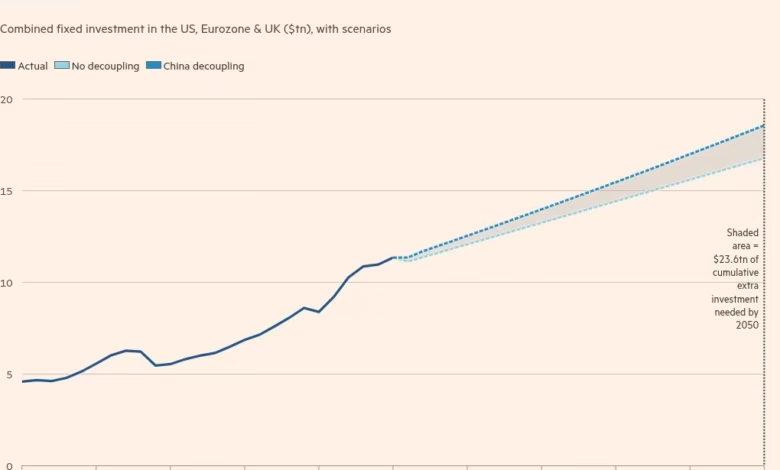
The United States and Europe would need to invest an additional $23.6 trillion over the next quarter-century to eliminate their reliance on China in critical manufacturing and technology sectors, according to an economic analysis by consultancy EY-Parthenon.
The study calculated that replicating the infrastructure, research, software, manufacturing, and supply chains currently reliant on China would cost the US $13.7 trillion, the Eurozone $9.1 trillion, and the UK $800 billion by 2050.
On an annual basis, the required US investment of $550 billion is roughly equivalent to the $600 billion invested by major US technology groups in data centers in 2025. For the European Union, the required spending would represent a near doubling of its annual budget.
“Localising supply chains without putting prohibitive costs on taxpayers and consumers will be one of the most formidable challenges for businesses and governments alike in coming years,” said Mats Persson, a former Downing Street adviser who is now at EY-Parthenon.
The analysis noted that while an average collective investment of $940 billion a year for 25 years is “not insurmountable” in theory, it would be required on top of existing commitments in energy, technology, defense, and infrastructure.
Supply Chain Vulnerabilities and Tariffs
The economic vulnerability of Western nations to Chinese policy decisions was highlighted last year when Beijing imposed export controls on critical rare earth metals. This action followed US President Donald Trump’s threat to impose 145 percent tariffs on imports from China.
The resulting supply disruption brought car industry production lines in both economies close to a standstill before Washington and Beijing reached a truce. The incident prompted renewed urgency in Western efforts to de-risk, including an EU initiative to stockpile rare earths.
According to an assessment by the International Energy Agency, China is projected to supply more than 60 percent of the world’s refined lithium and cobalt—essential for the transition to cleaner energy—and approximately 80 percent of battery-grade graphite and rare earth elements by 2035.
Alicia García-Herrero, chief economist for Asia Pacific at investment bank Natixis, stated that a short-term decoupling is highly unlikely due to Beijing’s control over critical industrial materials.
“The challenge is not just how much it would cost, but about China’s ability to intervene to stop such decoupling because of its existing control over the supply of everything from rare earths processing to active pharmaceutical ingredients,” she said.

Inflationary Pressures and Structural Challenges
Chinese manufacturers currently maintain a 20 to 100 percent factory price advantage over Western competitors. Consequently, reducing reliance on Chinese production would likely elevate prices and drive inflation.
In Europe, severing ties could increase prices by 1 to 2.5 percent in critical sectors. This could keep the European Central Bank and the Bank of England perpetually above their 2 percent inflation targets, according to an ECB analysis cited in the report.
Beyond physical infrastructure, Western nations would need to invest heavily in workforce training and factory automation to reduce dependence. Given these hurdles, Persson suggested that a “partial decoupling” is the more probable outcome, requiring businesses to selectively target investments to mitigate potential Chinese chokepoints.
Background: Critical Materials and Supply Chains
To understand the scale of the challenge, it is helpful to examine the specific materials underpinning modern technology and green energy.
Rare earth elements are a group of 17 chemical metals—including neodymium, dysprosium, and terbium—that are essential for manufacturing high-strength permanent magnets used in electric vehicle motors, wind turbines, and defense technologies. While these elements are not physically rare, extracting and processing them is highly complex, chemically intensive, and environmentally hazardous. Over several decades, China established dominant processing capacity, making global supply chains highly dependent on its output.
Similarly, active pharmaceutical ingredients are the chemical components responsible for the therapeutic effects of medications. Global pharmaceutical manufacturing relies heavily on chemical precursors and active ingredients produced in Chinese facilities, which benefit from lower operating costs and scaled infrastructure.
The International Energy Agency, established in 1974, serves as an autonomous intergovernmental organization providing analysis and data on the global energy sector. Its projections highlight the concentration of mineral processing, which remains a central focus of industrial policy in both the United States and the European Union.