EU Clean Tech Strategy Faces Hurdles as EV Tariffs Show Mixed Results
Research highlights the scale of investment needed for strategic autonomy as Chinese EV imports adapt to trade barriers.
The European Union faces a complex path toward securing its clean energy future, according to new research highlighting the limitations of current trade measures and the scale of investment required to reduce dependency on China.
A study by the Clean Technology Partnerships Initiative (CTPI) indicates that targeted investments between €19 billion and €36 billion across 10 supply chains could bolster production in partner nations by 10 to 15 percent. This figure is a fraction of the €600 billion currently invested annually in European energy, yet it contrasts sharply with the estimated $9.1 trillion required for the Eurozone to fully replicate all critical industries currently dependent on Chinese manufacturing.
The CTPI analysis identifies eight key technologies, ranging from offshore wind and batteries to green ammonia and geothermal energy. It emphasizes partnerships with nations such as South Korea, Japan, Australia, Canada, Brazil, Zambia, and Turkey, rather than relying on the United States as a primary procurement leader. The strategy focuses on specific interventions, including inward direct investment and long-term offtake agreements, to secure essential materials like copper and transformers.
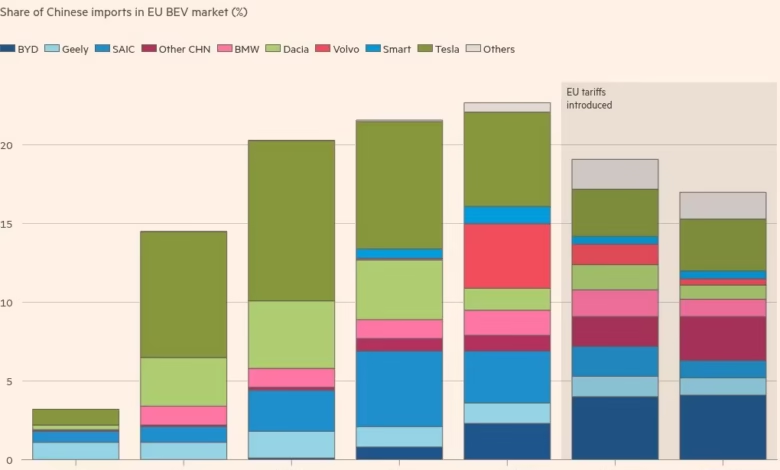
The push for strategic autonomy comes as the EU evaluates the effectiveness of its 2024 anti-subsidy tariffs on Chinese-built electric vehicles. Data from Transport and Environment (T&E) shows that while the market share of Chinese-made battery EVs fell from 22 percent in 2024 to 17 percent in the first quarter of 2026, the measures have seen significant circumvention.
Imports of hybrids and batteries, which were excluded from the tariffs, have increased significantly. Furthermore, Chinese manufacturers like BYD, which faced a 17 percent tariff on top of standard duties, saw sales more than double. In contrast, the decline in Chinese imports was most pronounced among Western carmakers, including Tesla.
The recent closing of the Strait of Hormuz has introduced fresh volatility into global energy discussions, though oil prices have remained unexpectedly stable. This stability persists despite concerns regarding the depletion of strategic reserves and potential supply chain chokepoints for products like urea and fertilizer.
Chinese companies have responded to the trade barriers by shifting production into the EU, with current efforts concentrated in Hungary and Spain. However, the long-term economic benefit of these plants remains under scrutiny regarding local job creation and value addition.

The Industrial Accelerator Act (IAA) is being viewed as a potential tool to provide incentives for “made in Europe” production. Yet, analysts warn that Beijing may retaliate by flooding markets or withholding key inputs such as rare earths.

Background: The Strait of Hormuz
The Strait of Hormuz is a vital shipping lane located between Oman and Iran, connecting the Persian Gulf with the Gulf of Oman and the Arabian Sea. It is considered the world’s most important oil transit chokepoint, as approximately one-fifth of the world’s total oil consumption passes through the strait daily. Any disruption to traffic in this narrow waterway typically has immediate and significant impacts on global energy markets and shipping insurance rates.
About the Industrial Accelerator Act
The Industrial Accelerator Act is part of the European Union’s broader legislative framework intended to speed up the deployment of net-zero technologies. Its primary goals include streamlining the permitting process for manufacturing facilities and ensuring the EU can compete with the industrial subsidies provided by other global powers. The act is a central pillar of the Green Deal Industrial Plan, aimed at ensuring the bloc does not trade its former dependence on Russian fossil fuels for a new dependence on Chinese clean technology.
Key Facts: Anti-Subsidy Tariffs
Anti-subsidy tariffs, or countervailing duties, are trade measures permitted under World Trade Organization (WTO) rules. They are designed to neutralize the negative effects of subsidies provided by a foreign government to its domestic exporters. In the case of Chinese EVs, the EU launched an investigation to determine if state support allowed Chinese manufacturers to sell vehicles at prices that unfairly undercut European competitors.