Trump Administration Rejects USMCA Renewal, Triggering High-Stakes Trade Renegotiation
Washington forces renegotiation of $1.5 trillion North American trade pact.
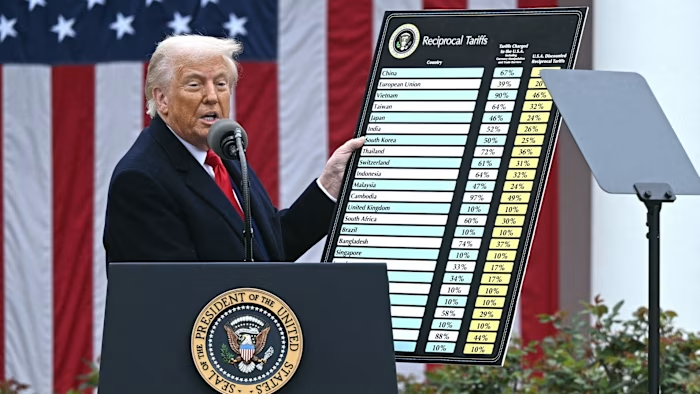
The Trump administration has formally declined to renew the United States-Mexico-Canada Agreement (USMCA) in its current form, signaling a period of prolonged economic friction for North America’s $1.5 trillion trade corridor.
U.S. Trade Representative Jamieson Greer confirmed the decision Wednesday following high-level discussions with Canadian and Mexican officials. The move effectively forces a renegotiation of the landmark 2020 pact, which replaced the North American Free Trade Agreement (NAFTA) during President Trump’s first term.
A U.S. official characterized the refusal as a rejection of a “rubber-stamp” process, emphasizing that the administration intends to address outstanding grievances rather than extend the status quo. This stance places the White House at odds with broad domestic sentiment; a survey by Public Opinion Strategies for the Global Business Alliance indicates that 72 percent of U.S. voters view the current agreement as beneficial to the national economy.
The United States-Mexico-Canada Agreement was originally designed with a “sunset clause” requiring a joint review every six years, a mechanism intended to prevent the deal from becoming stagnant. By choosing not to renew now, Washington initiates a multiyear window of uncertainty for industries ranging from automotive manufacturing to agriculture.
Labor organizations have hailed the decision as a necessary correction. United Auto Workers president Shawn Fain described the existing framework as a “free trade disaster” for the working class, calling for a “dramatic transformation” to prevent the offshoring of manufacturing to Mexico. Similarly, United Steelworkers president Roxanne Brown argued the pact had failed to sufficiently raise Mexican wages or end a regional “race to the bottom.”
Conversely, the Business Roundtable, representing major American CEOs, warned that the deal currently supports more than 13 million American jobs. Jonathan Samford of the Global Business Alliance argued that the agreement’s core value lies in “clear, stable rules” that provide international companies the confidence to invest in U.S. soil.
International partners are bracing for the fallout. Mexico’s economy minister, Marcelo Ebrard, noted that while the three nations have a decade to reach a new consensus, the goal is to resolve disputes within a “reasonable” timeframe. Canadian minister Dominic LeBlanc reaffirmed Ottawa’s “unwavering support” for the pact, citing its role in maintaining predictable access to Canada’s most vital export markets.
While the administration insists it does not want negotiations to last ten years, any significant modifications to the deal would likely require fresh approval from Congress if they necessitate changes to federal law.