IMF Chief Warns Advanced AI Models Could Threaten Global Financial System
Georgieva cites Anthropic's Mythos model as potential threat while cutting Eurozone growth outlook.
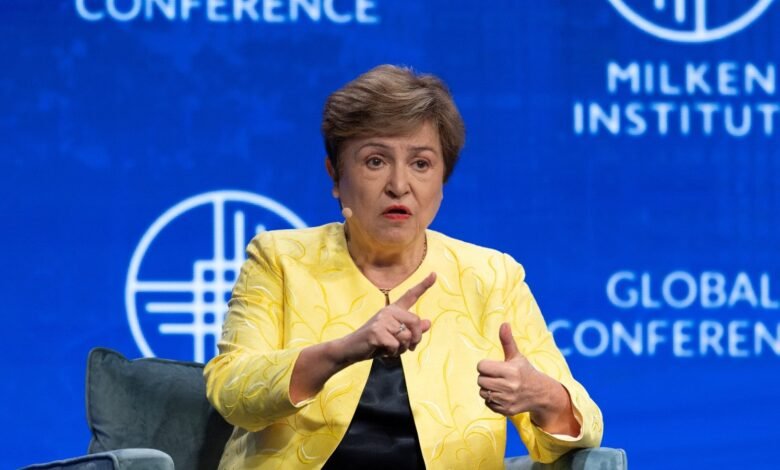
International Monetary Fund Managing Director Kristalina Georgieva warned that advanced artificial intelligence models could be used to destroy the financial system if adopted by malicious actors. Financial regulators have been on high alert since April regarding the cyber capabilities of the Mythos model developed by Anthropic.
Georgieva told reporters in Brussels that Mythos is the beginning of a trend of similar models. She stated that while leading AI models can identify cybersecurity vulnerabilities to protect systems, the same capabilities could be exploited to attack the financial system.
There is currently no global cybersecurity organization. Georgieva called for cooperation between advanced and developing economies to protect interconnected financial systems. She urged nations to prioritize public spending for cyber defenses and ensure sufficient fiscal space for these costs.
The IMF chief also identified the potential for an AI bubble to collapse. She described this as a low-probability but high-impact risk to the global financial system.
In its annual economic assessment for the Eurozone, the IMF lowered its growth outlook due to the war in Iran. Economic growth in Europe is projected at 0.9% in 2026 and 1.2% in 2027. These figures represent a decrease of 0.5 and 0.2 percentage points, respectively, from pre-war estimates.
Inflation in the Eurozone is expected to reach 2.8% in 2026 and 2.3% in 2027. This is an increase of 0.8 and 0.4 percentage points over previous forecasts.
Georgieva stated that 80% of measures intended to help households and businesses with energy costs do not meet IMF recommendations to be temporary and targeted. The IMF reported that broad financial support is currently unjustified and called for close monitoring of state aid for energy costs to avoid slowing the energy transition.
An independent EU spending watchdog stated that exempting green investments from spending rules sends a wrong signal by encouraging broad measures in response to the energy crisis.