Elijah Brown’s QB Audition Highlights Washington’s 41-24 Loss to Iowa
Defensive scheme failures and a starting quarterback injury reshape the Huskies' outlook heading into conference play.
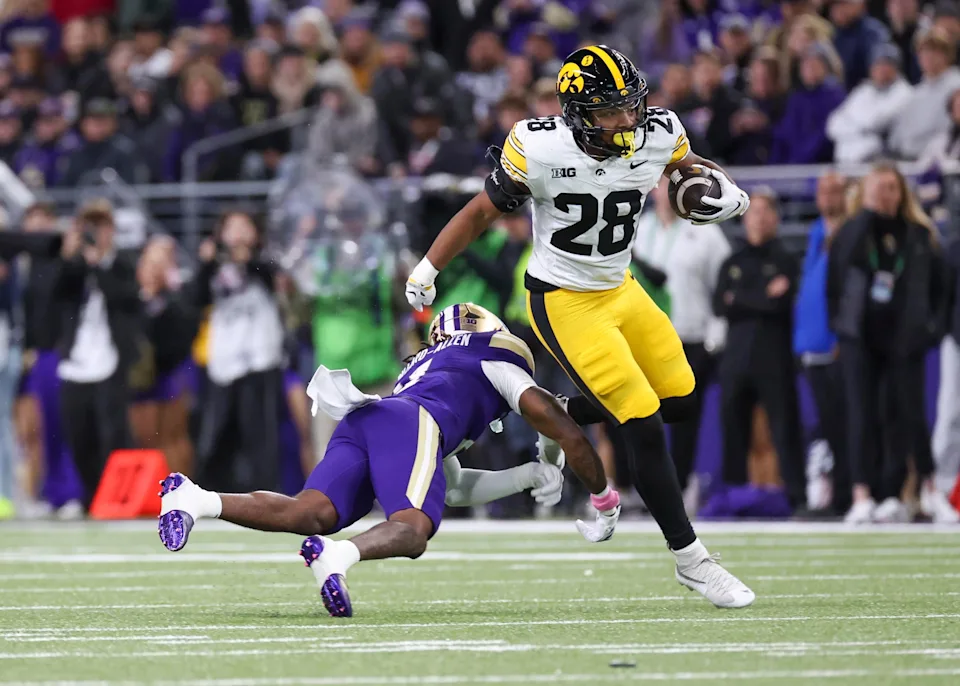
SEATTLE, WA – OCTOBER 09: Iowa Hawkeyes running back Kamari Moulton (28) evades a tackle by Washington Huskies safety Rylon Dillard-Allen (4) in the second quarter during the college football game between the Iowa Hawkeyes and Washington Huskies on October 9, 2026 at Husky Stadium in Seattle, Washington. (Photo by Leslie Plaza Johnson/Icon Sportswire via Getty Images) | Icon Sportswire via Getty Images
A fractured quarterback room has suddenly become the defining storyline for Washington football. The Huskies absorbed a 41-24 defeat to Iowa on Friday night at Husky Stadium, but the lasting consequence extends far beyond the scoreboard. Starting quarterback Demond Williams exited with an injury before halftime, thrusting backup Elijah Brown into a contest already slipping away at 27-0.
Brown’s subsequent performance — engineering 21 second-half points against a defense that had spent the opening two quarters dismantling his teammates — immediately reframed the program’s short-term trajectory. With early indicators suggesting Williams will be unavailable when Washington faces Purdue, Brown transitions from emergency substitute to probable Big Ten starter. His film against Iowa demonstrated processing speed and anticipation that the offense lacked entirely during its disastrous first half.


The contrast between the two quarterbacks exposed systemic issues within Jedd Fisch’s passing game. Williams struggled through five weeks holding the football too long, inviting pressure that a reshuffled offensive line could not mitigate. Even after Landen Hatchett returned to center, Kolt Dieterich moved to left guard, and John Mills anchored left tackle, the ground attack produced negative-three rushing yards for the entire evening. Brown bypassed those structural deficiencies by accelerating the timeline of every play.

SEATTLE, WA – OCTOBER 09: Elijah Brown #7 of the Washington Huskies stands in formation during a game between the Iowa Hawkeyes and Washington Huskies on October 9, 2026 at Husky Stadium in Seattle, Washington. (Photo by Henry Rodenburg/Icon Sportswire via Getty Images) | Icon Sportswire via Getty Images
Operating primarily out of Smash and Levels concepts, Brown consistently diagnosed defensive shells before the snap. On a critical third-and-six conversion in the third quarter, he identified Iowa rotating from a two-high shell into Cover 1 man coverage. Rather than waiting for receiver Chris Lawson to complete his corner route break, Brown delivered the football early, placing it low and away from the trailing defensive back. Anticipation throws of this nature are mandatory for quarterbacks lacking elite arm talent, mirroring the mechanics former Washington standout Jake Browning utilized throughout his collegiate career.
Brown repeated this diagnostic precision late in the fourth quarter on a third-and-18. Facing a 3×1 formation that forced Iowa to adjust its secondary geometry, Brown tracked the safeties rotating toward the field side during his dropback. He immediately snapped his eyes to the backside deep dig route, delivering a strike to Justice Williams precisely as the receiver cleared his break. Seven-man protection schemes bought him time, but his internal clock dictated the rhythm.
Protection breakdowns still surfaced. Interior linemen Champ Taulealea and Geirean Hatchett repeatedly lunged rather than anchoring their bases against bull rushes, compromising pocket integrity. When Trey Cooley failed to execute a chip block before releasing into a flat route, unblocked interior pressure collapsed the pocket instantly. Quarterbacks can mask edge rush deficiencies by climbing the pocket, but interior penetration neutralizes that escape valve.

Iowa’s offensive blueprint provides a concerning template for future Big Ten opponents. Kirk Ferentz’s staff deployed 12 personnel — one running back, two tight ends — relentlessly, gashing Washington for 263 rushing yards at 6.9 yards per carry. The Hawkeyes forced only four punts across 11 possessions, controlling tempo through zone-slice blocking combinations that systematically dismantled the Huskies’ defensive front.
Ryan Walters’ unit, which stabilized the team during the non-conference slate, suffered a catastrophic schematic collapse. Defensive ends Logan George and Jacob Lane were routinely washed multiple gaps laterally by double teams they were physically unequipped to absorb. Linebackers hesitated, taking false steps against pre-snap motion and slice blocks, allowing offensive linemen to reach the second level cleanly.
This run-game dominance triggered a fatal chain reaction in the secondary. Desperate to stem the bleeding on the ground, safeties and linebackers overcommitted to run fits, abandoning coverage responsibilities. Iowa exploited this panic with devastating play-action efficiency. On a third-and-one near the red zone, a fullback leaked into the flat completely uncovered because every second-level defender ignored fundamental assignment rules regarding lead blockers. The resulting touchdown epitomized a defense playing purely on emotion rather than structure.

Secondary communication disintegrated under the stress. Cornerback Dylan Robinson repeatedly bit on end-around fakes and pre-snap motion, vacating his deep-half responsibilities in inverted Cover 2 schemes. Emmanuel Karnley expected coverage handoffs that never materialized, leaving crossing routes and deep corner patterns wide open. Iowa backup quarterback Brendan Sullivan capitalized for 202 passing yards and three touchdowns, numbers that reflect Washington’s mental errors more than Sullivan’s individual brilliance.
Historically, Washington’s transition into the Big Ten was projected to test physical depth against power-run programs like Iowa. Friday’s result validated those concerns prematurely. The Pac-12 rarely featured offenses so singularly committed to zone-slice concepts paired with heavy personnel groupings, meaning these specific defensive vulnerabilities went unpunished during the first five weeks.
Facing Purdue next week introduces a different schematic challenge. The Boilermakers typically favor spread formations designed to isolate linebackers in space, contrasting sharply with Iowa’s condensed power approach. However, if Washington cannot stabilize its interior pass protection or correct its defensive eye discipline, schematic variety matters little.

Brown did manage to cross the goal line himself during the final period, securing his first legitimate rushing touchdown as a Husky. That brief moment of individual success now anchors a pivotal week of preparation in Seattle. Medical evaluations on Williams continue, but the coaching staff is structuring its upcoming game plan around the backup who salvaged the second half against Iowa.