Brazil Solar Installation Prices Rose 7% in Early 2026 as New Connections Fell
Residential projects gained capacity share as financing reached its lowest recorded proportion.
SAO PAULO — The average turnkey price of a photovoltaic system of up to 300 kilowatts (kW) in Brazil rose 7% between January and June 2026, while new distributed generation connections fell 16% from a year earlier. The figures come from the “Distributed Energy Solutions” strategic study released by renewable energy research firm Greener.
Brazil recorded 411,000 new distributed generation connections in the first half of 2026, compared with 488,000 in the same period of 2025. New consumer units receiving credits through the country’s net-metering system fell more sharply, dropping 43% from 951,000 to 541,000.
Residential installations nevertheless accounted for 65% of distributed solar capacity added in the first half of 2026, up from 39% in 2019. The commercial sector’s share of newly added capacity was 19%. Among installers surveyed by Greener, 80% said residential systems under 12 kW were their highest-volume sales category; projects from 12 kW to 75 kW, covering small commercial and larger residential systems, accounted for 16% of integrators’ primary sales, and minigeneration projects above 75 kW for the remaining 4% of primary sales volume.

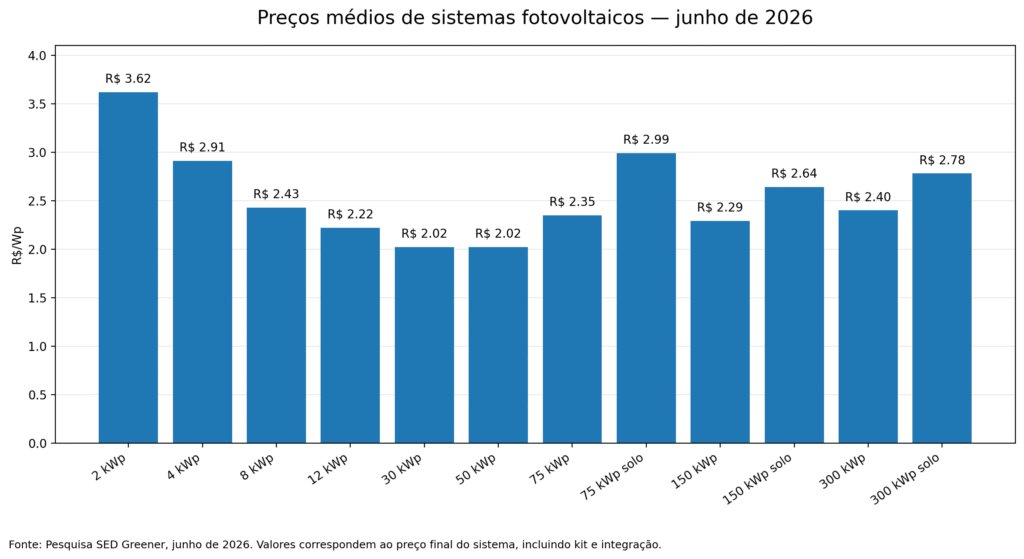
The price rise was driven primarily by wholesale hardware inflation. Photovoltaic kits containing solar modules, inverters, mounting structures and electrical cabling became more expensive across multiple project categories. For a 4 kW residential installation, the average kit price rose 18.3%, from BRL 1.42 per watt ($0.27/W) in January to BRL 1.68/W in June. A separate turnkey measure for a 2 kW micro-system reached BRL 3.62/W in June, up from BRL 3.44/W in January, putting a typical 2 kW residential array at approximately BRL 7,200.
Turnkey prices include the equipment kit as well as engineering, logistical freight, electrical labor, permitting and installer margins. Among rooftop categories, 30 kW and 50 kW commercial arrays had the lowest installed cost per unit of power, at BRL 2.02/W ($0.38/W). Their average total capital expenditures were approximately BRL 60,600 and BRL 101,000, respectively. At the wholesale level, the price of a 50 kW kit rose 8.8%, from BRL 1.14/W to BRL 1.24/W; a 300 kW kit rose 2.0%, from BRL 1.02/W to BRL 1.04/W.
Fewer sales were financed with debt. Bank financing or dedicated solar credit lines were used in 33% of system sales closed by integrators in the first half of 2026, down 8 percentage points from 2025 and the lowest share Greener has recorded since it began tracking the measure. The remaining 67% were funded through direct cash payments, credit cards or direct supplier financing arrangements.
Under Law 14.300/2022, Brazil’s legal framework for microgeneration of up to 75 kW and minigeneration from 75 kW to 3 MW for non-dispatchable sources, consumer units generating power on-site or through remote shared-generation facilities receive billing credits against the grid electricity they consume. The framework provides for gradual phase-ins of distribution wire tariffs, known as the “Fio B” component.
For larger projects, a 300 kW rooftop installation averaged BRL 2.40/W, or approximately BRL 720,000 in total. A ground-mounted system of the same capacity required an average investment of approximately BRL 834,000, roughly BRL 2.78/W, because of additional civil works, site preparation and foundation requirements. Despite the first-half increase, prices remained below levels recorded during the initial rollout of distributed generation under National Electric Energy Agency (ANEEL) regulations: a 4 kW residential system averaged BRL 7.74/W in January 2017 and BRL 2.91/W in June 2026, while a 50 kW commercial system fell from BRL 6.06/W to BRL 2.02/W over the same period.