Fixed-Speed Flywheel System Poised to Cut Grid Integration Costs
Novel variable-inertia design bypasses costly power converters for enhanced grid stability.
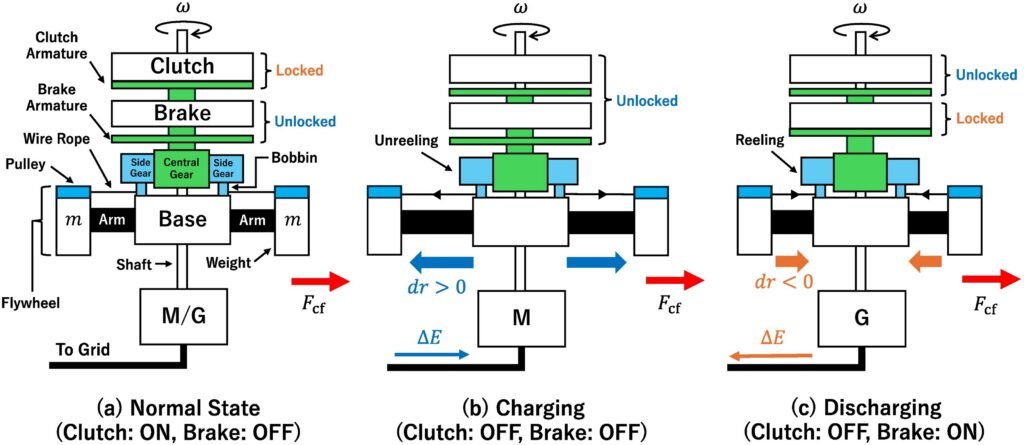
A modified centrifugal brake with two 0.856 kg weights on pivoting arms delivered electrical power to the grid at synchronous speeds of 400, 450, and 500 rpm during tests by Tokyo University of Science researchers.
The prototype is a fixed-speed flywheel energy storage system. It stores kinetic energy as rotational motion. Conventional versions rely on power electronic converters to manage varying flywheel speed during electricity exchange. Those converters account for 17.3% to over 50% of total cost in some utility-scale applications. The new design maintains an approximately constant rotational speed by actively changing its moment of inertia. Direct grid connection becomes possible. Overcurrent tolerance improves.
Corresponding author Ryoga Sugata stated, “The main novelty is the development and experimental evaluation of a flywheel mechanism that enables charging and discharging through active changes in its moment of inertia while maintaining an approximately constant rotational speed.” He added, “To our knowledge, experimental studies of such mechanisms remain limited, particularly those that deliberately reduce the moment of inertia to extract stored rotational energy.” Earlier variable-inertia fixed-speed designs struggled to achieve positive net power output during discharge because of low efficiency. A wire-rope mechanism controls the pivoting arms. Steady-state losses in the induction machine currently prevent net electrical energy discharge over a complete operation. Mechanical discharge efficiency reached 53% after accounting for steady-state mechanical power input. The Journal of Energy Storage detailed the prototype.


Flywheel systems have rapid response times, high power density, and long cycle life. Grids integrating intermittent renewable energy sources lose system inertia and face frequency stability challenges. Short-duration applications like grid frequency regulation require these traits.
Sugata’s team plans to refine the mechanical design to minimize friction and losses associated with clutch and brake operation. They intend to explore replacing the current induction machine with a synchronous machine to reduce electrical losses. Synchronous condensers currently provide reactive power and inertia to stabilize the grid. They do not supply active power. Integrating the variable-inertia flywheel could add controllable active-power storage capability to them.