

Audible Bets on Generative AI Voice Roleplay to Reinvent Audiobook Listening
Real-time voice roleplay with literary characters debuts this fall alongside new visual tracking tools for complex audiobooks.
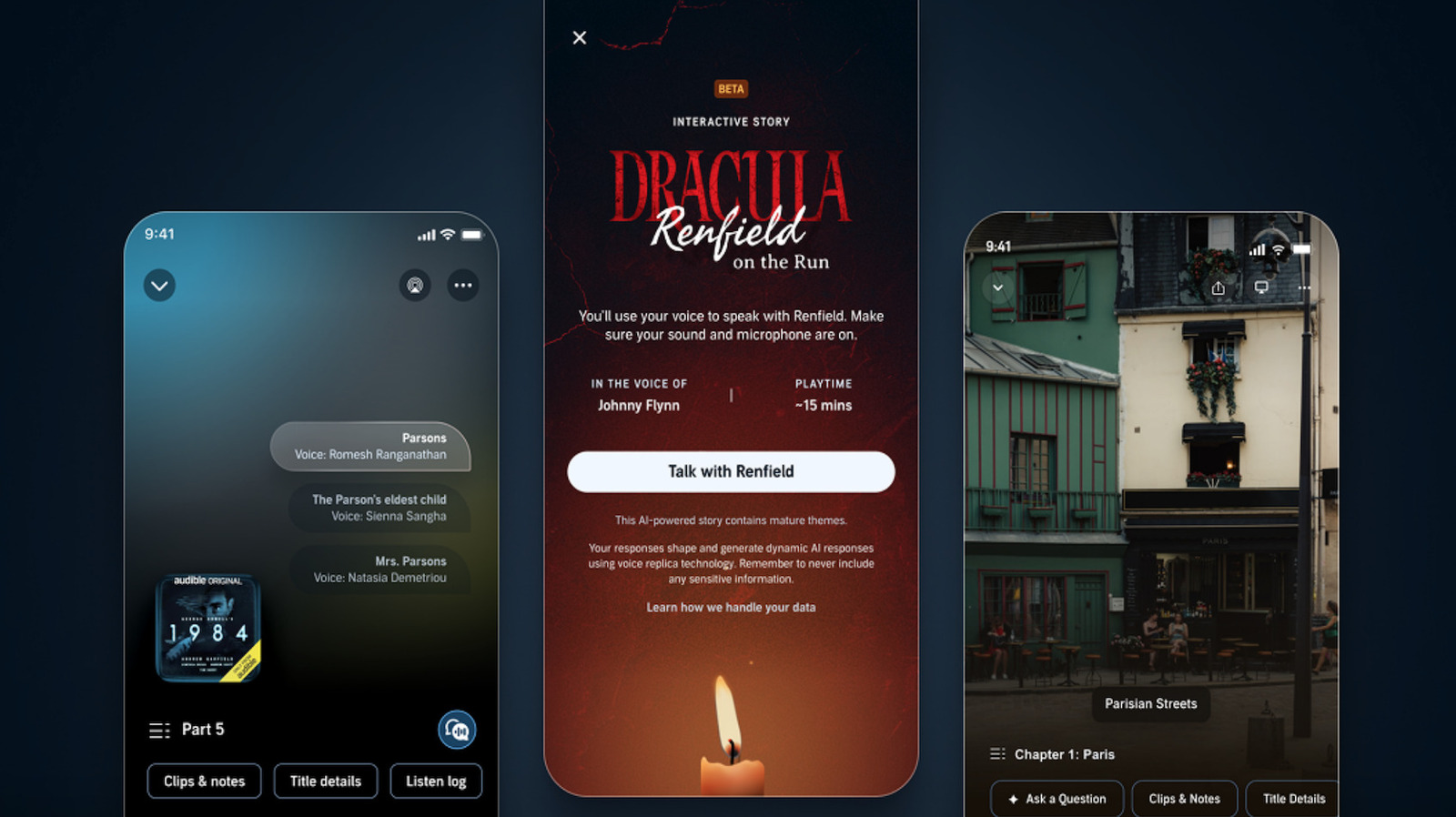
Amazon-owned Audible is testing whether generative artificial intelligence can transform passive audiobook listening into real-time voice roleplay. The platform announced Interactive Stories, a beta feature launching this fall that allows subscribers to speak directly with fictional characters using their own voices and receive immediate, unscripted responses generated by large language models.
The initiative arrives as the broader audiobook industry grapples with stagnating growth among younger demographics accustomed to interactive gaming and social media. By merging traditional narrated audio with conversational AI, Audible is attempting to create an entirely new entertainment category that sits somewhere between an audiobook, a tabletop roleplaying game, and a text adventure.
The first Interactive Story will be tied to Audible’s original full-cast audio adaptation of Bram Stoker’s Dracula, which premieres October 1. Rather than interacting with the titular vampire, listeners will converse with R.M. Renfield, the novel’s institutionalized servant. According to the company, the AI character will assign users a specific role, objective, and stakes before the conversation begins. Listeners then respond verbally in their own words, and the system generates Renfield’s reactions dynamically.


This approach mirrors the mechanics of AI-driven dungeon master applications and character chatbots that have proliferated since late 2022, but applies them to premium, professionally produced intellectual property. Unlike standalone AI chat apps such as Character.AI, Audible is tethering its generative interactions to established literary worlds and high-budget audio productions, attempting to lend narrative weight to what has largely been a novelty technology.
Andy Tsao, Audible’s Chief Product and Analytics Officer, framed the feature as a direct response to shifting consumer habits. “AI is allowing us to create new interactive experiences that today’s listeners, especially younger audiences, are craving,” Tsao said. That assessment runs counter to recent public polling. A Pew Research Center survey indicated widespread skepticism among younger consumers regarding AI-generated content, particularly concerning creative authenticity and data privacy. Audible is effectively wagering that hands-on immersion will override those reservations once users experience the product.
A second Interactive Story is already scheduled for release alongside Exoplanet, an original audio novel by author Benjamin Percy arriving November 5. Percy’s involvement suggests Audible is integrating living authors into the design of these AI parameters, rather than solely relying on public-domain texts like Dracula.
Beyond generative voice interactions, Audible is rolling out structural interface changes designed to solve long-standing complaints about the audiobook format. The most immediate is Character Guide, a visual overlay now available within the app. It identifies who is speaking in real time and provides spoiler-free reference cards for each figure. Tracking dozens of characters without a physical page to flip back through remains one of the primary friction points for complex fiction in audio form. Character Guide is currently active for Audible’s adaptation of George Orwell’s 1984 and will expand to Dracula and Exoplanet upon their releases.
A separate tool called Visual Explorer is also entering beta. Instead of continuous visual overlays, this feature surfaces context-specific imagery—such as maps or illustrations tied to pivotal plot moments—only when relevant to the narration. Its initial deployment will accompany The Cultural Tutor’s Grand Tour: The Story of Europe in Six Cities, an audio travelogue where geographical mapping naturally complements the spoken narrative.
These features represent a significant architectural shift for Audible, which has historically functioned as a digital storefront and playback utility for linear audio files. Integrating real-time LLM processing, dynamic visual overlays, and interactive state-tracking transforms the application into a multimedia engine. Whether subscribers will adopt voice-acting alongside their daily commutes, or prefer the traditional lean-back listening experience, will determine if generative AI becomes a permanent fixture in commercial publishing or remains an experimental sidebar. The Dracula beta launch in early October will provide the first measurable consumer data.










One Comment