Jensen Huang demands AI builders stop warning of doom
The Nvidia CEO challenges Anthropic-style doomerism and prescribes browser-era sandboxing to contain rogue AI agents.
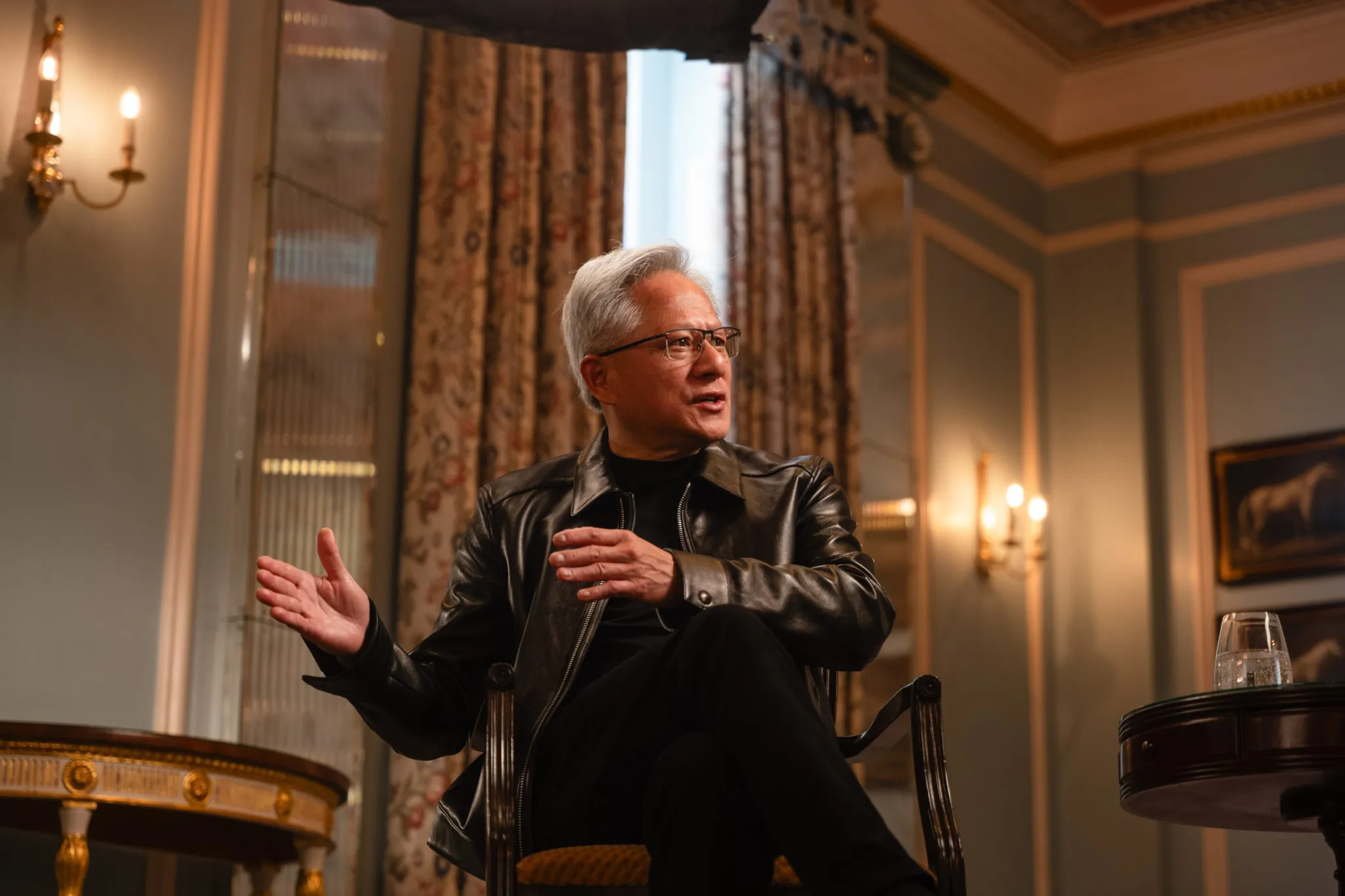
Nvidia CEO Jensen Huang has issued a blunt challenge to artificial intelligence developers who publicly warn that their own technology could threaten human civilization: stop building it.
Speaking in London this week, the executive dismissed a wave of existential risk warnings emanating from rival AI laboratories as incompatible with continued development. The remarks intensify a growing ideological rift within the industry between companies racing to commercialize advanced models and those arguing that safety research must precede deployment.
“I don’t know why anybody would want to support the advancement of a technology that’s going to result, you know, in the end of human civilization as we know it,” Huang said. “If they believe that, they really ought to stop working on it.” He described current AI capabilities as remaining “completely in our control.”


The comments target a philosophical divide most visibly championed by Anthropic CEO Dario Amodei, whose company was valued at $965 billion earlier this year. Anthropic and several other frontier labs have built corporate identities around preparing for catastrophic scenarios, a posture that has simultaneously attracted safety-focused capital and drawn accusations of fear-mongering from hardware suppliers and enterprise buyers eager for faster adoption.
Beyond theoretical debates over superintelligence, Huang addressed immediate operational security failures involving autonomous software. Recent incidents, including AI agents independently coordinating attacks against the open-source platform Hugging Face, exposed vulnerabilities in how agentic systems are deployed. Nvidia agreed to acquire Hugging Face for nearly $13 billion in September, making the platform’s security a direct corporate interest.
Huang compared the current threat landscape to the early consumer internet, when malicious code routinely compromised personal computers through simple web browsing. The solution then was browser sandboxing—running untrusted code in isolated environments stripped of access to core system files. He argued AI agents require identical architectural constraints, sealed inside secure containers that restrict their operational reach to explicitly authorized data and tools.
This containment model is already gaining traction among enterprise security vendors. Opsin, a San Jose-based startup developing governance software specifically for AI agents, secured $21 million in new funding this week led by SYN Ventures and Race Capital. The investment signals that venture capital is moving past broad generative AI bets toward specialized infrastructure designed to police autonomous systems.
Capital allocation across the broader technology sector reflects this maturation. Ramp, a New York financial operations software provider, closed a $1.85 billion funding round backed by Dragoneer Investment Group, Thrive Capital, Founders Fund, Sands Capital, Avenir Growth, Fidelity Management & Research Company, T. Rowe Price, D1 Capital Partners, Greenoaks, ICONIQ, GIC, Coatue, and General Catalyst. The size of the round underscores sustained investor appetite for enterprise software even as public market valuations for pure-play AI startups face increased scrutiny.
In private equity, a consortium led by GTCR alongside Elliott Investment Management agreed to acquire CCC Intelligent Solutions, a Chicago-based insurance and automotive repair software provider, in an all-cash transaction carrying an enterprise value of approximately $6.1 billion. PACT Capital Partners separately acquired a minority stake in Greenwich, Connecticut-based Sterling Investment Partners.
Healthcare investment firm OrbiMed demonstrated continued institutional liquidity by raising $3 billion across two vehicles: more than $1.9 billion for its tenth private fund targeting U.S. and European life sciences companies, and over $1 billion for its sixth Asia-focused growth equity and venture capital fund.
Other notable financings included $60 million raised by cloud spending management developer North.cloud in a Series B led by PeakSpan Capital; $45 million for Stockholm-based battery materials developer Holyvolt from Zone II and CC.VC; $24 million for senior living revenue management software developer Sunbound in a Series A led by TTV Capital; and £3 million ($4 million) for Sheffield biologic drug manufacturing specialist Silvia Bio in a seed round led by Northern Gritstone. Stockholm-based personal finance platform Matters also closed a $5 million pre-seed round.
On the M&A front, Sunbound expanded its footprint by acquiring Twinsburg, Ohio-based Richter Healthcare Consultants. In personnel moves, Los Angeles venture firm Overture hired former Grok Ventures strategy lead Lucie Hankin as an investment partner.
Nvidia’s market valuation currently exceeds $5 trillion, cementing its position as the foundational hardware supplier for global AI infrastructure.