S&P 500 Energy Stocks Surge 50% as Global Markets Rally
AI data center power demand pushes energy stocks to historic gains while investors rotate out of tech amid easing Fed rate hike expectations.
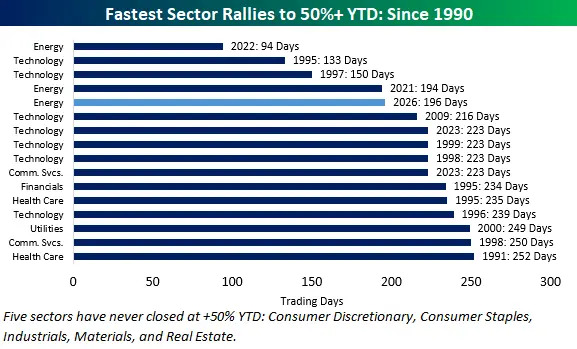
The S&P 500 energy sector has surged 50% year-to-date, becoming the first of the index’s 11 official sectors to reach that milestone in 2026. The rally, tracked by Bespoke Investment Group, ranks as the fifth-fastest 50% sector gain since 1990 and underscores a profound structural shift in how Wall Street values traditional fossil fuel producers.
Unlike previous energy rallies driven almost entirely by geopolitical supply shocks or OPEC production cuts, this year’s surge is anchored by a new, persistent demand source: artificial intelligence infrastructure. The rapid buildout of hyperscale data centers required to train and run generative AI models has placed unprecedented strain on U.S. power grids. Because renewable energy deployment has not kept pace with the sheer velocity of data center construction, utility companies have increasingly turned to natural gas and oil-fired generation to meet baseload power demands. This dynamic has fundamentally altered the earnings outlook for major exploration and production companies, transforming them into critical infrastructure plays for the technology sector.
Brent crude trading at $105 per barrel reflects both this surging industrial demand and lingering global supply constraints. Historically, oil prices above $100 trigger concerns about consumer spending and inflation, but the current market environment is absorbing the cost differently due to the capital expenditure flowing directly into energy-intensive tech infrastructure.


This massive outperformance in energy has catalyzed a broader rotation across global equities, pulling capital away from the software and semiconductor names that dominated trading volumes earlier in the year. Speculation surrounding cloud computing firm CoreWeave’s debt obligations triggered heavy selling pressure in technology stocks earlier this week, forcing traders to reassess risk in high-valuation growth names. Rather than liquidating portfolios, institutional money shifted rapidly into value and cyclical sectors.
The equal-weight S&P 500, which strips out the outsized influence of the largest megacap technology companies, climbed 1.36% Thursday. By contrast, the cap-weighted S&P 500 gained just 0.33%, while the Nasdaq finished flat. Deutsche Bank strategist Jim Reid noted that 378 individual names within the S&P 500 advanced during the session, signaling exceptionally broad participation. The benchmark index remains within 1% of its record high despite the turbulence in technology.
Chris Beauchamp, chief market analyst at IG, characterized the price action as a necessary recalibration. While acknowledging that technology stocks face lingering uncertainty following the CoreWeave volatility, he noted that the aggressive rotation into other sectors provides the exact type of market breadth required to sustain a longer-term bull run.
Global markets mirrored the U.S. rotation overnight. South Korea’s KOSPI led Asia with a 2.05% jump, followed by Japan’s Nikkei 225, which rose 1.39%. India’s Nifty 50 added 0.36%, and China’s CSI 300 edged up 0.11%. In Europe, the Stoxx 600 advanced 0.46% in early Friday trading, though London’s FTSE 100 remained flat heading into the afternoon session. U.S. equity futures pointed to a higher open in New York, with S&P 500 contracts up 0.42%.
Monetary policy expectations provided a secondary tailwind for the rally. Federal Reserve Chair Kevin Warsh addressed the International Monetary Fund meetings this week without signaling any intention to raise interest rates at the upcoming October policy meeting. Equity investors, who had been bracing for tighter financial conditions, interpreted the absence of hawkish rhetoric as implicit reassurance.
Paul Donovan, an economist at UBS, observed that while Warsh technically avoided providing formal forward guidance, his failure to sound hawkish effectively served as guidance itself. Donovan noted that Warsh’s comments aligned with recent remarks from New York Fed President John Williams, further dampening expectations for a rate hike. According to CME FedWatch data, futures markets are now pricing in an 85% probability that the central bank will hold rates steady later this month.
Bitcoin traded at $82,101, holding near recent highs as the prospect of stable borrowing costs supported risk assets broadly.