

SynthID Detector: How to Scan Images, Video and Audio for AI
The free web tool reads invisible watermarks embedded by major AI developers including OpenAI, NVIDIA and Kakao.
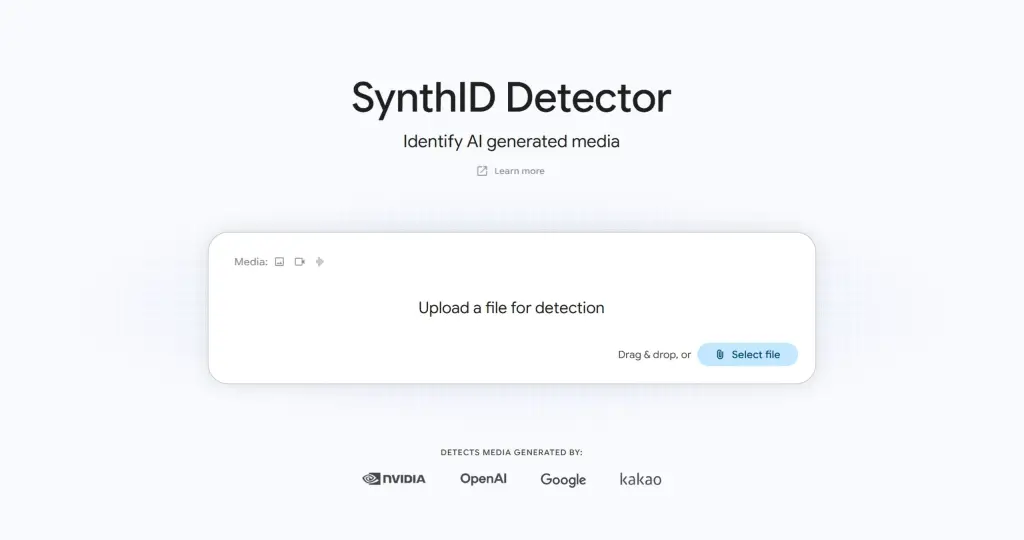
A web-based scanner capable of reading invisible watermarks embedded in artificial intelligence-generated media is now available to the public through synthid.com. The tool, SynthID Detector, allows anyone to upload images, video or audio files to determine whether they were produced or altered by generative AI models.
Unlike forensic analysis software that attempts to spot visual artifacts or statistical anomalies in pixel data, SynthID Detector looks specifically for a digital watermark called SynthID. Developed by Google DeepMind, this watermark is injected directly into the latent space of the content during the generation process rather than appended as metadata. Because it exists within the mathematical structure of the file itself, the marker survives common modifications such as cropping, resizing, compression, color filtering and format conversion.
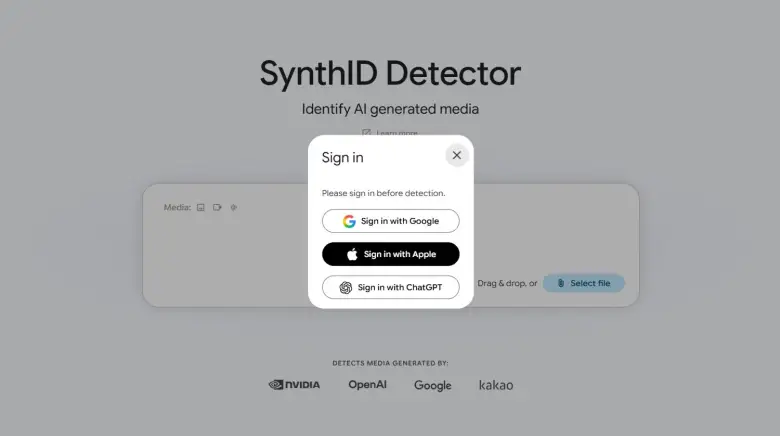
The scanner supports a broad range of file types. Users can submit JPG, JPEG, PNG, BMP, WEBP, AVIF, HEIC, HEIF, TIFF, TIF and GIF formats for image analysis. Video scanning covers MP4, MOV and WEBM files, while audio verification accepts WAV, MP3, OGG, FLAC, AAC and M4A formats. Accessing the utility requires authentication through a Google, Apple or ChatGPT account.


While the technology originated inside Google’s own ecosystem to tag outputs from Gemini, its reach has expanded across competing platforms. OpenAI, NVIDIA and Kakao have integrated SynthID watermarking into their respective generation pipelines. Apple is also preparing to adopt the standard. This cross-industry adoption addresses a fundamental limitation of proprietary detection tools, which historically could only verify content generated by their own systems.
The detector does not function as a comprehensive editing history log. When a file triggers a positive match, the interface confirms the presence of the AI watermark but does not specify which model produced the content or detail the exact nature of the modifications applied. The system can, however, identify if a watermarked file underwent subsequent manual editing after the initial AI generation.
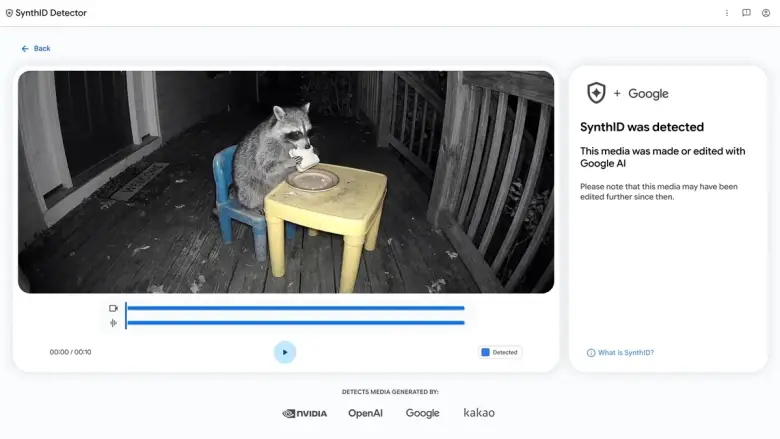
The technology carries inherent limitations. Repeatedly passing the same media through multiple generative AI transformations can eventually degrade the watermark signal to the point where detection fails. Furthermore, the scanner can only evaluate content produced by models whose developers have actively implemented SynthID. Media generated by open-source models running locally on consumer hardware, or by commercial platforms that have declined to adopt the watermarking protocol, will return no result regardless of their origin.
This distinction separates watermark-based verification from universal detection methods. The Coalition for Content Provenance and Authenticity (C2PA) pursues a parallel approach using cryptographic credentials attached to files at the point of capture or creation, favored by camera manufacturers and news organizations. SynthID, by contrast, focuses exclusively on synthetic media at the point of generation.
The public launch arrives as regulatory pressure intensifies globally. The European Union’s AI Act mandates that providers of generative AI systems ensure their outputs are machine-readable and identifiable as artificially generated. California’s SB 1047 and similar state-level proposals in the United States continue to push for mandatory disclosure mechanisms. Voluntary integration of watermarking infrastructure by major AI developers serves as an industry response ahead of stricter enforcement deadlines.
Files processed through synthid.com are evaluated against the embedded markers without retaining the uploaded media permanently on the platform’s servers. The service currently operates as a free web utility without requiring API keys or enterprise subscriptions for individual use.









