

Micro Center Requires ID and Export Pledge for RTX 5090 PCs
Buyers must surrender driver's licenses and sign non-export agreements to purchase the flagship GPU amid tightening AI chip restrictions.
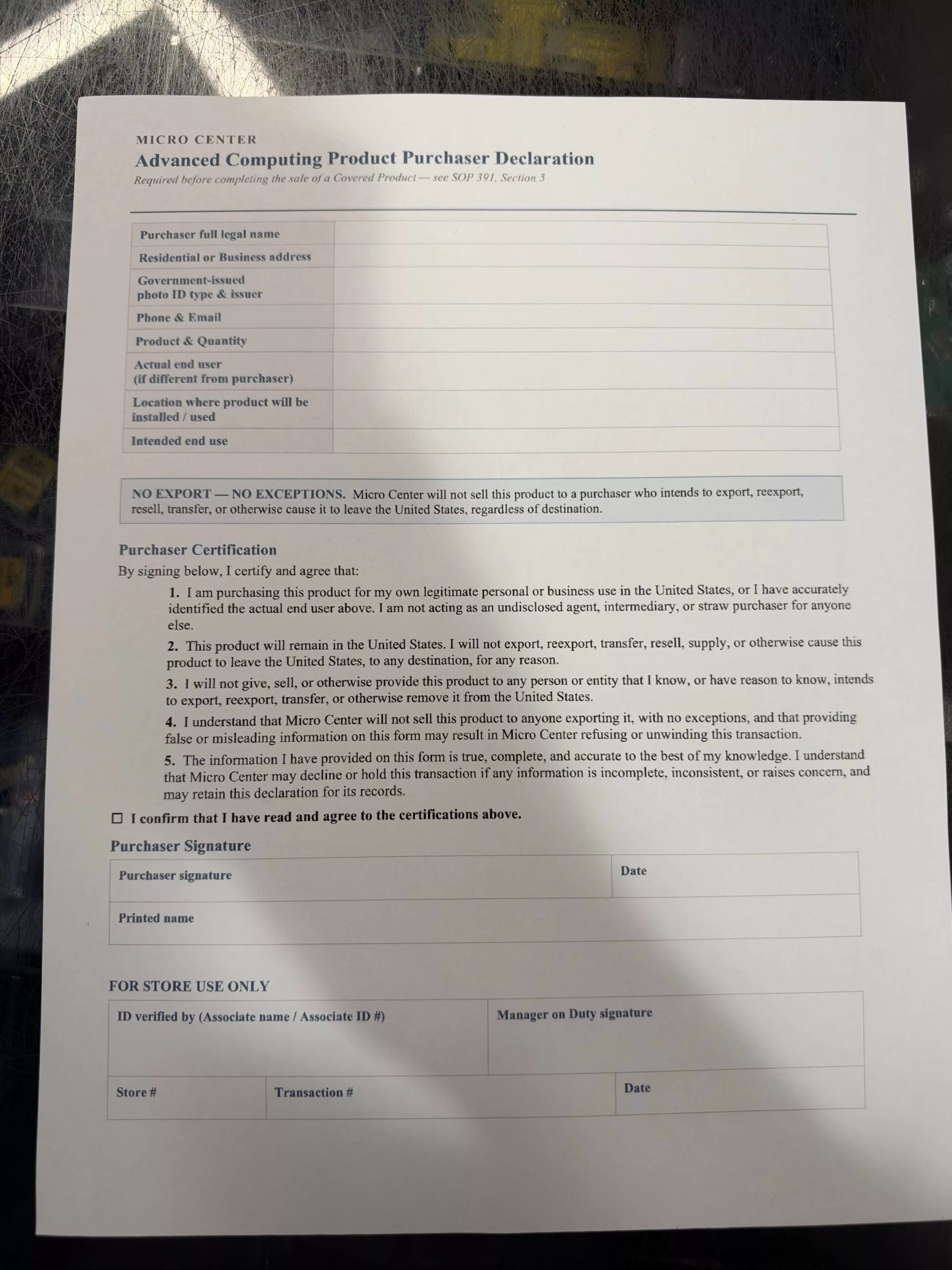
U.S. electronics retailer Micro Center has begun requiring customers to submit photo identification, phone numbers, and signed declarations promising not to export their hardware when purchasing prebuilt computers equipped with Nvidia GeForce RTX 5090 graphics cards.
The policy, implemented at store level within the last few days, mandates that a manager scan the buyer’s driver’s license and link it directly to the transaction. Purchasers must sign a form affirming the system is intended strictly for personal or domestic business use inside the United States. The declaration explicitly prohibits exporting, reexporting, transferring, reselling, or supplying the machine to any foreign destination under any circumstances.
A customer who recently purchased a PowerSpec Ai90 prebuilt system containing the flagship GPU detailed the encounter on Reddit, noting the store manager confirmed the documentation requirement was newly enforced. According to other users in the same discussion, some Micro Center locations are also refusing to sell an RTX 5090-equipped system to any individual who has previously bought one from the retailer, effectively capping purchases at a single unit per customer.


Retailers are absorbing enforcement friction normally handled by federal agencies because of the unique position the RTX 5090 occupies in the current semiconductor market. While marketed primarily as a consumer gaming card, its 32GB of GDDR7 VRAM and Blackwell architecture deliver computational performance that brushes against thresholds established by the U.S. Department of Commerce’s Bureau of Industry and Security (BIS). Under existing export controls designed to restrict advanced artificial intelligence hardware from reaching mainland China, the standard RTX 5090 cannot be legally shipped there. Nvidia engineered region-specific variants — the RTX 5090 D and the subsequent RTX 5090 D V2 — with reduced interconnect bandwidth and altered specifications to comply with those federal rules.
Because standalone RTX 5090 cards routinely command more than $7,000 on the secondary market, with specialized editions exceeding $11,000, buying a complete prebuilt desktop has become a financial workaround for buyers seeking the silicon. Smugglers and unauthorized brokers exploit this price inversion, purchasing entire systems solely to extract the GPUs for illicit overseas shipment. Micro Center’s documentation requirements appear designed to create a paper trail that deters bulk purchasing and straw-man acquisitions, where one individual buys hardware on behalf of an undisclosed foreign end user.
The legal mechanics of a retail-store non-export pledge remain untested. Federal export controls operate under the Export Administration Regulations (EAR), which carry statutory weight, criminal penalties, and civil fines enforceable by BIS and the Department of Justice. A private retailer’s point-of-sale contract does not supersede or replicate federal law. However, the signed document provides Micro Center with immediate grounds to void warranties, refuse future sales, and potentially pursue civil breach-of-contract claims if a traced serial number surfaces in an intercepted overseas shipment.
Practical enforcement over time presents significant hurdles. Once a consumer takes physical possession of a PC, tracking its lifecycle through secondhand sales, private transfers, or theft becomes virtually impossible for a brick-and-mortar retailer. The chain of custody ends at the register.
Other major U.S. computer hardware chains, including Best Buy and B&H Photo Video, have not publicly announced identical point-of-sale identification scanning or export-pledge requirements for consumer-grade desktop purchases, though inventory limits on high-end GPUs have been common across the industry since the RTX 50-series launch earlier this year.
Nvidia has not commented on whether it requested retailers to implement these specific verification steps or if Micro Center developed the protocol independently to manage its own liability exposure. The BIS declined to comment on individual retailer compliance strategies.
Micro Center currently lists limited quantities of PowerSpec prebuilt configurations featuring the RTX 5090, with availability fluctuating daily across its 28 U.S. store locations.









