UK Solar Pipeline Stalls on Financing and Grid Skills Despite Record Planning Approvals
Planning success masks deepening crises in funding, labor, and regulatory clarity for large-scale renewables.

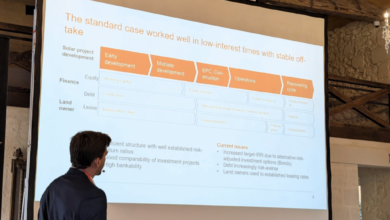
The United Kingdom’s utility-scale solar sector has solved its most notorious bottleneck: local opposition. Developers have become adept at navigating the Nationally Significant Infrastructure Project (NSIP) regime, securing Development Consent Orders (DCOs) for gigawatt-class facilities with increasing regularity. Yet, as demonstrated during the “Delivering the NSIP pipeline” panel at Solar & Storage Live UK in Birmingham this September, obtaining permission is no longer the primary barrier to construction. The critical constraints have shifted decisively to capital availability, specialized labor scarcity, and regulatory predictability.
Ben Fawcett, head of business development UK at Lightsource bp, highlighted a structural disconnect between government net-zero ambitions and investor reality. While recent Contracts for Difference (CfD) auctions set records for procured solar capacity, these one-off wins do not guarantee long-term bankability. For large-scale projects requiring hundreds of millions in upfront capital, lenders demand visibility into future revenue streams. Fawcett argued that without a confirmed ninth CfD tender window, developers cannot lock in the contracted prices necessary to finance the next wave of 100 MW+ assets. This uncertainty creates a holding pattern where approved projects sit idle, waiting for fiscal signals that may not arrive until after election cycles or budget reviews.
Beyond finance, the physical execution of these mega-projects faces a human resource crisis. Tracey Elliot, director at Eden Sustainable, pointed out that the talent pool for engineers certified to work on extra-high voltage transmission networks is dangerously thin. Previous booms relied heavily on overseas contractors, but post-Brexit immigration rules and rising global competition for skilled trades make this model unsustainable. Elliot advocated for domestic upskilling initiatives, noting that creating high-quality local jobs can simultaneously address labor shortages and strengthen community support—a dual benefit that purely extractive development models miss.

Community engagement strategies are also undergoing a forced evolution. David Hoare, technical director at RSK Group, whose firm has delivered 40 NSIP projects, warned that traditional “church hall diplomacy”—passive public consultations held late in the process—is becoming obsolete. As grid congestion intensifies and land use competes with agriculture and housing, proactive, continuous dialogue with stakeholders is required to preempt objections before they reach formal planning stages. However, Simon Wheeler, director of development at Enso Energy, cautioned against over-regulating this interaction. He emphasized that while better consultation is valuable, imposing new mandatory procedural burdens on developers already managing complex infrastructure builds could stifle progress further.
While the utility-scale segment grapples with macro-economic headwinds, the residential market is experiencing a different kind of friction: regulatory incompleteness. The August 2026 introduction of plug-in solar regulations allowed consumers to self-install arrays up to 800 W using standard British Standard three-pin sockets. This move, following a February 2026 government commitment, positions the UK alongside leaders like Germany. However, the policy remains half-implemented. Crucially, UK regulations still prohibit the amateur installation of plug-in battery storage. Manufacturers displayed hybrid solutions at the NEC, but without legal pathways for consumer-owned storage, households cannot fully arbitrage energy costs. An ongoing safety consultation suggests it could be more than a year before these restrictions lift, delaying the full economic potential of rooftop-plus-battery systems.
This delay coincides with immediate financial pressure on UK households. From October 1, 2026, Ofgem’s energy price cap will rise by 4%, pushing the average annual bill for gas and electricity to approximately £1,723 ($2,200). With 22 million households protected by the cap, this increase acts as a powerful driver for behind-the-meter generation. Exhibitors noted that anxiety over Middle East conflicts and volatile wholesale markets is accelerating interest in retrofit solar. Data presented by Australian consultancy SunWiz indicated a pivotal shift: standalone energy storage installations now exceed standalone solar deployments in the UK. Consumers are increasingly prioritizing batteries to exploit time-of-use tariffs offered by major utilities, decoupling storage investment from PV adoption.
The disparity between the stalled utility pipeline and the surging residential demand underscores a fragmented national strategy. Utility-scale projects remain hostage to auction timing and grid connection queues, which continue to be oversubscribed despite new financial commitment measures designed to rationalize the list. Meanwhile, residential adoption is driven by direct cost savings and technological readiness, albeit hampered by incomplete regulatory frameworks for storage. The coming months will test whether policymakers can align revenue certainty for large developers with safety standards for home innovators, ensuring both segments contribute effectively to the UK’s clean energy targets.