

How Crypto-Mining Scrap Became PlayStation 5-Class Gaming Hardware
Discarded mining GPUs gain new life through unlocked hardware and Linux-based FSR4 software
The AMD BC-250 began appearing in early 2022 inside multi-GPU mining servers manufactured by ASRock. Unlike consumer graphics cards, it was sold without display outputs and could not be plugged directly into a monitor. Its headless architecture depended on secondary processors or integrated graphics for display output while the BC-250 handled raw mathematical calculations.
That design became a liability after Ethereum executed “The Merge” in September 2022, moving its network to a proof-of-stake consensus mechanism. Graphics-card-based mining was no longer needed, leaving millions of specialized GPUs obsolete almost overnight and sending cheap, abandoned hardware to secondary marketplaces like eBay.
Some of that hardware is now being recovered by an active community of open-source developers and hardware enthusiasts working to keep discarded components out of landfills. Their target is cheap, headless mining silicon that can be converted into functional gaming hardware through custom software workarounds, Linux compatibility tools, and advanced image-reconstruction techniques.


The BC-250 shares its lineage with the custom system-on-chip manufactured by TSMC on its 7-nanometer process node for the Sony PlayStation 5. This “Oberon” processor is built on AMD’s RDNA 2 graphics microarchitecture, the same architecture used by the company’s Radeon RX 6000-series consumer desktop graphics cards.
In its mining configuration, the BC-250 shipped with only 24 of its 40 physical RDNA 2 compute units enabled, a restriction intended to optimize energy efficiency and thermal output. A standard retail PlayStation 5, by comparison, uses 36 active CUs out of the 40 physically present on its chip.
Custom firmware modifications and Linux-based driver tweaks later allowed developers to bypass the factory limits and unlock all 40 physical compute units on the BC-250. The result is a cut-down mining processor that theoretically outperforms the silicon configuration of the retail PlayStation 5.
The newest work has moved beyond raw hardware modifications. Software developers have ported AMD’s latest FidelityFX Super Resolution (FSR) upscaling and frame-generation technologies to the BC-250 under Linux, giving the salvaged hardware access to software-driven performance optimization.
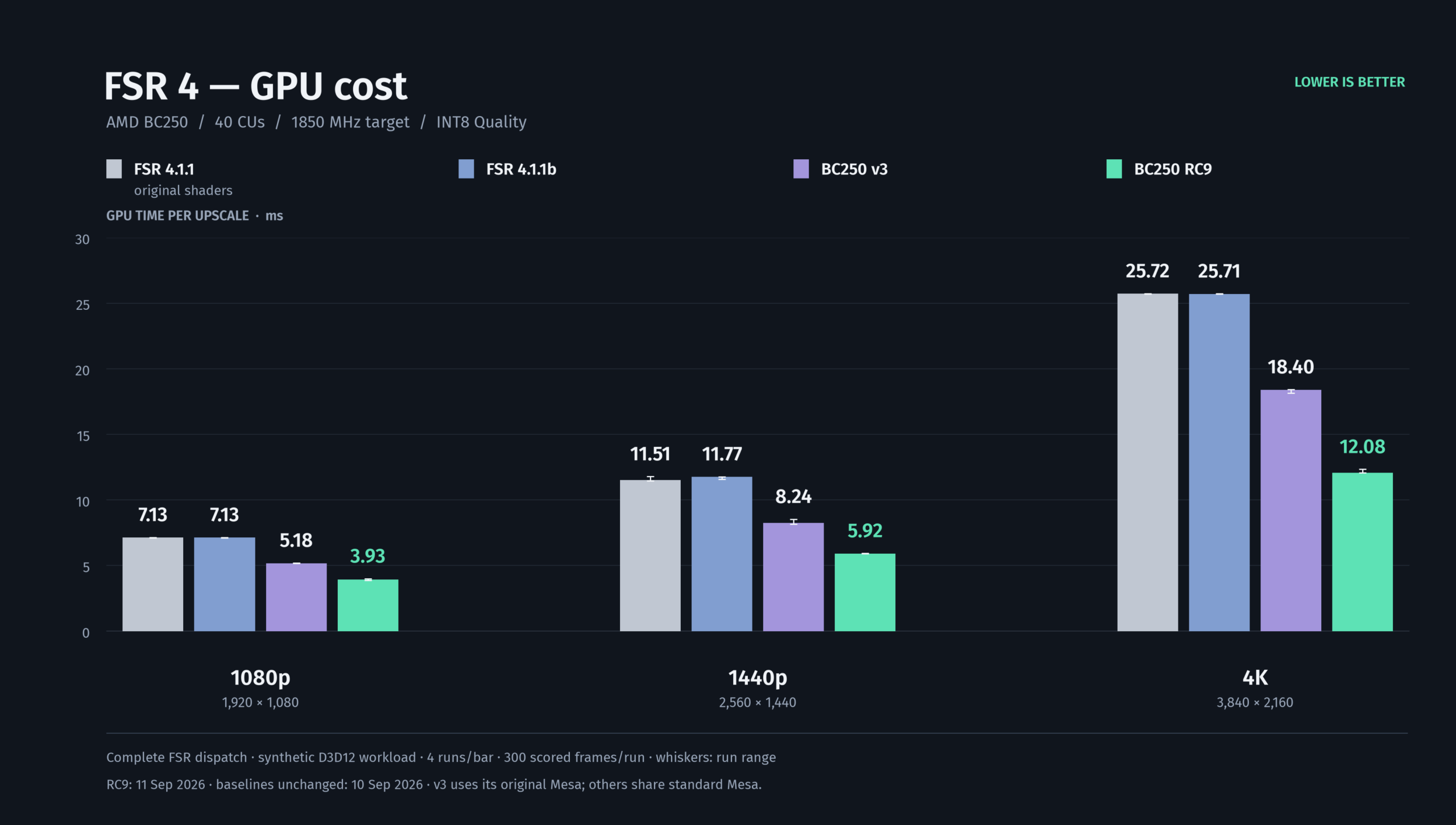
The recently released fork, designated “BC250 FSR4 4.0.0-rc9,” packages the upscaling algorithms as a standard Windows x64 dynamic-link library (DLL). Modern Linux gaming commonly uses translation layers such as Wine and Valve’s Proton, which run Windows applications on Linux by translating DirectX instructions to Vulkan.
That compatible DLL can be dropped into the directory of games that natively support FSR. It can also be used with OptiScaler, an open-source, post-processing injection framework designed to bridge different upscaling technologies, allowing Linux users to inject the features into standard PC games.
In preliminary Linux testing, the new DLL reduced the overall rendering overhead on the GPU and enabled the BC-250 to reach high frame rates at modern display resolutions. Developers targeted a 2560×1440 (1440p) rendering resolution with a “Quality” preset input resolution of 1706×960.
The upscaling process reconstructed that lower-resolution input into a sharp 1440p output without a perceptible loss in image quality, significantly easing the computational strain on the salvaged hardware. The BC250 FSR4 tool, however, has so far been thoroughly tested only under Linux, and testing has been confined to the spatial upscaling portion of the suite.
Its frame-generation capabilities and compatibility with native Windows operating systems have not yet been verified. Nonetheless, the project serves as a proof of concept for how discarded, industrial-grade silicon can be kept out of the waste stream and repurposed for consumer entertainment.









