Sony ECM-W5 Wireless Mic Adds 32-Bit Float at $400
Native Multi Interface Shoe integration and 64GB internal storage target professional solo shooters over budget alternatives.
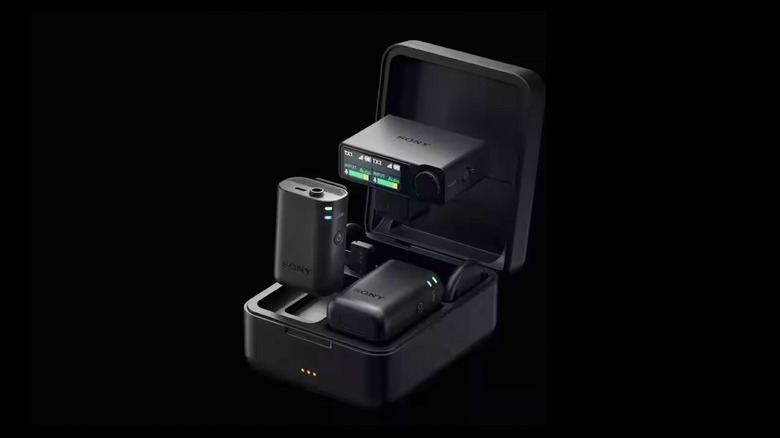
Sony is betting that professional-grade audio capture will justify a steep premium for solo videographers and small production crews. The company’s newly announced ECM-W5 wireless microphone system arrives with 32-bit float recording, a feature increasingly demanded by independent creators who cannot afford to ruin takes with clipped or distorted audio.
Priced at $400 for the base kit, the system ships with two transmitters and one receiver. Pre-orders are open now, with units scheduled to reach buyers in November.
The defining technical advantage of the ECM-W5 lies in its 32-bit float architecture paired with 64GB of internal storage on each transmitter. Unlike traditional 16-bit or 24-bit audio formats, 32-bit float captures an enormous dynamic range. This allows operators to record extremely quiet dialogue and sudden loud noises simultaneously without manually adjusting gain levels during a shoot. If a subject unexpectedly shouts, the audio remains recoverable in post-production software such as Adobe Premiere Pro or DaVinci Resolve. Because this high-resolution data requires significant storage bandwidth, Sony routes the 32-bit float files directly to the transmitters’ onboard memory rather than streaming them wirelessly to the receiver.


That internal recording capability transforms the transmitters into standalone backup recorders. Even if the wireless link drops, the original high-fidelity audio remains safely stored on the device attached to the talent.
Wireless transmission itself operates at a 96kHz sampling rate across distances up to 500 meters under clear line-of-sight conditions. While real-world performance typically degrades around obstacles like buildings or dense crowds, the stated range positions the ECM-W5 well beyond standard Bluetooth microphones and competitive with dedicated UHF systems used in broadcast television.
Hardware integration heavily favors existing Sony users. The rectangular receiver mounts directly onto Alpha series cameras using the Multi Interface Shoe. This proprietary connection delivers both power and digital audio transfer, eliminating the need for auxiliary cables or separate batteries for the receiver. For those shooting on smartphones, PCs, or competing camera brands from Canon or Panasonic, the receiver includes a USB-C adapter to route the audio signal externally.
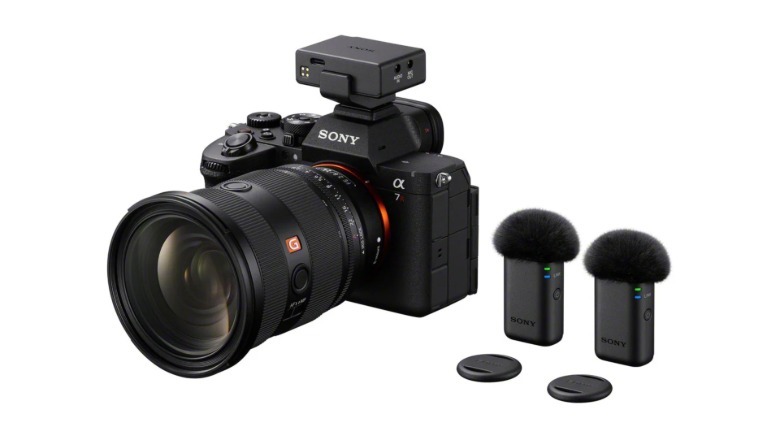
Operators managing complex shoots can expand the system beyond the included two-microphone configuration. By purchasing additional transmitters for $120 each, crews can record up to four isolated tracks simultaneously. Each transmitter offers 11 hours of battery life and features a magnetic backplate for tool-free attachment to clothing.
Monitoring capabilities extend to Bluetooth LE, allowing sound mixers to listen to playback wirelessly through compatible Sony headphones while making adjustments on the receiver’s touchscreen interface.
The $400 price tag places the ECM-W5 significantly above mass-market alternatives. DJI dominates the accessible end of the creator economy with the $99 DJI Mic Mini and the $259 DJI Mic 3. However, those cheaper systems generally lack the combination of 32-bit float internal recording and deep native camera integration found here. The ECM-W5 competes more directly with established industry tools like the Rode Wireless PRO, which also leverages 32-bit float technology but relies on universal mounting solutions rather than brand-specific shoe connections.
For those looking to build out their audio inventory incrementally, Sony is selling the components separately. A standalone ECM-W5R receiver costs $190, while individual ECM-W5T transmitters retail for $120.