AI Chip Maker Etched Reaches $10.3 Billion Valuation in $300 Million Series C Round
Artificial intelligence chip startup Etched has secured $300 million in Series C financing at a $10.3 billion valuation, doubling its enterprise market value in roughly seven months as competitive pressure mounts in the specialized hardware sector.
The round was led by venture capital firm Sequoia, with participation from Andreessen Horowitz, SK Hynix, Jane Street, and Diffusion Capital, alongside earlier backers including Peter Thiel, Andrej Karpathy, Dylan Field, and Amjad Masad. According to co-founder and chief operating officer Robert Wachen, the transaction represents the highest valuation ever recorded for a Series C round led by Sequoia.
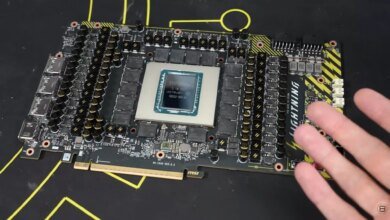
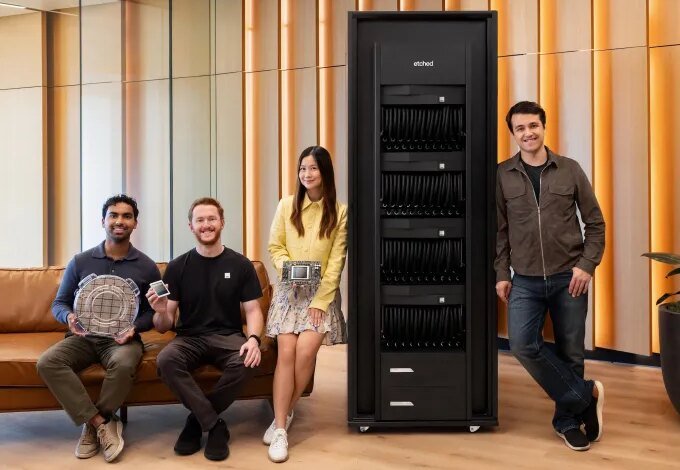
The financial milestone follows a $500 million fundraising round in December that valued the San Jose-based company at $5 billion. Etched has recently completed manufacturing of its first physical silicon through contract manufacturer Taiwan Semiconductor Manufacturing Co. (TSMC), delivering complete server rack systems to early customers for testing while registering $1 billion in advance purchase commitments.
The enterprise shift toward dedicated AI hardware comes as global compute demands transition from model training—the resource-heavy initial phase of feeding data into algorithms—to model inference, the ongoing operational process of serving queries to end users. While graphics processing units (GPUs) designed by market giant Nvidia remain the industry standard for general-purpose compute, application-specific chips are gaining traction by optimizing power efficiency and execution speed for specific mathematical workloads.
Etched has designed its hardware systems specifically around optimizing the two distinct phases of AI inference: prefill and decode. The prefill stage processes incoming prompts and context through compute-intensive mathematical calculations, whereas the decode stage handles token generation, requiring rapid access to system memory.
To optimize performance across these phases, the startup engineered a proprietary low-voltage prefill chip alongside custom memory architecture. Operating silicon at lower electrical voltages significantly reduces thermal output, enabling designers to pack higher transistor densities onto a single die without incurring thermal throttling. For token decoding, the company introduced a low-latency interconnect framework termed “cluster-scale memory,” which aggregates memory modules across multiple chips into a single unified pool.
Addressing market misconceptions that its systems are restricted to specific large language models, Wachen emphasized that the platform supports diverse architectures. These include standard transformer models underlying platforms like ChatGPT, Mixture of Experts (MoE) designs such as DeepSeek and Qwen—which route tasks to specialized sub-networks—and alternative state-space architectures like Mamba.
Founded in 2022 by Harvard University dropouts Gavin Uberti, Robert Wachen, and Chris Zhu, Etched initially struggled to secure early venture backing in a hardware environment skeptical of non-GPU architectures. The company built credibility by offering private hardware demonstrations to prominent figures across the artificial intelligence sector, including OpenAI researcher Noam Brown and computer scientist Geoffrey Hinton.
From operating out of an employee’s residential garage during its initial engineering phase, Etched has expanded its operational footprint to 400 employees. Alongside a 2-megawatt data center at its San Jose headquarters, the company recently commissioned an 80,000-square-foot, 10-megawatt testing facility in nearby Milpitas, California, as it prepares full-scale commercial manufacturing.