OpenAI Expands ChatGPT Health Access Across U.S. as Weekly Queries Reach 300 Million
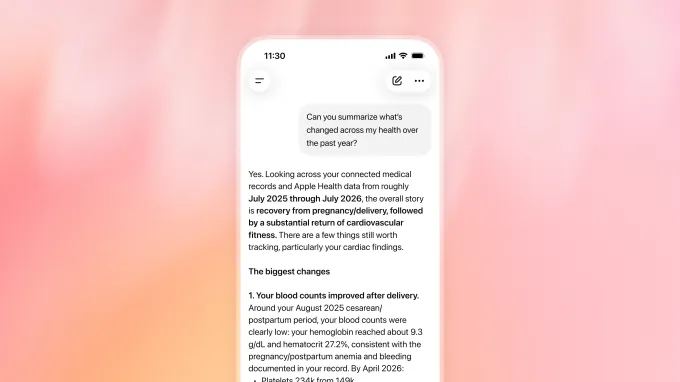
OpenAI has launched its ChatGPT Health tools to all U.S. adult users across both free and premium subscription tiers, allowing the artificial intelligence chatbot to pull personal medical records and fitness metrics directly into standard daily conversations.
The nationwide rollout on web and iOS platforms expands access across Free, Go, Plus, and Pro accounts, following a pilot phase initiated in January. The expansion comes as OpenAI reports a sharp rise in user engagement, with weekly health-related queries climbing from 230 million during early testing to 300 million.
Under the updated setup, users can link data from electronic health record providers—including Epic and Oracle Health—as well as clinical platforms like One Medical and Function Health, alongside consumer tracking applications such as Apple Health and MyFitnessPal. While testing previously relied on an isolated hub, internal usage data revealed that 70 percent of health questions occurred within standard conversation threads. Consequently, the tool now enables users to reference their health metrics contextually across general chats, such as evaluating dietary advice or food allergies.
The public release comes a day after a Florida pastor filed a lawsuit against OpenAI, alleging that the chatbot provided a near-fatal suggestion not to consult a doctor. In response to growing legal scrutiny, OpenAI pointed to its platform terms, which explicitly state that its services are not intended for use in the diagnosis or treatment of any health condition. The company stated that it is actively working on making health-related answers safer, while urging users to verify information and make medical decisions with qualified professionals.
Integrating personal medical data into conversational models operates in a sensitive regulatory landscape. While clinical software in hospital settings must adhere to rigorous health information privacy standards, consumer-facing conversational tools often navigate complex boundaries regarding user data handling. OpenAI stated that it does not use user data to train its models for this feature and collaborates with physicians to improve system responses.
On the technical front, OpenAI claims improved diagnostic accuracy in its recent model architecture. The company noted that GPT 5.6-Luna, the smallest model from its latest release, outperformed GPT 5.5 on HealthBench, an open-source evaluation benchmark developed by the company to test large language models on health queries.
Despite documented concerns from medical researchers regarding AI reliability for clinical advice, commercial competition in healthcare software continues to intensify. Tech companies including Google and Anthropic are expanding similar health-focused AI features to capture growing consumer demand for automated medical information.