2026 Kia Sorento PHEV Review: Premium Cabin and Off-Road Capability Meet Powertrain Compromises
Evaluating the premium cabin, real-world fuel economy, and powertrain refinement of Kia's three-row plug-in hybrid SUV.
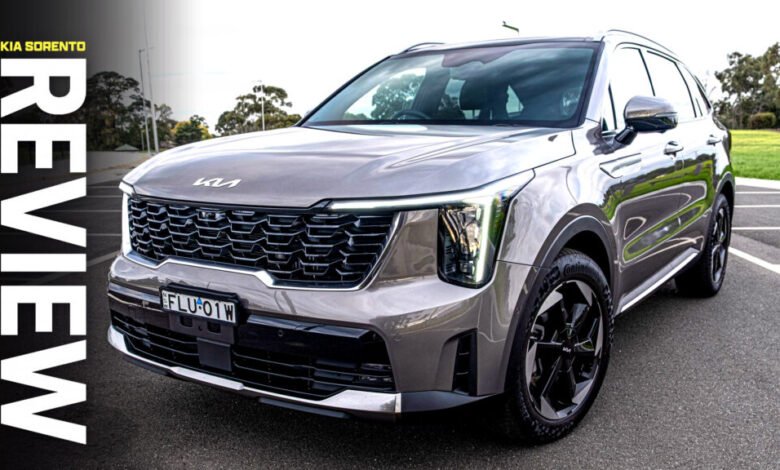
The market for three-row plug-in hybrid SUVs remains sparsely populated. In Australia, buyers looking for this specific configuration are limited to a small selection of vehicles, including the Mazda CX-80, Chery Tiggo 9, BYD Sealion 8, and the updated Kia Sorento PHEV. While the Kia brand offers a familiar and trusted badge, a close evaluation of the 2026 Kia Sorento GT-Line PHEV reveals a mix of premium interior refinement, capable off-road performance, and notable powertrain compromises.
Platform and Powertrain Details
Kia has been manufacturing the fourth-generation Sorento since mid-2020, utilizing the same N3 architecture as the Hyundai Santa Fe. While the Santa Fe transitioned to its fifth generation recently, an all-new Sorento is not expected until at least 2027. To keep the current model competitive, Kia introduced a mid-life facelift in 2024.
One of the primary differentiators for the Sorento is its plug-in hybrid option, whereas the current Hyundai Santa Fe is only available as a traditional hybrid without a plug.
The 2026 Kia Sorento GT-Line PHEV is powered by a 1.6-liter turbocharged four-cylinder engine paired with an electric motor integrated into a six-speed automatic transmission. Supported by a 14 kWh lithium-ion polymer battery, the system produces a combined output of 195 kW (262 hp) and 350 Nm (258 lb-ft) of torque.
In Australia, Kia offers 12 Sorento variants. Pricing starts at AU$58,340 ($41,800) on-road for the entry-level S Diesel DCT, with diesel options topping out at AU$73,940 ($53,000). The eight hybrid and plug-in hybrid models range from AU$59,490 ($42,600) up to AU$84,600 ($60,600) for the flagship GT-Line PHEV AWD. In the United States, standard combustion models span eight trims, while three hybrid variants, including the PHEV, start from $48,290. Kia removed navigation from the 2026 Sorento S trim while raising its base price.
Interior and Cabin Experience
The facelifted Sorento features a redesigned dashboard that replaces individual displays with twin screens housed under a single curved piece of glass. The system supports wireless Apple CarPlay and Android Auto as standard. Kia also updated the HVAC controls, shifting them lower on the dashboard into a narrow touchscreen interface rather than physical buttons.
The GT-Line trim adds premium touches, including supple black Nappa leather, heated and ventilated front seats, a wireless smartphone charging pad, and a large panoramic glass roof. However, the third-row seating remains tight, making it suitable primarily for children or teenagers. Families requiring more spacious third-row accommodations may find larger vehicles like the Kia EV9, Telluride, or Carnival more appropriate.
Driving Performance and Efficiency
Real-world testing of the Sorento PHEV highlighted several performance characteristics. The 1.6-liter turbocharged engine is noticeably loud and clattery, particularly under hard acceleration and even during routine city cruising. Additionally, because the electric motor is integrated into the six-speed automatic transmission, gear shifts can occasionally be heard inside the cabin.
The vehicle has a claimed electric-only driving range of 68 km (42 miles), though real-world testing indicates a realistic range of approximately 50 km (31 miles). While Kia claims an official fuel consumption rate of 1.6 l/100 km (147 US mpg) with a fully charged battery, operating the vehicle without regular charging significantly alters these figures. During a week of testing without external charging, the vehicle averaged 6.4 l/100 km (36.7 US mpg), even with the brake regeneration system set to its highest level. By comparison, the standard all-wheel-drive diesel Sorento has a quoted fuel consumption of 6.0 l/100 km (39.2 US mpg).
The Sorento PHEV weighs over 2,000 kg (4,409 lbs), resulting in a slightly firm but controlled ride that effectively absorbs road imperfections. Drivers can select from Eco, Normal, and Sport driving modes, alongside Terrain modes configured for Snow, Mud, and Sand.
Background: Understanding PHEV Technology and Platforms
PHEV vs. HEV Efficiency
A Plug-in Hybrid Electric Vehicle (PHEV) differs significantly from a traditional Hybrid Electric Vehicle (HEV). While both utilize an internal combustion engine and an electric motor, a PHEV features a larger battery pack that can be charged via an external power source. This allows the vehicle to operate purely on electricity for daily commutes. However, if a PHEV is not regularly plugged in and charged, it operates primarily as a heavy conventional hybrid, carrying the added weight of the battery pack without reaping the efficiency benefits, often resulting in higher fuel consumption than comparable diesel or standard hybrid models.
The N3 Architecture
The N3 platform is a modular vehicle architecture developed by Hyundai Motor Group. Designed to support front-wheel-drive and all-wheel-drive configurations, the platform underpins a variety of mid-size SUVs and sedans across the Hyundai and Kia brands. It is engineered with a low center of gravity, improved crash safety structures, and multi-load path structures to absorb collision energy. Crucially, the N3 architecture was designed from the outset to accommodate diverse powertrains, including internal combustion engines, traditional hybrids, and plug-in hybrids, without severely compromising cabin or cargo space.