Earth Microbes Could Endure for Days in Moon’s Shadowed Polar Craters, NASA Study Finds
Shadowed polar craters create microclimates where terrestrial fungi can survive up to seven days.
NASA scientists have determined that permanently shadowed zones near the lunar south pole offer conditions capable of keeping terrestrial microbes alive for days, altering how space agencies evaluate planetary contamination risks. As major spacefaring nations prepare crewed landers for polar touchdowns, the discovery upends the longstanding assumption that the lunar environment instantly sterilizes all Earth organisms.
Detailed in Science Advances, the research evaluated candidate sites for the Artemis program, such as Connecting Ridge and Nobile Rim. Investigators leveraged environmental data gathered by NASA’s Lunar Reconnaissance Orbiter to simulate surface parameters, assessing those conditions against the environmental tolerances of spacecraft-associated fungi and bacteria.
Thermal data from the Lunar Reconnaissance Orbiter shows that deep craters at the Moon’s poles experience perpetual shadows where temperatures drop below -300 degrees Fahrenheit (-180 degrees Celsius). These conditions create physical cold traps that freeze volatile compounds like water ice, while simultaneously dampening thermal degradation of cellular matter.
While the vast majority of the lunar landscape experiences extreme thermal swings, intense radiation, and unfiltered ultraviolet rays, specific polar topographies remain permanently shaded and exposed only to scattered illumination. Rather than sterilizing biological matter, the sub-zero temperatures in these microclimates act to preserve microbial structures over time.
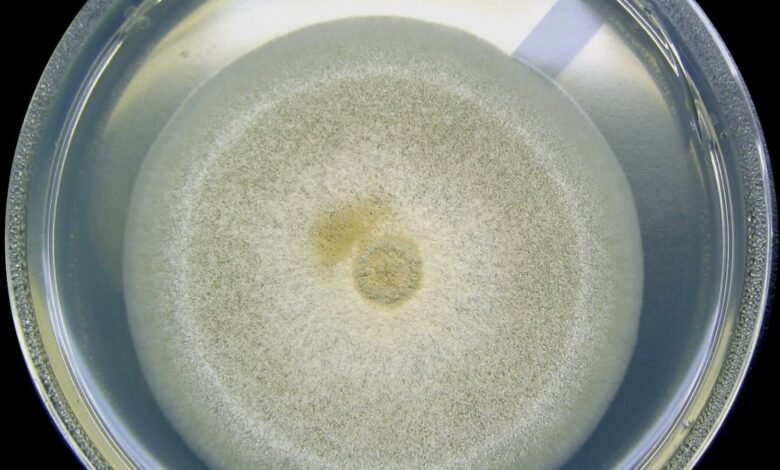
Simulations revealed that multiple target locations could sustain microbial viability for limited windows. Within these computer models, the fungal species Aspergillus maintained its integrity for up to seven Earth days inside certain shadowed microenvironments.
“Aspergillus was our champion, and possesses characteristics (thick walls and dark pigments that protect them from X-rays, cosmic radiation, and UV-C radiation) that make it especially well suited to survive in regions of the lunar poles,” said Prabal Saxena, a research space scientist at NASA Goddard Space Flight Center who led the study, in an email to 404 Media.
The research evaluated organism endurance rather than active proliferation, indicating that microbes would enter a dormant state instead of multiplying across the surface. Nevertheless, their capacity to endure for multiple days introduces the possibility that landing craft could inadvertently deposit terrestrial life into prime zones slated for scientific investigation and future surface operations.
Both NASA’s Artemis initiative and a joint Chinese-Russian lunar venture are targeting human landings near the south pole during the 2030s. Space agencies are concentrating on this region because permanently shadowed regions are believed to harbor substantial deposits of water ice, an essential resource for life support systems and rocket propellant manufacturing.
The environmental traits that make these cold traps prime candidates for water extraction simultaneously set them apart from the broader lunar terrain. Lower exposure to direct sunlight and solar radiation enables specific spacecraft-borne microorganisms to remain viable far longer than scientists previously estimated.
“Recent studies have shown how unique the conditions are on the surface of the lunar poles and we realized that it was worth studying how amenable those might be to survival for certain microbes, particularly in the context of recent work on how hardy some bacteria and fungi are when exposed to space conditions,” Saxena said.
The investigation merged datasets from planetary surface physics, microbiology, and planetary protection protocols. Saxena noted that the team assembled experts from NASA Goddard specializing in lunar lighting dynamics, clean-room microbiology, biochemistry, and lunar evolution.
The geographic boundaries where microbes could potentially endure proved significantly wider than initial projections suggested.
Saxena explained that scientists originally hypothesized only a handful of organisms would survive brief exposures within permanently shadowed craters due to low radiation levels and freezing temperatures. However, computer modeling demonstrated that viable pockets covered larger areas and permitted longer survival windows than the research team had anticipated.
These results could force mission planners to reevaluate current clean-room sterilization standards and refine landing zone criteria. Biological contamination risks distorting scientific analysis of the lunar geological record, particularly in regions that preserve pristine cosmic and solar particles.
Investigators pointed out that terrestrial biological material might also have traveled to the lunar surface through natural impact ejection processes over geological time.
Saxena noted that meteoroid collisions and ejected particles continuously facilitate material exchange between Earth and the Moon, while deep-space impacts periodically bombard the lunar crust, establishing a plausible pathway for interplanetary microbial transfer.
Saxena underscored that because the Moon functions as a natural archive of Earth, Sun, and deep space history, preventing cross-contamination ensures future landers can read that untouched record cleanly without confusing native chemical signals with hitchhiking microbes.