Ordinals Developer Proposes Alternative Bitcoin Client to Bypass Transaction Size Limits
The proposed 'Bitcoin $DOG Mode' client seeks to lift restrictions on Ordinals and Runes transactions.
A prominent figure in the Bitcoin Ordinals ecosystem has proposed a radical software fork designed to bypass the transaction restrictions enforced by the network’s dominant software clients.
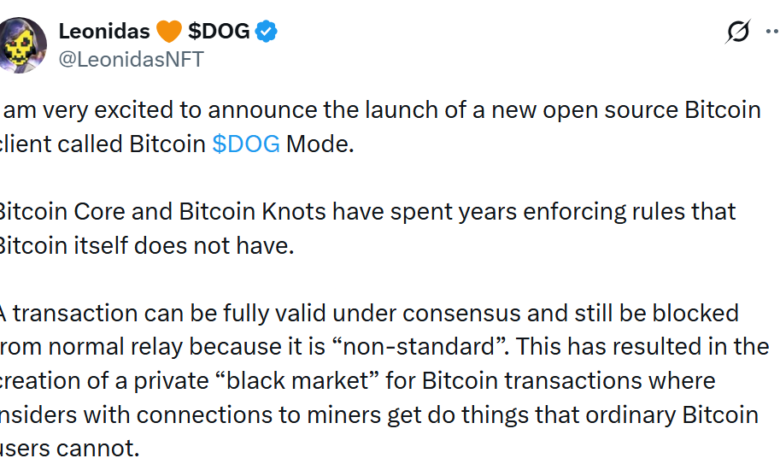
Leonidas, a well-known developer and advocate for the protocol, announced plans to develop a new open-source Bitcoin client dubbed Bitcoin $DOG Mode. The proposed software aims to eliminate policy-level constraints that currently hinder the transfer of Ordinals inscriptions and Runes, which function as non-fungible and fungible tokens on the Bitcoin blockchain.
Under current default rules set by Bitcoin Core, the software that powers the vast majority of the network’s nodes, individual transactions are capped at 400,000 weight units (WU). The proposed client would aggressively raise this limit to 3.9 million WU, effectively allowing a single transaction to occupy almost an entire Bitcoin block. This change would enable users to embed significantly larger files, such as high-resolution digital art or entire collections, directly into the blockchain in a single transaction.
Additionally, the new client seeks to lower the dust limit to just 1 satoshi, down from the current default threshold of 294 to 546 satoshis. The dust limit was originally established as a spam-prevention measure to stop the creation of tiny, economically unspendable transaction outputs (UTXOs) that bloat the network’s global database. However, Ordinals and Runes users often find themselves forced to “pad” their transactions with extra satoshis to ensure they are accepted and broadcast by standard nodes. Lowering this limit would streamline token creation and transfer.
“Bitcoin Core and Bitcoin Knots have spent years enforcing rules that Bitcoin itself does not have,” Leonidas stated on social media platform X. He argued that the community behind these digital assets is “done asking for permission” and that it is time to dismantle what he described as “frivolous restrictions.”
The debate over Ordinals and Runes has exposed a deep philosophical divide within the Bitcoin community. Purists and conservative developers argue that using the blockchain to store arbitrary data, like images and meme coins, represents “spam” that drives up transaction fees and increases the storage requirements for running a node. Prominent figures, including Blockstream CEO Adam Back and MicroStrategy’s Michael Saylor, have previously expressed skepticism or outright opposition to proposals that facilitate these protocols.
Conversely, supporters argue that Ordinals have revitalized the developer ecosystem on Bitcoin and generated critical fee revenue for miners, which will become increasingly vital as block rewards continue to halve.
By introducing an alternative client, Leonidas hopes to garner enough adoption among node operators to create leverage. If a significant portion of the network transitions to the new software, it could pressure the maintainers of Bitcoin Core to reconsider their default policy settings.