Michael Saylor Opposes BIP-110, Outlining 110 Reasons Against Bitcoin Fork Proposal
The MicroStrategy executive chairman warns against policing transactions, drawing comparisons to the historic Blocksize Wars.
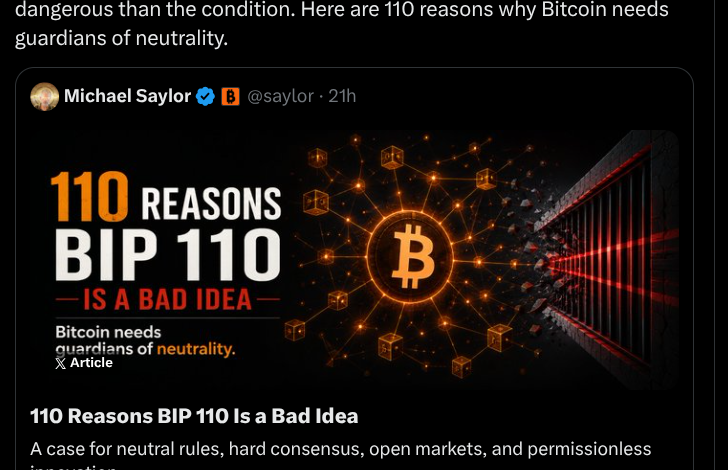
MicroStrategy executive chairman Michael Saylor has strongly opposed Bitcoin Improvement Proposal 110 (BIP-110), outlining “110 reasons” why the proposed temporary fork to restrict non-monetary transactions is a mistake for the network.
In a detailed post on X.com on Sunday, Michael Saylor—who oversees the world’s largest corporate treasury of Bitcoin—advocated for “neutral rules, hard consensus, open markets, and permissionless innovation.”
BIP-110 was introduced in December 2025 to curb Ordinals inscriptions and other arbitrary data from consuming network block space. Proponents argue the measure is necessary to preserve Bitcoin’s primary utility as a decentralized, peer-to-peer electronic cash system.
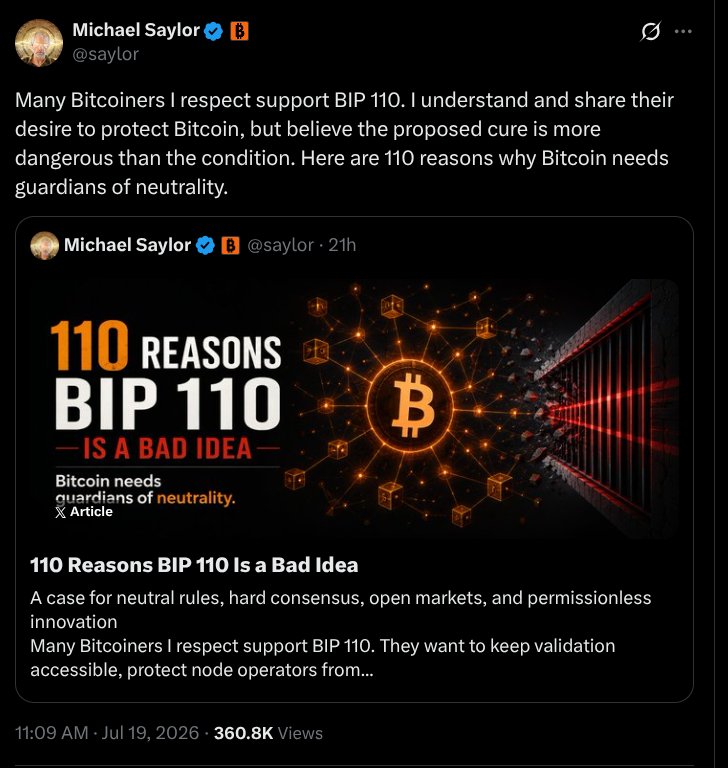
Source: Michael Saylor on X.com
While acknowledging the concerns of the proposal’s advocates, Saylor argued that altering the protocol’s core rules is the wrong approach.
“Many Bitcoiners I respect support BIP 110. They want to keep validation accessible, protect node operators from unwanted costs and content, preserve affordable payments, and keep Bitcoin focused on sound money rather than general-purpose data storage. Those are serious concerns. I share the objectives. I disagree about the remedy,” Saylor said.
## A Deepening Protocol Dispute
The debate surrounding BIP-110 has emerged as the most significant protocol-level disagreement within the Bitcoin development community since the Blocksize Wars of 2015 to 2017. During that era, ecosystem participants clashed over whether to increase the block size limit to scale the network, risking a permanent chain split.
The current proposal was introduced by pseudonymous developer Dathon Ohm, with prominent backing from Ocean protocol founder Luke Dashjr. Conversely, opponents of the measure include Blockstream CEO Adam Back, alongside Saylor.
Adam Back has criticized the proposal, describing it as a “quest to police other people.” He argued that Bitcoin’s decentralized nature dictates that “you can’t impose your views on others,” asserting that such restrictions are fundamentally incompatible with Bitcoin’s cypherpunk ethos of permissionless, censorship-resistant money.
In contrast, Luke Dashjr and other supporters view Ordinals-driven data bloat as a “serious threat” to the network’s long-term health, requiring immediate intervention. Proponents emphasize that BIP-110 would not cause a chain split, noting that the fork enforces a temporary, one-year limit and would not permanently invalidate fee-paying transactions.
## Low Activation Probability Amid Declining Activity
According to decentralized network monitors, the likelihood of BIP-110 being activated remains low. The proposal requires the support of at least 55% of validating nodes within a specific Bitcoin block period to take effect.
On-chain data indicates that during the most recent block period—period 475, spanning blocks 955,584 to 957,599—only 1% of blocks signaled support for the proposal.
Furthermore, the urgency of the debate comes at a time when Ordinals activity has declined significantly. Daily Ordinals inscriptions have fallen to fewer than 10,000 over the past month, a sharp contrast to the peak of over 400,000 daily inscriptions recorded in August 2023.
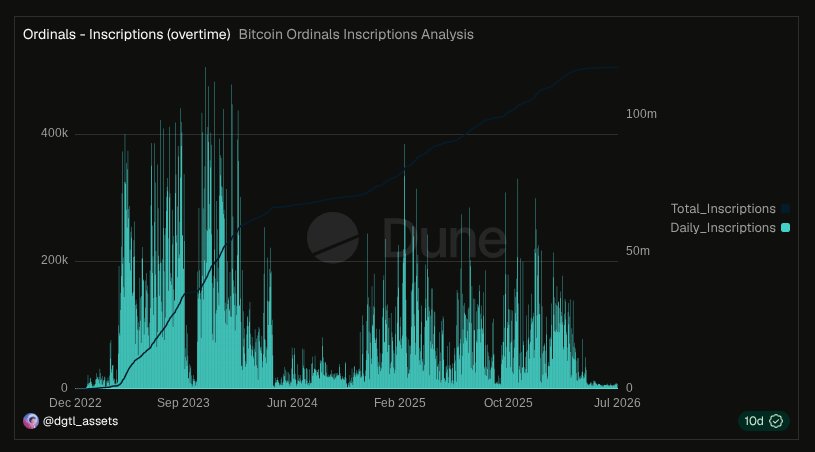
Change in daily Ordinals inscriptions since December 2022.
Source: Dune Analytics
As the debate continues, the low node signaling rate suggests that the Bitcoin network is unlikely to adopt the temporary fork, reflecting the community’s historical resistance to protocol-level transaction filtering.