Traditional Equities and Commodities Overtake Crypto Derivatives on Hyperliquid
Decentralized trading platform Hyperliquid recorded a landmark shift in mid-July as trading volumes for real-world assets (RWAs)—synthetic tokenized contracts tracking traditional financial instruments—surpassed cryptocurrency derivatives for the first time in the exchange’s history.
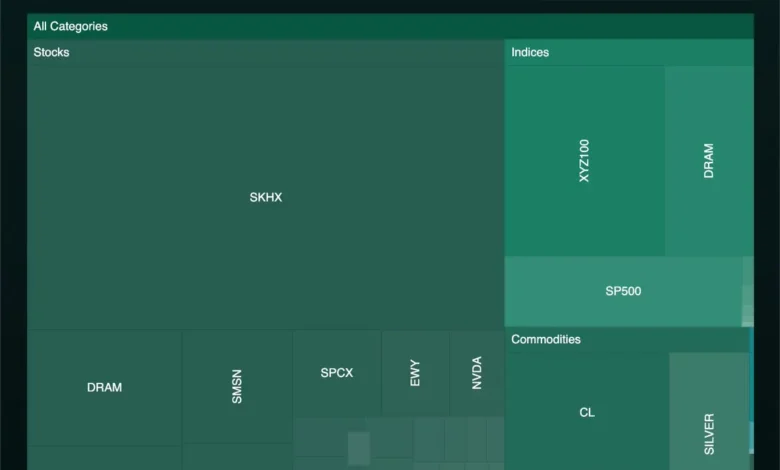
Between July 13 and July 19, derivative trades linked to conventional shares, market indices, and commodities generated approximately $26 billion on Hyperliquid, accounting for 54% of the venue’s overall $50 billion weekly volume. Data compiled by crypto analytics provider Blockworks previously pegged the weekly RWA total at $25.1 billion, or 52% of total volume, reflecting a rapid expansion of non-crypto derivative activity on the protocol.
The surge highlights Hyperliquid’s growing footprint within the broader decentralized finance ecosystem. Total perpetual trading volume across all decentralized exchanges globally reached $79 billion over the same seven-day window. With Hyperliquid facilitating $50 billion of that overall liquidity, its real-world asset trading volume alone eclipsed the combined cryptocurrency derivative volume of every other competing decentralized exchange across the market.
This pivot into traditional finance was unlocked by the deployment of Hyperliquid’s HIP-3 framework in October 2025. The permissionless infrastructure allows independent development teams to launch customized perpetual futures—contracts that enable traders to speculate on asset price movements using leverage without an expiration date. To establish new markets under the HIP-3 architecture, builders are required to stake 500,000 HYPE tokens, an allocation currently valued at roughly $30 million.
Single-stock perpetual contracts have driven the bulk of this activity, accounting for 61% of all RWA transactions on the platform since June. South Korean semiconductor manufacturer SK Hynix—a vital supplier of high-bandwidth memory for artificial intelligence hardware and a key rival to Samsung—emerged as the most actively traded equity underlying contract. The platform has also hosted pre-initial public offering derivative markets for high-profile private technology firms, including SpaceX, Anthropic, and OpenAI.
Institutional observers have taken note of the exchange’s shifting volume dynamics. Lorenzo Valente, director of digital assets research at Ark Invest, highlighted the milestone on social media platform X, describing it as the beginning of “a new era for DeFi.” Valente suggested that trading venues specializing in tokenized real-world assets may eventually split from traditional crypto liquidity hubs, noting that a protocol’s control over Bitcoin and Ethereum volume may no longer guarantee dominance as traditional markets migrate on-chain.
The milestone builds on earlier attention from major investment firms. In September 2025, ARK Invest Chief Executive Officer Cathie Wood publicly compared Hyperliquid’s trajectory to the early growth phase of the Solana network. While ARK has not confirmed a direct position in the protocol, Valente noted that market participants remaining exclusively focused on crypto-native tokens risk missing a broader structural transition in global decentralized finance.