Cardano Achieves Full Decentralization with Community-Led Van Rossem Upgrade
The network transitions to protocol version 11 in its first major upgrade approved entirely by on-chain community voting.
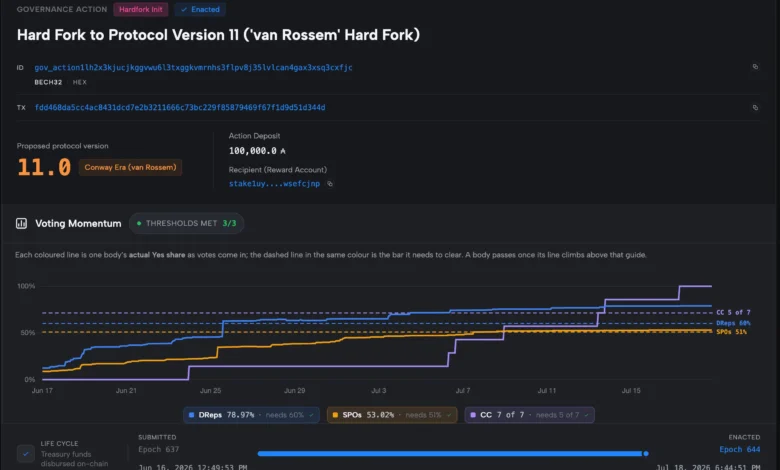
The Cardano blockchain has officially entered a new era of decentralization following the successful activation of the Van Rossem hard fork. The upgrade, which transitioned the network to Protocol Version 11, represents a historic milestone: it is the first major technical change in Cardano’s history to be proposed, voted on, and ratified entirely through on-chain community governance, without the direct intervention of its founding development firm.
Historically, major network transitions on Cardano were directed by Input Output (IOG), the engineering company behind the blockchain’s core architecture. However, this upgrade was executed under a newly established decentralized governance framework, marking a significant step toward complete community self-determination.
The Governance Vote
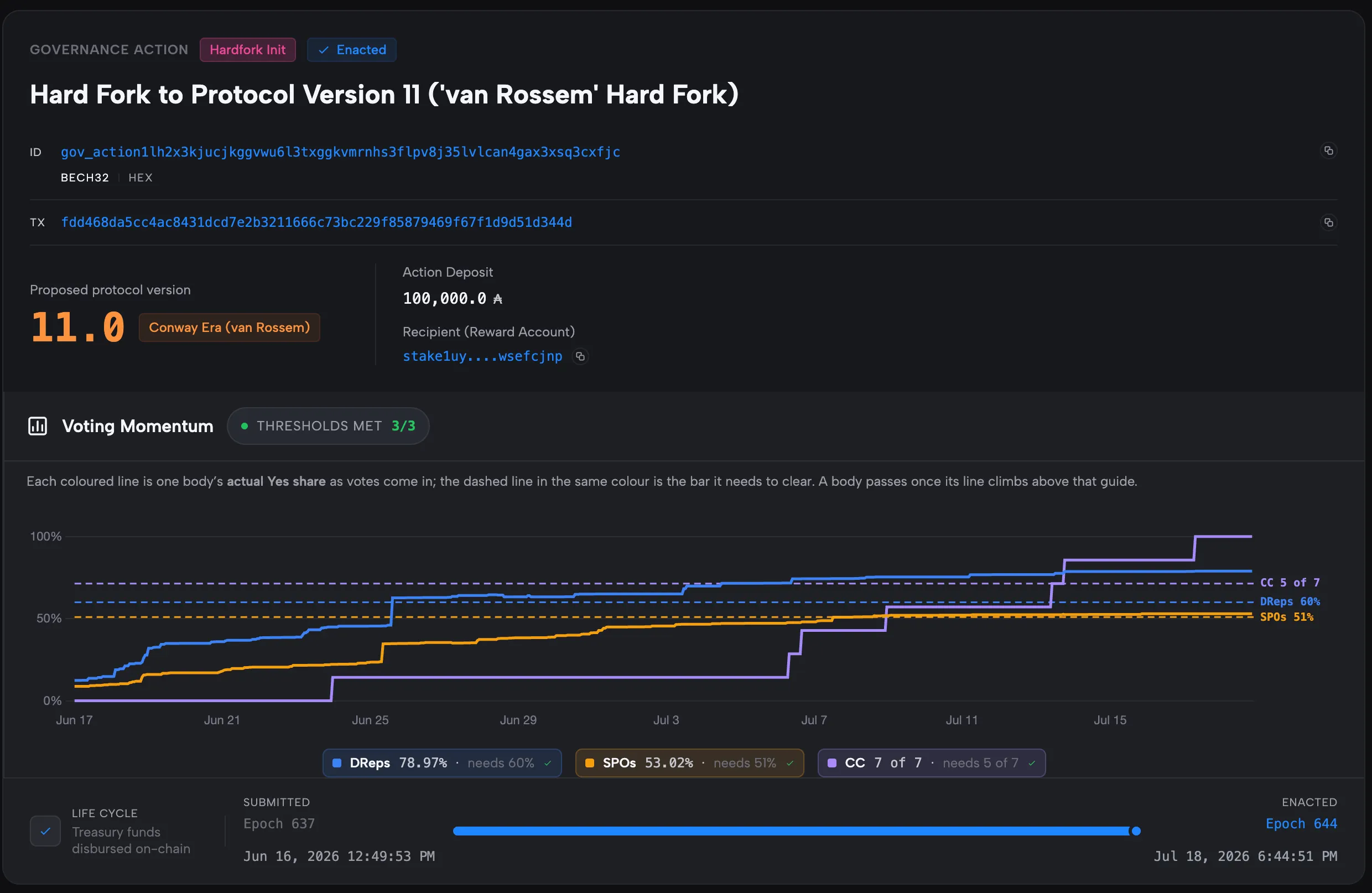
The activation of the upgrade required consensus across three distinct governing bodies within the Cardano ecosystem. Delegated representatives, known as DReps—who are elected by ADA holders to vote on network proposals—approved the measure with 77.63% support, comfortably exceeding the required 60% threshold.
Meanwhile, stake pool operators (SPOs), who maintain the physical infrastructure of the network, approved the fork with a 52.7% majority, just passing the 51% requirement. Finally, the seven-member Constitutional Committee, tasked with ensuring all proposals align with the network’s core principles, gave its formal approval.
This multi-tiered voting structure is the culmination of a multi-year roadmap. Cardano began transitioning to this model during the Chang hard fork in 2024, which introduced basic voting mechanisms, followed by the Plomin upgrade in early 2025, which expanded voting rights to ADA token holders.
The upgrade itself is named in honor of Max van Rossem, a prominent Dutch developer, node operator, and constitutional delegate who passed away in October 2025. Van Rossem was instrumental in designing the very governance protocols that enabled this transition.
Technical Enhancements and Plutus Optimization
Classified as an “intra-era” upgrade, the Van Rossem hard fork does not overhaul Cardano’s underlying ledger rules but instead introduces targeted optimizations. The primary objective of the release is to reduce Plutus execution costs. Plutus is the smart contract programming language used to build decentralized applications (dApps), decentralized finance (DeFi) protocols, and non-fungible token (NFT) marketplaces on Cardano. By lowering these execution costs, developers can deploy more complex smart contracts more efficiently.
Additionally, the upgrade bundles several critical technical improvements. These include new cryptographic tools designed to accelerate digital signature verification and a vital security patch. This patch mandates that every stake pool use a unique cryptographic key, effectively closing a known attack vector that could have compromised pool operations.
This release also serves as a technical stepping stone for Ouroboros Leios, Cardano’s upcoming consensus upgrade designed to dramatically boost transaction throughput. Ouroboros Leios aims to increase the network’s processing capacity by 30 to 65 times, pushing speeds beyond 1,000 transactions per second. Cardano founder Charles Hoskinson has indicated that Leios is on track for a mainnet release before the end of 2026, following the launch of its public testnet, Musashi Dojo, on June 23.
This governance milestone coincides with a broader organizational shift. IOG recently announced plans to transition core development responsibilities to independent, specialized development teams starting in August, making the Van Rossem hard fork the first major upgrade executed under this decentralized development strategy.
Market Reaction and On-Chain Data
Despite the historical significance of the upgrade, the price of Cardano’s native token, ADA, remained largely unchanged. ADA has traded flat, hovering around $0.1662 with a total market capitalization of approximately $6 billion.
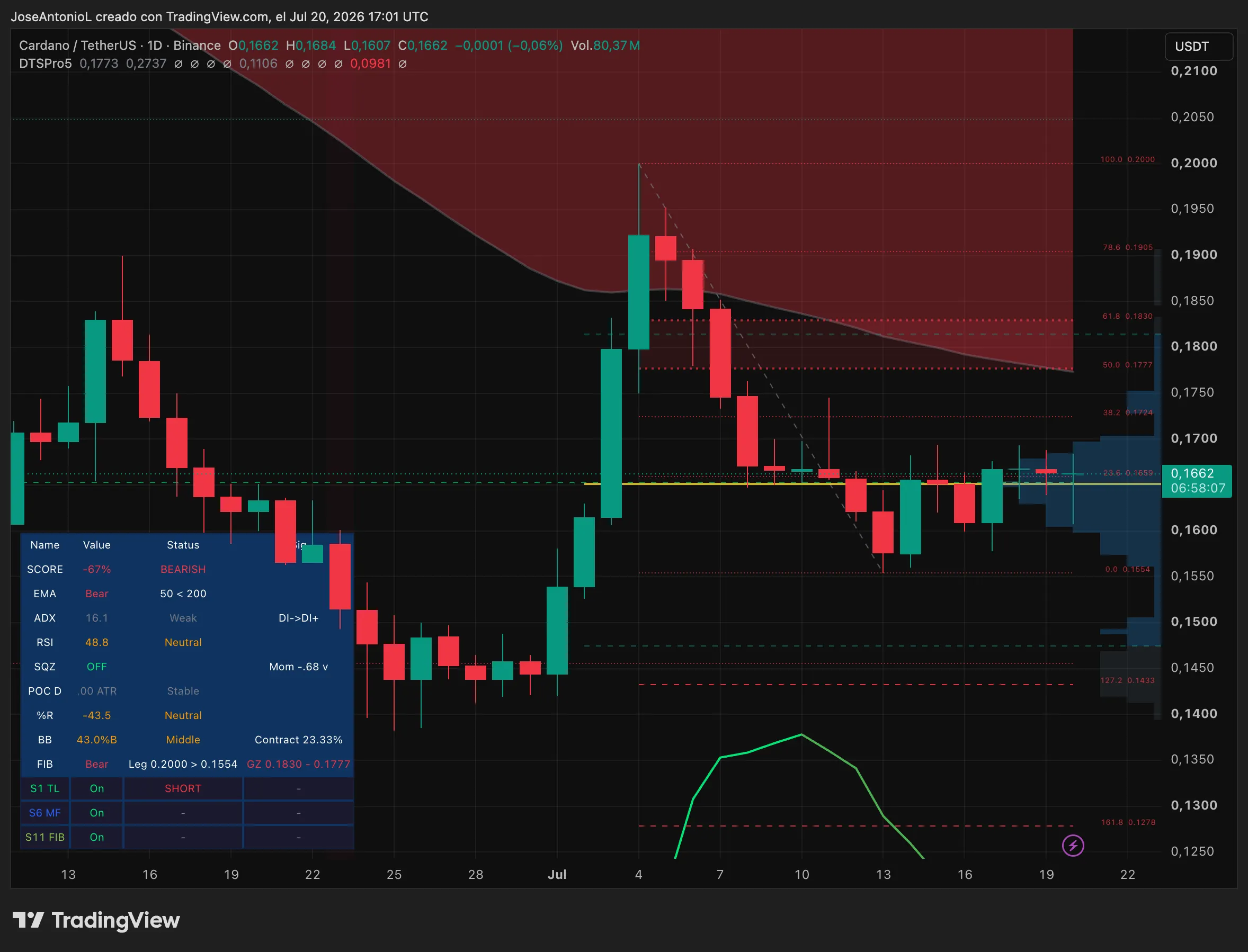
Technical indicators suggest a prevailing bearish sentiment, though the successful hard fork appears to have established a temporary price floor. The 50-day exponential moving average (EMA) remains below the 200-day EMA, a classic bearish indicator. The Relative Strength Index (RSI) sits at a neutral 48.8, while the Average Directional Index (ADX)—which measures trend strength—is weak at 16.1. However, the ADX’s directional component has begun shifting from bearish to bullish, hinting at a potential trend reversal.
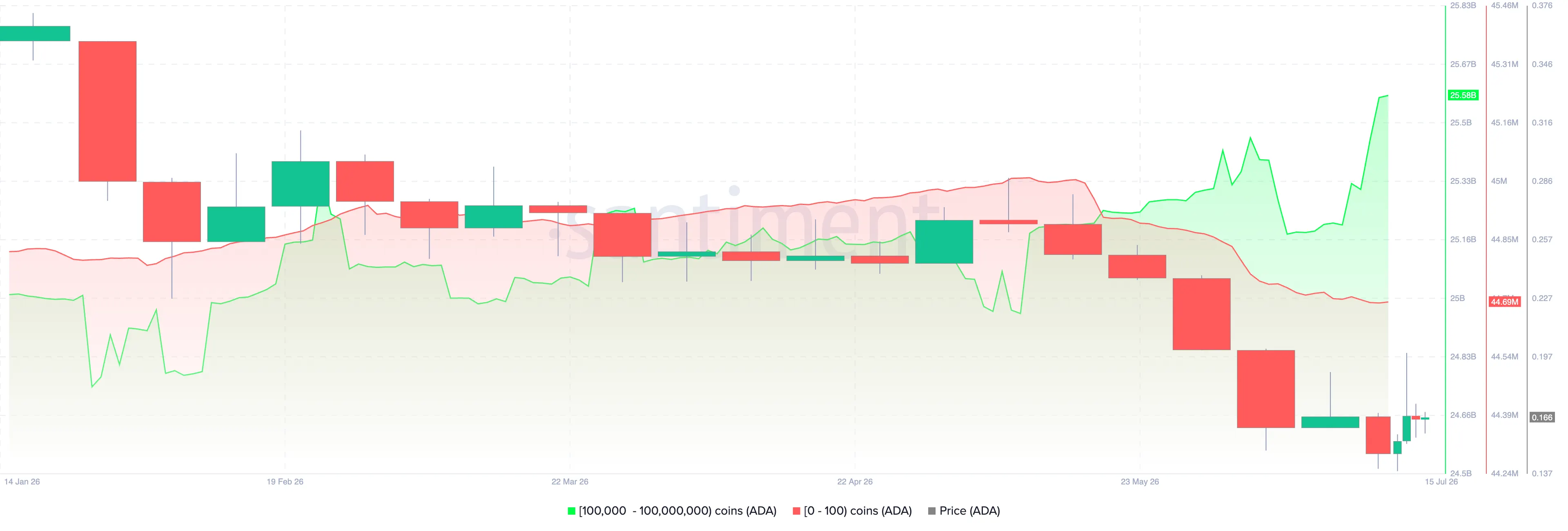
On-chain data from analytics firm Santiment reveals contrasting behavior among different holder cohorts. Large-scale investors, or “whales,” holding between 100,000 and 100 million ADA, have aggressively accumulated tokens, pushing their collective balances to the highest levels observed since 2023. Conversely, smaller retail holders have reduced their exposure during the same period.