Bitcoin Outpaces Kospi in Stability, But Regulatory Hurdles and Geopolitical Headwinds Keep Price Under Pressure
While BTC trades below its 50-day moving average, on-chain data shows smart money holding firm amid policy gridlock in Washington.
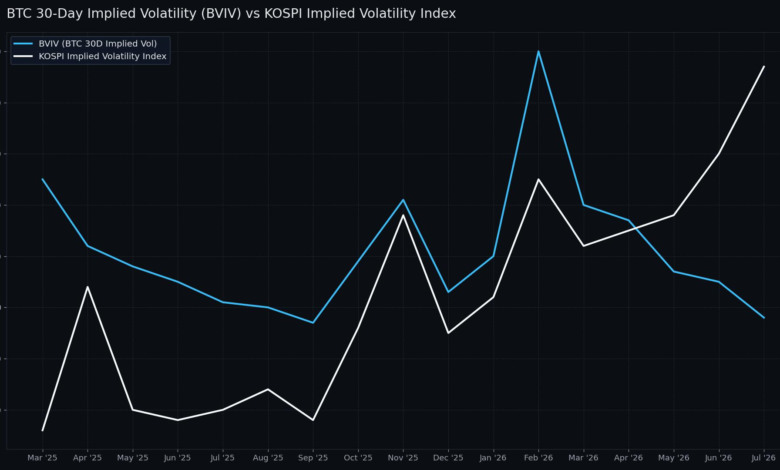
Bitcoin’s evolution from a highly speculative digital asset into a mature financial instrument is often measured by its volatility relative to traditional markets. In a striking turn of events for cryptocurrency advocates, Bitcoin has recently demonstrated greater stability than South Korea’s benchmark Kospi index. For long-term proponents, this relative calmness compared to a major sovereign equity index represents a notable milestone.
However, the broader picture reveals that the digital asset market still has a long way to go before achieving mainstream parity with traditional safe havens. The largest cryptocurrency remains twice as volatile and risky as the S&P 500 index, whose 30-day volatility index (VIX) sits below 20%. In the options and derivatives markets, traders closely monitor the Bitcoin Volatility Index (BVIV) to price risk. Perhaps the true milestone for Bitcoin bulls will be the day when the VIX becomes more expensive than the BVIV, signaling that traditional equities are perceived as riskier than the premier cryptocurrency.
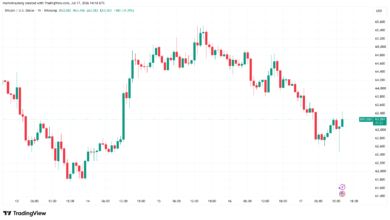
In the immediate term, Bitcoin’s price remains under pressure. The asset is currently trading below its widely followed 50-day moving average, a key technical indicator that analysts use to assess medium-term momentum. When an asset trades below this line, it often signals a bearish phase or a period of consolidation, keeping short-term traders cautious.
Despite this technical weakness, on-chain data offers a glimmer of optimism. According to analytics firm Nansen, the smart money wallets that typically move first and in the largest size during geopolitical flare-ups have not meaningfully shifted their capital into stablecoins. In times of market panic, investors typically flee volatile assets in favor of dollar-pegged stablecoins to preserve capital. The lack of such a flight suggests that large-scale holders are choosing to ride out the current market turbulence rather than capitulating.
“This is consistent with prior Middle East flare-ups: Short-term leveraged longs get flushed, and then accumulation resumes,” Nicolai Sondergaard, a research analyst at Nansen, said in an email. This pattern of derivatives liquidations clearing out over-leveraged traders before spot buyers step back in has been a recurring theme in crypto market cycles.
While on-chain metrics suggest underlying resilience, macroeconomic and regulatory developments in Washington D.C. are poised to dictate the market’s next structural phase. Market observers are urging a close focus on the forthcoming legislative hearings, where critical regulatory frameworks are being debated.
“The Clarity Act faces what could be its final test today, the industry insisting its gets done while the bill snags on Trump conflict of interest provisions and fresh Senate hurdles before the August recess. This is the regulatory clarity the institutional bid has been waiting for,” analysts at Marex said.
The legislative battle over the Clarity Act highlights the ongoing tension between crypto industry advocates, who view clear guidelines as essential for growth, and lawmakers grappling with political complications. For major Wall Street players, clear rules of the road are a prerequisite for deploying capital at scale. Until these regulatory hurdles are cleared, the highly anticipated institutional bid may remain partially on the sidelines, waiting for a green light from Washington.