BMW’s 30-Year Struggle to Crack the Entry-Level Code: Why the 4-Door Compact Died
The 1990s E36/5 prototype that nearly became BMW's Golf fighter — and why the board said no
BMW’s boardroom rejected a four-door 3 Series Compact prototype in the 1990s because the numbers simply refused to work — a decision that delayed the automaker’s true entry-level breakthrough by a decade and fundamentally reshaped its compact strategy.
The one-off E36/5 prototype, unveiled publicly for the first time this month by BMW Classic to Retro Garage Official, represents a pivotal “what if” in the company’s history. Built on a 316i sedan chassis with a chopped rear section and Compact tailgate, the vehicle was a parts-bin mashup: sedan doors with manual cranks but power-window switches still wired in, a Compact dashboard, and a structure that would have required expensive reinforcement to meet safety standards.
“Cost may be the likeliest factor,” according to Retro Garage Official’s analysis of the prototype. The four-door Compact would have been priced perilously close to the standard 3 Series sedan, cannibalizing higher-margin sales while demanding its own tooling and crash-test programs. The two-door Compact already used E30 rear suspension to keep costs down; a four-door version would have erased those savings.

BMW’s American experiment with the two-door 3 Series Compact (1994-1997) confirmed the market reality. Sales fell short of expectations, killing the E46/5 successor’s US chances. European buyers embraced the hatchback format, but even there, the Compact’s truncated trunk and compromised rear-seat space limited its appeal against the Volkswagen Golf — the benchmark BMW was chasing.
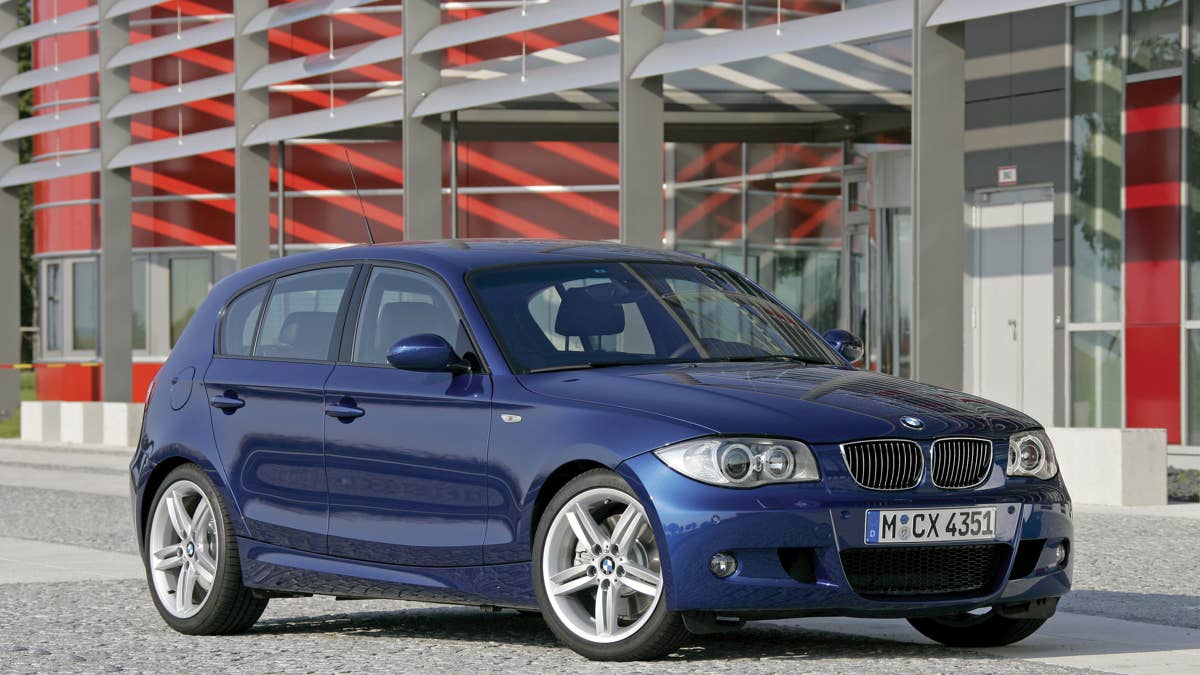
The prototype’s existence reveals a deeper strategic tension. BMW needed volume below the 3 Series but lacked a scalable platform. The E36 architecture, designed for rear-wheel-drive sedans and coupes, could not be efficiently stretched into a practical four-door hatchback without massive investment. The company would wait until 2004, when the first-generation 1 Series arrived on a dedicated rear-drive platform, to finally crack the formula — only to abandon that layout in 2019 for the front-drive UKL architecture shared with Mini.
That third-generation pivot underscores the same economic logic that killed the four-door E36/5. BMW’s own research showed most 1 Series owners didn’t know or care about rear-wheel drive. The UKL platform delivered the interior space and cost efficiency the 1990s prototype could not, boosting European sales even as the X1 crossover began cannibalizing the hatchback’s core buyers.
The four-door Compact prototype, repainted from its original Boston Green to Hellrot red, now sits in BMW’s collection as a testament to a strategy that required three decades and two platform revolutions to execute. The 2 Series coupe and convertible retained rear-wheel drive, but the volume play — the one that pays for the M cars — lives on a Mini platform today.