

India’s Solar Boom Runs Into a 217 GW Oversupply Problem
Domestic manufacturing expands faster than India’s solar market
NEW DELHI — India’s installed solar capacity has surged from less than 3 GW in March 2014 to 168 GW by August 2026, making the solar sector the undisputed vanguard of the country’s clean-energy growth. Yet the industrial drive supporting that expansion is creating pressure for manufacturers and project developers.
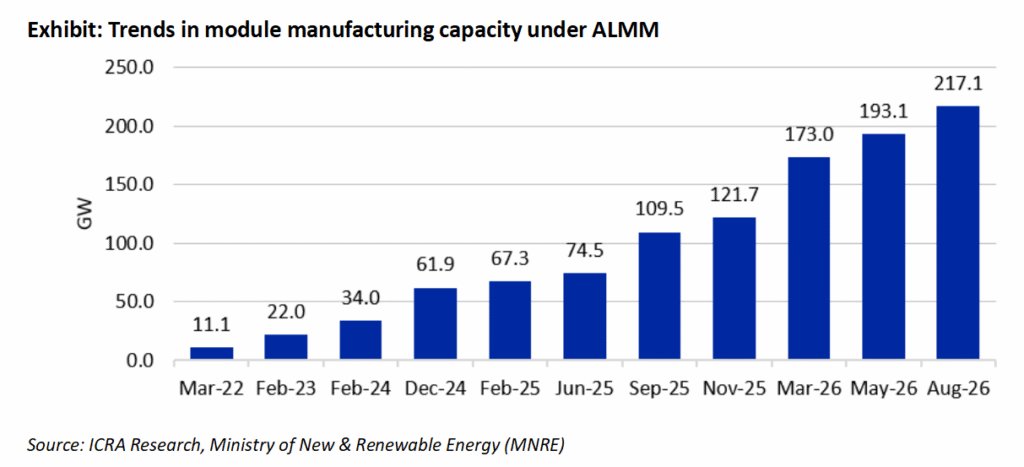
The country’s installed solar photovoltaic (PV) module manufacturing capacity reached 217 gigawatts (GW) in August 2026, up from less than 20 GW in 2022. India’s projected annual solar capacity installation, however, is only 55 to 60 gigawatt direct current (GWdc).
India’s aggressive campaign to build an independent, domestic solar supply chain has been powered in part by the Ministry of New and Renewable Energy’s (MNRE) Approved List of Models and Manufacturers (ALMM). First introduced in 2019 to protect domestic factories from cheap imports, primarily from China, the administrative trade barrier has undergone multiple delays and revisions before being strictly enforced.

ALMM effectively blocks the use of unlisted foreign modules in government-backed and net-metered projects. While the policy has catalyzed a massive expansion in domestic manufacturing capacity, it has also contributed to severe local oversupply, raised capital costs for green-energy projects, and threatened to push consumer electricity tariffs higher.
Global trade friction has added to the imbalance. Uncertainty around U.S. tariff measures and anti-dumping duties on solar imports from Southeast Asia has forced Indian manufacturers to divert modules originally intended for export back into the domestic market.
Smaller, “pure-play” module assemblers are particularly vulnerable as the sector moves toward consolidation. Many operate older production lines based on Polycrystalline and MonoPERC (Monocrystalline Passivated Transmitter and Rear Cell) technologies, while demand has shifted rapidly toward Tunnel Oxide Passivated Contact (TOPCon) and Heterojunction (HJT) modules. The industry’s actual operational capacity therefore remains significantly below its nominal installed capacity.
For developers, localized sourcing is proving expensive. Using imported solar PV cells, domestic manufacturers can produce modules at a landed cost of 13 to 15 cents per watt. The government’s extension of ALMM mandates to solar cells starting in June 2026 is increasingly pushing developers toward domestically manufactured cells.
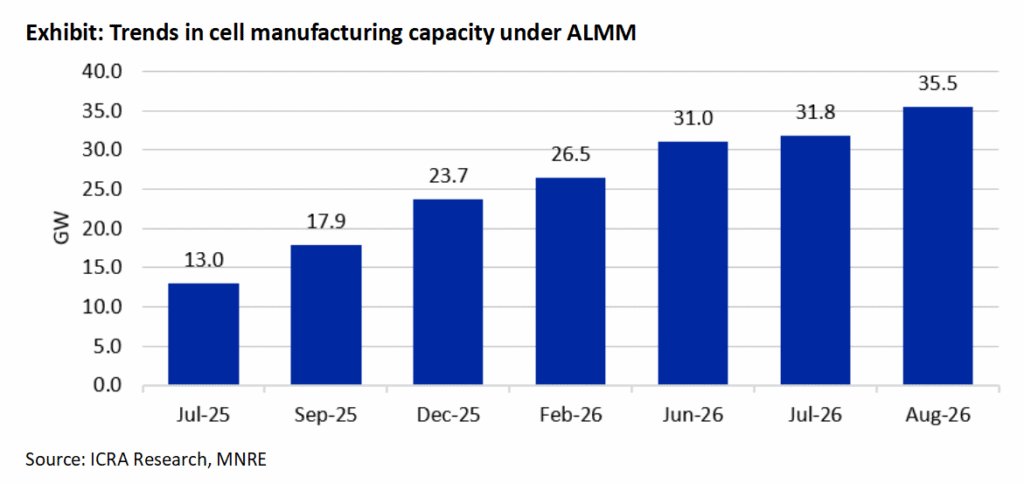
India’s solar cell manufacturing capacity rose from 13 GW in July 2025 to 35 GW by August 2026, with industry projections pointing to 100 GW by December 2027. Domestic cell manufacturers currently enjoy healthy profit margins because local supply is limited, although those margins are expected to moderate over the medium term as additional production lines come online and achieve economies of scale.
Because cell manufacturing in India lacks the scale of global competitors, modules built with Indian-made cells carry a landed cost of between 21 and 23 cents per watt. The premium is projected to raise the overall capital expenditure (capex) of setting up a solar power plant by 15% to 17%, a development that analysts warn will inevitably drive up solar power tariffs in future auction rounds.
The move from module assembly to cell fabrication also brings a sharp increase in investment requirements. Module assembly is relatively low-tech and requires capital investments of only INR 80 crore to INR 90 crore ($9.6 million to $10.8 million) per gigawatt. Cell manufacturing is highly capital-intensive, requiring INR 400 crore to INR 500 crore ($48 million to $60 million) per gigawatt.
India also remains heavily dependent on foreign equipment, primarily from China, to build cell factories. Geopolitical tensions and supply-chain bottlenecks affecting specialized machinery, along with the technical challenges of stabilizing a plant after commissioning, threaten to delay planned cell-capacity expansions.
The manufacturing difficulties become greater farther upstream, where production includes silicon ingots, wafers, and polysilicon. These stages are more complex and energy-intensive and require advanced process know-how that Indian firms have struggled to acquire.
To force development in this part of the supply chain, the MNRE has proposed extending the ALMM mandate to solar wafers starting in June 2028. Under the proposal, module and cell makers would have to source wafers from approved domestic suppliers that also possess equivalent ingot manufacturing capacity.
The government has set a safeguard for the policy: wafer ALMM will not be enforced until India has at least three operational wafer-manufacturing facilities with a combined annual capacity of 15 GW. Progress is currently lagging. Only one domestic manufacturer has completed an ingot and wafer facility, with a modest capacity of 2 GW.
Major conglomerates have announced plans for fully integrated gigafactories, supported in part by the government’s Production Linked Incentive (PLI) scheme, which has allocated billions of rupees to high-efficiency solar PV manufacturing. Without the immediate protection of trade barriers such as ALMM, however, domestically produced wafers and polysilicon remain uncompetitive against cheap Chinese imports because of high capital and operational costs.
Experts note that long-term success will belong primarily to heavily capitalized, vertically integrated giants capable of controlling the entire supply chain from polysilicon to finished module.
India has set a target of reaching 500 GW of non-fossil fuel electricity capacity by 2030, a goal announced by Prime Minister Narendra Modi at the COP26 climate summit. As of August 2026, the country’s combined renewable energy and large hydro-based power generation capacity stood at 296 GW.
That combined capacity has recorded a compound annual growth rate (CAGR) of approximately 12% since March 2014, when India’s clean-energy push began in earnest. Renewable and hydro sources now account for roughly 53% of the country’s total power-generating capacity.
Whether India can sustain its momentum toward its 2030 climate goals will depend on how effectively it balances its desire for industrial self-reliance with the immediate economic realities of solar project development.






One Comment