India’s Solar Module Capacity Hits 261.7 GW, but Cell Shortage Delays Projects
Imports and U.S. export demand add pressure as procurement rules restrict eligible supply.
India’s solar module manufacturing capacity reached 261.7 gigawatts (GW) by June 2026, but domestic solar cell capacity stood at just 36.6 GW, according to research firm Mercom India’s “State of Solar PV Manufacturing in India 1H 2026” report. The shortage is raising costs for local projects and causing developers to delay or pause construction, even as module makers added 50.6 GW of capacity in the first half of the year.
The imbalance leaves factories dependent on imported cells. India’s imports of solar cells and modules rose 18% in the first half of 2026 from the same period in 2025. Cells accounted for 81% of those imports, compared with 19% for finished modules. Much of the imported cell supply comes from China and Southeast Asia and is assembled into modules in India.
Government procurement rules have intensified the squeeze. Under the Ministry of New and Renewable Energy’s Approved List of Models and Manufacturers (ALMM), projects that receive government subsidies or sell power to state utilities may use only modules and cells from approved manufacturers. The framework is intended to build a self-reliant supply chain and reduce dependence on Chinese imports.


By the first half of 2026, cumulative module capacity on ALMM List-I had reached 225.5 GW, while cell capacity on ALMM List-II was roughly 35.5 GW. Demand for eligible domestic cells has outstripped commercial supply, lifting prices for compliant modules. New cell lines also need several months of calibration and testing before producing stable, commercial-grade output, leaving less usable supply than installed-capacity figures suggest and making it difficult for module manufacturers to maintain consistent production schedules.
Export demand is competing with Indian projects for modules. The United States took 92% of India’s solar exports in the first half of 2026, as Indian manufacturers prioritized higher-margin overseas sales. U.S. developers have turned to Indian suppliers amid domestic content incentives under the Inflation Reduction Act (IRA) and rigorous enforcement of the Uyghur Forced Labor Prevention Act (UFLPA) against Chinese imports. Much of India’s high-quality module output is consequently shipped abroad rather than supplied to local projects.
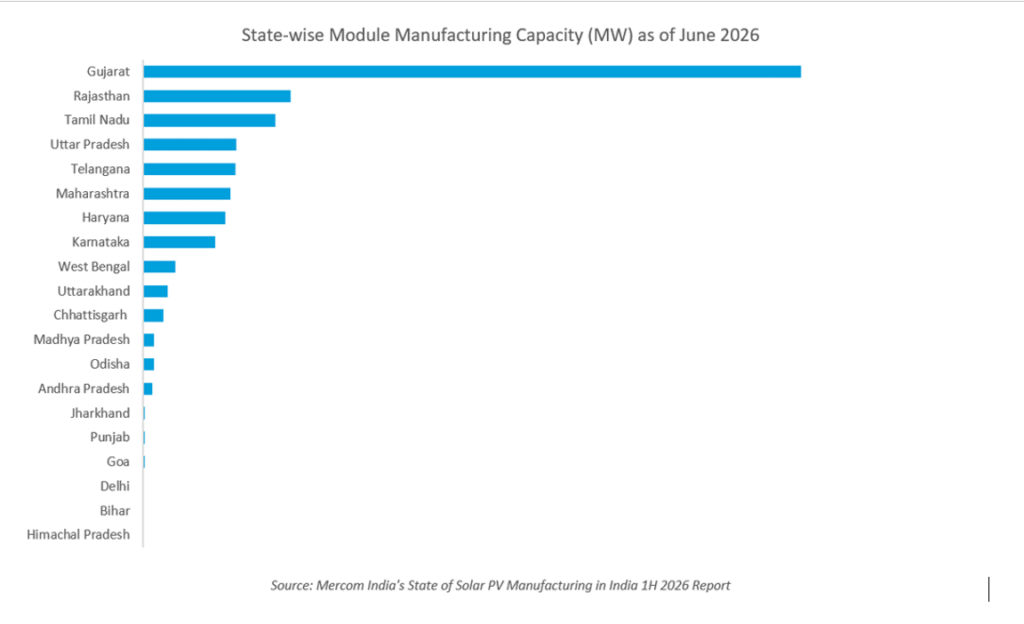
The manufacturing base is concentrated in Gujarat, which held nearly 45% of India’s cumulative module capacity as of June 2026. Favorable state industrial policies, cheap land allocation and port infrastructure supporting exports to the U.S. and Europe have made it the country’s primary hub. Rajasthan had 26.1 GW of module capacity, followed by Tamil Nadu with 23.4 GW.
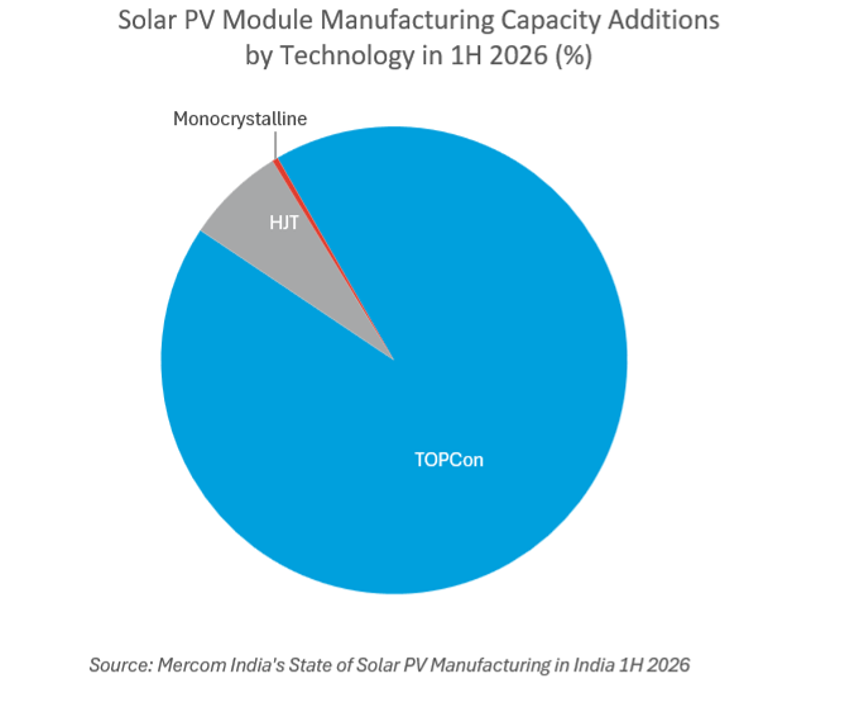
Manufacturers have also shifted toward higher-efficiency products. Tunnel Oxide Passivated Contact (TOPCon) technology made up 80% of ALMM-listed module capacity as of June 2026, followed by monocrystalline PERC/TOPCon hybrid lines at 11%. Legacy mono PERC accounted for 4%, Heterojunction (HJT) for 3% and thin-film technology for 2%. The move away from standard mono PERC reflects manufacturers’ pursuit of higher conversion efficiencies and better performance in high-temperature, utility-scale installations.
India’s multi-billion-dollar Production Linked Incentive (PLI) scheme aims to encourage vertically integrated factories spanning raw polysilicon processing, wafers, cells and modules. Assembly has nevertheless expanded much faster than cell fabrication, leaving the industry exposed to supply-chain friction until domestic cell output reaches commercial scale and catches up with module production. Gujarat held 37% of national annual cell capacity; among the other leading states, Tamil Nadu had 4.3 GW and Telangana 4.2 GW.