Flock Safety ALPR Abuse Exposes Gaps in Police Surveillance Oversight
Unauthorized federal queries, stalking cases, and pending Supreme Court precedent expose structural gaps in national license plate reader oversight.
A Texas sheriff’s deputy searching for a woman who self-managed an abortion triggered queries across more than 83,000 cameras nationwide in May 2025. The logged reason read: “had an abortion, search for female.” The sweep reached Illinois, where state law explicitly prohibits sharing license plate data to enforce another state’s abortion ban. No judicial review was required.
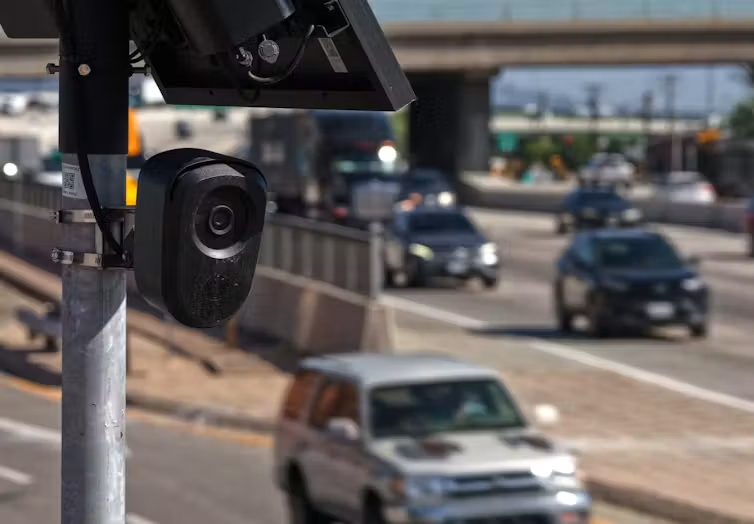
That single query illustrates the operational reality of automated license plate readers operated by Flock Safety. What local municipalities purchase as traffic or property-crime tools function as a cross-jurisdictional surveillance network accessible to authorized users without independent oversight, warrants, or technical barriers preventing searches tied to constitutionally protected activities.
Flock Safety supplies camera hardware and software to thousands of police departments, homeowners associations, and private businesses. The company reported more than 140,000 monthly users. By default, participating agencies share their camera feeds into a broader searchable database unless they manually opt out. A department that leaves sharing enabled often cannot see which outside agencies are querying its local footage.


This architecture allowed U.S. Customs and Border Protection to access more than 80,000 cameras during an undisclosed nationwide vehicle-tracking pilot in 2025. At least one police department had its cameras queried by federal agents without its knowledge. Public records from Danville, Illinois, documented over 4,000 searches by federal agencies, including queries with potential immigration-enforcement targets, despite U.S. Immigration and Customs Enforcement holding no direct contract with Flock. A separate 2026 analysis found 11,935 immigration-related searches within partial records from just eight college police departments, some conducted by federal agents unknown to campus officials.
The scale of data collection extends far beyond alphanumeric plate characters. In September 2026, Wired and 404 Media analyzed logs copied by hackers from a single Flock camera over 21 days. The cache contained roughly 50,200 vehicles and 1.6 million images. The onboard software detected people and bicycles, isolating specific visual details such as an American flag patch on a motorcyclist’s saddlebag. Flock stated it lacked sufficient information to assess the hackers’ claims regarding security vulnerabilities. This capability directly challenges legal arguments treating ALPRs strictly as vehicle-tracking tools rather than person-surveillance systems.
Authorized users have repeatedly leveraged this reach for personal purposes. Braselton, Georgia, Police Chief Michael Steffman searched the license plates of his ex-girlfriend and her teenage daughter approximately 600 times. Investigations by The Washington Post identified at least 100 police department employees charged with or accused of misusing ALPR systems, including at least 50 officers specifically accused of misusing the technology and 26 who used Flock cameras to track current or former romantic partners. None of these incidents required stolen credentials or hacking; every user accessed the system through standard login procedures.
Internal audit logs record these queries but do not prevent them. Indianapolis police did not routinely review Flock search logs until reporters flagged thousands of questionable inquiries made by a single officer. A subsequent systemwide audit revealed alleged misuse by four additional officers. Multiple departments nationwide first learned of internal abuses through media inquiries rather than automated alerts or supervisory reviews.
Courts remain divided on how Fourth Amendment protections apply to aggregated ALPR data. In October 2025, a Virginia appeals court ruled that retrieving three images spanning seven minutes from Norfolk’s 172-camera network required no warrant because the system photographed vehicles rather than people. A federal judge upheld the Norfolk network in January 2026, reasoning that photographing two plaintiffs’ vehicles 475 and 325 times over four and a half months did not capture their entire movements. That ruling is under appeal.
These lower-court decisions predate the Supreme Court’s June 2026 ruling in Chatrie v. United States. The high court held that police conduct a Fourth Amendment search when obtaining stored location history, returning the case to determine whether the specific warrant satisfied constitutional requirements. While Chatrie distinguished vehicles exposed to public view from cellular data tracking individuals into private spaces, the justices expressed explicit concern about comprehensive digital archives enabling retroactive searches. The 2018 Carpenter v. United States decision previously established that acquiring seven days of historical cellphone location records generally requires a warrant. Flock’s national database can reconstruct a driver’s past movements across jurisdictions without any judicial authorization.
Flock implemented policy changes in August 2026, shortening its recommended data retention window from 30 days to seven and requiring users to enter case codes and misuse detection flags to document searches. Customers retain the ability to store data longer. Emergency exceptions bypass case code requirements, and entering a case number does not require judicial approval or verification.
Marion County Prosecutor Ryan Mears noted that proposed internal guardrails would not have prevented the documented misconduct in Indianapolis, pointing instead to the necessity of independent or judicial oversight. Legal scholars, including Arizona State University criminology professor Henry F. Fradella, have outlined structural reforms: requiring probable-cause warrants for retrospective regional searches, implementing technical blocks against reproductive-health and immigration queries, mandating short deletion windows, shifting interstate data sharing to an opt-in model, and establishing independent audits of search logs and device security.
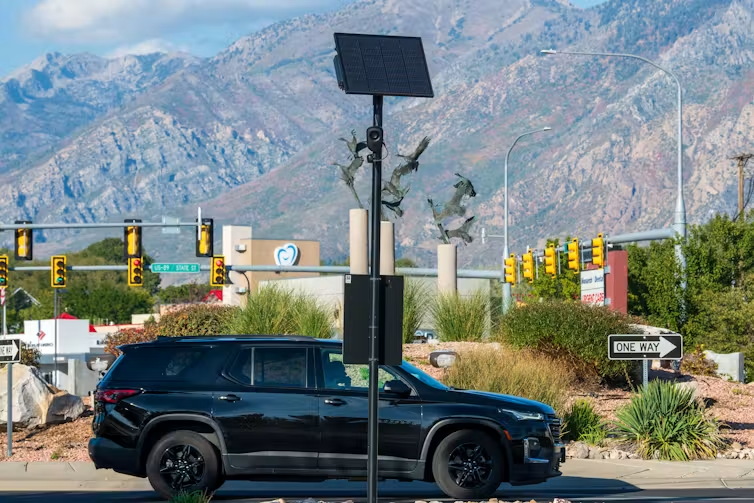
As of late September 2026, solar-powered Flock units continue expanding into new jurisdictions, including installations monitored in American Fork, Utah, while the appellate challenge to the Norfolk network remains pending.