

Scenic Eclipse II Proves Small Cruise Ships Can Handle Rough Seas
Polar Class 6 engineering and oversized stabilizers allow the 228-passenger discovery yacht to navigate 20-foot Atlantic swells without disrupting onboard service.
The cruise industry has long operated on a simple physics equation: bigger ships mean smoother rides. Megaships carrying 5,000 or more passengers rely on sheer mass to plow through ocean swells, while smaller vessels historically left travelers vulnerable to every shift in the weather. Scenic Eclipse II is dismantling that assumption.
During a recent 12-night transit from Norway to Portugal, the 228-passenger discovery yacht encountered 20-foot gales in the North Sea. Rather than shuddering through the crossing, the vessel remained virtually motionless inside passenger cabins—a performance rooted in engineering specifications originally designed for polar ice navigation rather than European coastal cruising.
The stability comes from a combination of Polar Class 6 hull reinforcement and custom zero-speed fin stabilizers roughly 50% larger than standard maritime installations. While most cruise ship stabilizers only deploy while the vessel is underway, zero-speed systems actively counteract roll even when the ship is anchored or drifting. This technology was initially developed for offshore oil supply vessels and naval ships operating in extreme conditions before migrating to the luxury expedition market over the past decade.

Polar Class 6 certification, governed by the International Association of Classification Societies, dictates specific structural requirements for operating in medium first-year ice. For Scenic Luxury Cruises & Tours, which deploys both Scenic Eclipse and Scenic Eclipse II to Antarctica and the Arctic, this classification is operational necessity. But it yields secondary benefits on temperate routes, turning heavy Atlantic storms into minor inconveniences.
This engineering-first philosophy defines the broader ultra-luxury expedition sector, which has expanded rapidly since the original Scenic Eclipse debuted in 2019. Competitors such as Seabourn Venture, Swan Hellenic’s SH Vega, and Ponant’s Le Commandant Charcot have similarly prioritized ice-class hulls and advanced stabilization over the resort-style amenities found on mainstream lines. The target demographic—travelers willing to pay premium fares for access to remote geography without sacrificing comfort—has driven a wave of newbuilds specifically designed to bridge the gap between research-grade capability and five-star hospitality.
Aboard Scenic Eclipse II, that balance manifests in hardware rarely seen outside military or specialized commercial fleets. Two six-seat Airbus helicopters operate directly from custom upper-deck hangars. Unlike shore-based sightseeing flights that require ground transfers and fixed schedules, these aircraft launch and recover while the yacht is moving. During the European itinerary, flights over Spain’s Ría de Arousa allowed guests to survey Galicia’s granite coastline and mussel farming operations before landing back on the ship’s helipad mid-transit. The vessel also carries a submersible, typically deployed during Antarctic sailings for underwater exploration.
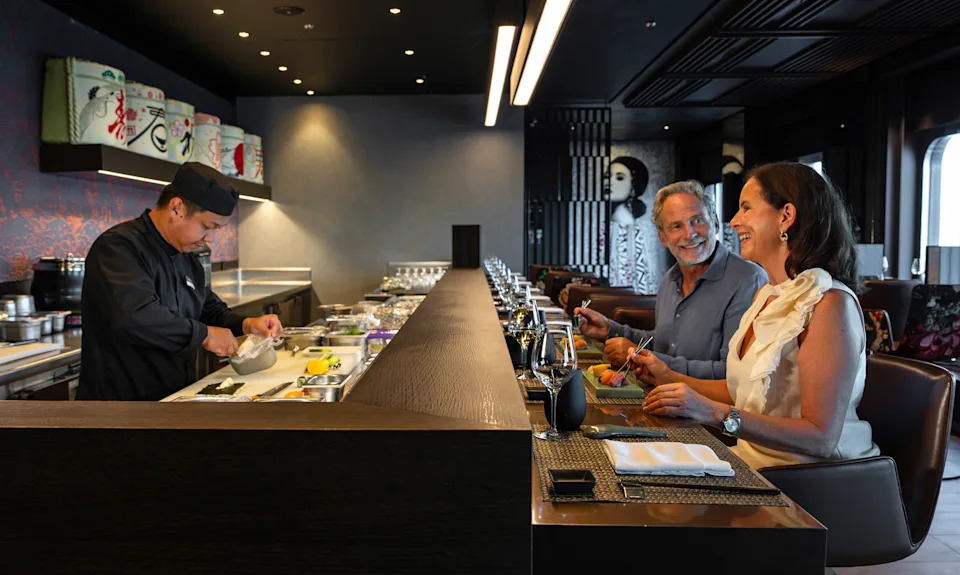
The small passenger capacity fundamentally alters provisioning logistics. Mainstream cruise lines feeding thousands daily must rely on massive, standardized supply chains loaded at major hub ports. A 228-guest vessel can source perishable ingredients locally at smaller stops. When the ship docked in Normandy, the culinary team procured regional Camembert, Livarot, and Pont-l’Évêque cheeses directly from French markets for same-day service across its 10 dining venues, including Lumière and Koko’s.
Beverage programs follow the same unrestricted model. Because Scenic operates on a genuinely all-inclusive fare structure, the main lounge stocks over 150 whiskey varieties alongside an extensive wine list without the per-drink billing or tiered beverage packages common across the wider industry. An invite-only Chef’s Table offers multi-course tasting menus paired with specific vintages, functioning closer to a Michelin-caliber restaurant than a traditional cruise dining room.
Accommodations are uniformly configured as all-veranda suites, eliminating the interior cabin categories that dominate larger fleet economics. Suite hardware includes electronically adjustable king-size beds controlled via bedside remotes—a feature borrowed from high-end medical and residential furniture design to accommodate reading, resting, or viewing passing coastlines at customized angles. Butler service is assigned across every suite category rather than reserved for top-tier bookings.
The nearly one-to-one guest-to-crew ratio enables operational flexibility impossible on larger ships. Crew members manage personalized service routines without the theatrical formality often associated with luxury hospitality. The Senses Spa thermal area, encompassing infrared saunas, traditional Finnish saunas, and aromatic steam rooms, remains open to all guests without requiring spa treatment purchases or day passes—a direct contrast to the paywalled thermal suites standard on most contemporary cruise ships.
Scenic Eclipse II continues operating seasonal itineraries, transitioning between polar expeditions and coastal voyages based on the hemisphere’s summer months.









