US Army Selects Ballistic-Protected Humanoid Robot Alex Among Five Winners in Military xTechHumanoid Competition
Developed by the Florida Institute for Human and Machine Cognition, the 29-joint platform uses custom quasi-direct drive actuators and features integrated ballistic armor for combat operations.
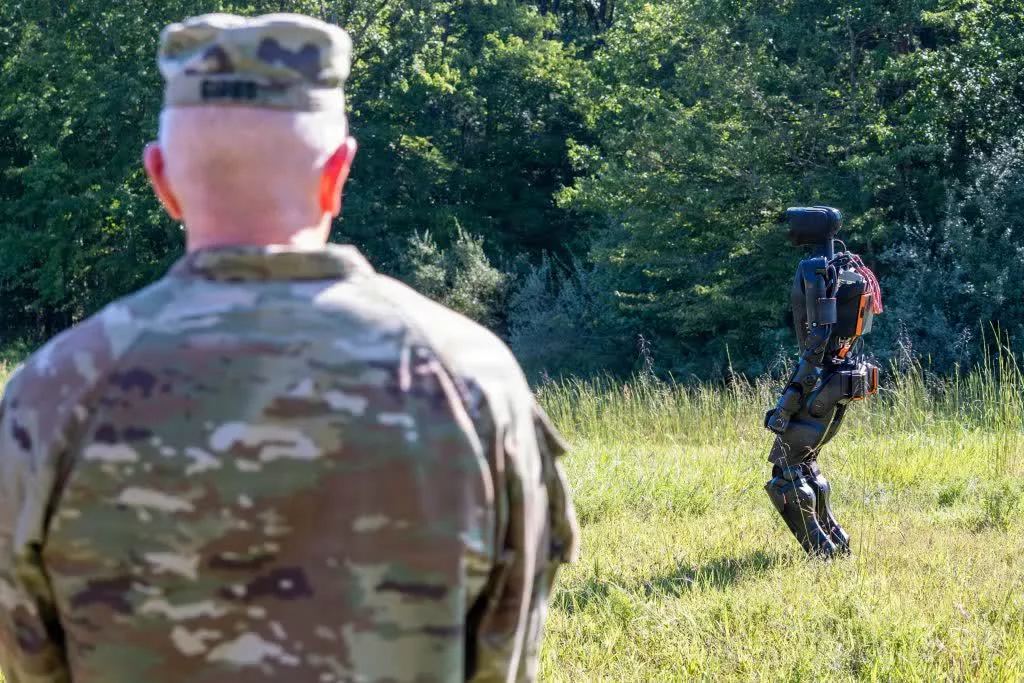
A humanoid robot engineered with ballistic armor and a hybrid control system combining artificial intelligence with human oversight has secured one of five top spots in a U.S. Army competition designed to fast-track commercial technology for battlefield deployment.
The machine, named Alex, was developed by the Florida Institute for Human and Machine Cognition, a non-profit research organization. Unlike many commercial humanoid platforms built primarily for warehouse logistics or controlled laboratory environments, Alex was designed from the ground up for physical resilience and unpredictable terrain. Its frame incorporates 29 joints, providing a range of motion intended to navigate obstacles that would stall wheeled or tracked vehicles.
Movement is driven entirely by custom quasi-direct drive actuators. These highly backdriveable motors allow the robot to absorb impacts and execute natural motions without relying on the rigid, gear-heavy transmissions common in older industrial robotics. This mechanical compliance means the limbs can yield when struck rather than shatter, a critical requirement for operating in combat zones where debris, falls, and kinetic impacts are constant threats.


The Army selected Alex through xTechHumanoid, a prize competition run under the broader FUZE xTech program. The initiative bypasses traditional defense procurement timelines, which frequently stretch across years of studies and requirements drafting before any hardware reaches soldiers. Instead, the program surveys existing commercial and dual-use technologies, evaluating them against immediate operational gaps.
Out of 103 submitted proposals, military leaders and technical experts narrowed the field to five winners. Beyond the complete Alex platform, the Army funded two distinct power systems, fingertip tactile sensors capable of detecting minute pressure variations, and specialized software architectures. Together, these selections represent an effort to build a modular supply chain for humanoid components rather than relying on a single integrated manufacturer.
This push operates under the Humanoid Community of Collaboration, a Joint Force organization established in 2023 to coordinate development across the Department of Defense. The HCoC serves as the central node ensuring that different military branches do not duplicate research or develop incompatible robotic standards.
“Humanoid robots are part of a broader autonomy push to increase the depth and breadth of robotic platforms and components industry can provide for a range of missions,” said Dr. Alex Miller, U.S. Army Chief Technology Officer. He characterized the xTech model as a deliberate strategy to identify mission needs and equip formations quickly, avoiding the delays inherent in conventional acquisition pipelines.
The integration of bipedal machines into military doctrine represents a distinct shift from the current generation of battlefield automation. Over the past decade, armed forces have heavily invested in unmanned aerial systems, autonomous naval vessels, and remote-controlled turrets. However, those platforms struggle in environments built for human bodies—urban rubble, dense forests, trench networks, and the interiors of buildings. Bipedal robots theoretically bridge that gap, offering the ability to use standard infantry tools, open doors, and climb stairs while removing personnel from direct fire.
Washington is not pursuing this capability in isolation. Beijing has significantly accelerated its own military robotics programs. A recent review of more than 100 Chinese military procurement notices, academic studies, patents, and defense-company materials revealed extensive state-backed planning for the wartime deployment of humanoid units. China’s approach heavily leverages its dominant position in commercial electric vehicle and battery manufacturing, repurposing civilian supply chains for defense applications.
For the U.S. Army, competitions like xTechHumanoid attempt to counter that industrial advantage by tapping directly into American university labs and agile startups before larger defense primes lock down the sector.
The five winning projects will now transition from evaluation into accelerated development phases aligned with specific Army mission profiles. The exact timeline for deploying Alex or its component technologies to active units remains classified, though the selection marks the first formal step toward integrating armored bipedal platforms into U.S. ground force structures.