Tongwei TNC 2.0 FULLX G12R-48 Solar Module Targets Rooftop Efficiency With 490W Output and Low-Light Gains
The 48-cell panel generates up to 12.32% more power during peak-rate morning and evening hours compared to back-contact alternatives.
Rooftop solar installers navigating tight spaces, suboptimal roof angles, and European time-of-use electricity tariffs face a new hardware option as Tongwei Solar releases the TNC 2.0 FULLX G12R-48. The 48-cell photovoltaic module targets distributed generation systems where maximizing energy yield per square meter dictates project economics.
The module measures 1762 by 1134 by 30 millimeters, aligning with standardized residential and commercial mounting hardware already deployed across global supply chains. Standardizing dimensions allows installers to integrate the panel into existing racking ecosystems without custom fabrication. Built on Tongwei’s proprietary TNC cell architecture—a specific evolution of tunnel oxide passivated contact (TOPCon) technology—the unit produces up to 490 watts at 24.5% conversion efficiency.
That power density translates directly into spatial economics. Against conventional TOPCon panels currently saturating the market, the G12R-48 delivers an additional 30 watts per module. For a standard 12-panel residential array, this differential permits higher total installed capacity on the same roof footprint, a critical variable for properties constrained by dormers, HVAC equipment, or shading obstacles.


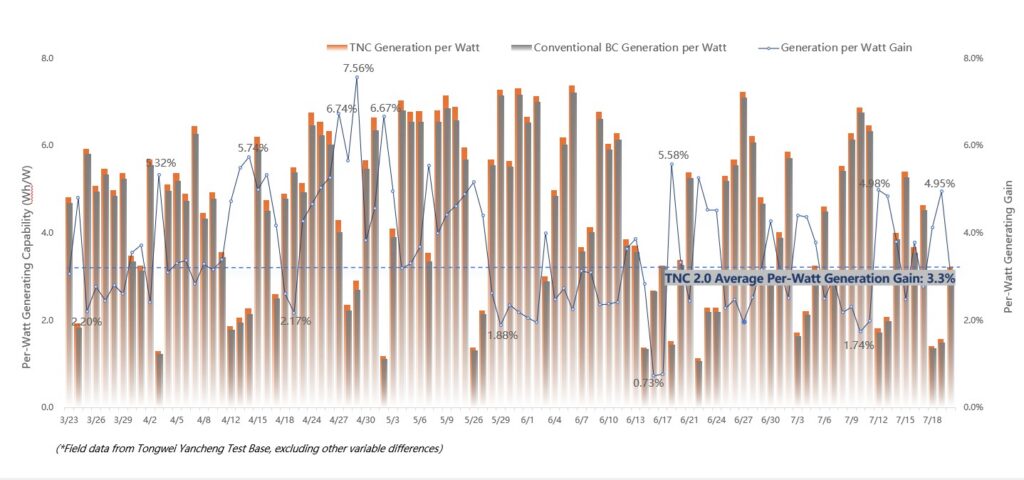
Energy yield under low irradiance separates the TNC platform from competing back-contact (BC) cell architectures. Field data recorded at Tongwei’s Yancheng test facility demonstrated a 3.3% advantage in per-watt daily generation over BC modules, accumulating 447.56 equivalent full-load hours against 433.27 hours for the BC baseline. This performance gap widens substantially during early morning and late afternoon periods, where generation gains peak at 12.32%. For commercial operators and residential users subject to time-of-use pricing—common across Germany, Spain, and parts of the U.S.—harvesting power when grid electricity rates are highest alters return-on-investment calculations. Under the tested parameters, this temporal advantage generated approximately €0.03 in additional daily revenue per system.
Beyond raw output, upfront capital expenditure remains a primary barrier for rooftop adoption. A typical 12-module configuration utilizing the TNC 2.0 FULLX G12R-48 reduces initial module investment by more than €400 compared to equivalent BC-based systems, lowering the levelized cost of energy before a single kilowatt-hour is produced.
Physical installation variables frequently degrade theoretical panel performance, particularly regarding roof tilt and orientation. Simulations modeled on German weather patterns revealed that BC modules suffer nearly 2.5 times more energy loss from non-ideal roof pitches under low-light conditions. At a fixed 40-degree tilt, BC cells lost between 3.53% and 3.72% of their low-light generation across various orientations, while the TNC architecture restricted losses to a narrow band of 1.02% to 1.11%. Tilt-related energy loss specifically dropped to 0.38% for the TNC module versus 0.96% for BC technology.
Soiling accumulation—dust, pollen, and particulate matter—further degrades rooftop arrays that lack automated cleaning infrastructure. The TNC cell design mitigates fractional power loss incrementally as environmental debris builds up. Compared to BC modules, power loss reduction reached 0.40 percentage points under light soiling, expanded to 0.73 percentage points under moderate accumulation, and hit 0.99 percentage points when heavily soiled. This resilience matters significantly in arid climates or agricultural zones where airborne particulates rapidly coat glass surfaces.
Aesthetic integration drives purchasing decisions in residential markets. The G12R-48 ships in both full-black and black-frame configurations, allowing architects and homeowners to match roofing materials without sacrificing the electrical advantages of passivated contact cells.
Tongwei Solar, headquartered in Chengdu, China, has aggressively expanded its international footprint over the past three years, transitioning from a dominant polysilicon supplier into a vertically integrated module manufacturer. The release of the TNC 2.0 series intensifies direct competition with established European and North American distributors currently sourcing BC and heterojunction (HJT) panels for premium rooftop projects.