

Why Wired USB Still Wins Where Every Millisecond Matters
The hardware limits behind every millisecond of input delay
Professional esports tournaments, competitive gaming arenas, and high-stakes digital audio production studios still require physical cables. The consumer electronics market has spent more than a decade moving toward a wireless-first ecosystem, but professional computing sectors continue to depend on wired USB connections because of strict physical, regulatory, and engineering constraints surrounding radio frequency transmission.
Input latency is the time between a physical keypress and the corresponding action appearing on screen. A delay of several milliseconds is nearly imperceptible when someone is typing an email or editing a spreadsheet. In competitive environments, however, human reaction times average between 150 and 250 milliseconds, so hardware-induced latency can determine the outcome of a match.
Polling rates establish one of the first performance differences between wired and wireless input devices. Measured in Hertz (Hz), polling rate indicates how frequently a peripheral reports its status to the host computer’s operating system. A standard office keyboard typically polls at 125Hz, communicating once every 8 milliseconds.



High-performance wired keyboards designed for gaming or professional music production commonly operate at 1,000Hz, producing a 1 millisecond response time. Elite models with advanced USB controllers can reach 8,000Hz, or a 0.125 millisecond response time.
Bluetooth connections face different constraints because of the protocols used to transmit data over the air. Bluetooth is a universal standard managed by the Bluetooth Special Interest Group (SIG), and its Human Interface Device (HID) profile connects peripherals.
Its polling rate is strictly throttled to conserve battery power and preserve compatibility across an infinite variety of host devices, from smartphones to smart televisions. Although Bluetooth can theoretically reach latency as low as 8 milliseconds, physical barriers and competing signals routinely push real-world delay beyond 200 milliseconds. Skipped inputs, sluggish cursor movement, and desynchronized audio can follow, making real-time tracking impossible under those conditions.
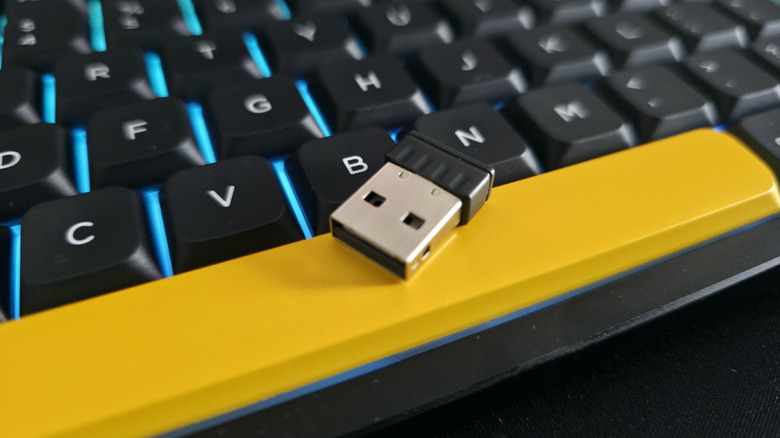
Manufacturers created proprietary 2.4GHz wireless transmission standards to bypass Bluetooth’s built-in performance limits. These systems operate on the unlicensed Industrial, Scientific, and Medical (ISM) radio band and need a dedicated USB transceiver, or dongle, for a point-to-point connection.
Unlike the unified Bluetooth protocol, 2.4GHz wireless protocols are developed independently by each manufacturer. That customization lets brands optimize wireless data-packet structures for raw speed instead of universal compatibility. High-end proprietary wireless technologies can reach a 1,000Hz polling rate, reducing wireless latency to approximately 1 millisecond, functionally identical to a standard wired connection.
The same 2.4GHz spectrum is shared by consumer Wi-Fi routers using 802.11b/g/n, baby monitors, microwave ovens, and Bluetooth devices. This congestion creates the risk of packet loss and signal degradation. A separate bottleneck can come from nearby hardware: engineering whitepapers published by Intel state that USB 3.0 (SuperSpeed USB) connectors and cables emit broadband radio frequency noise directly within the 2.4GHz to 2.5GHz range.
If a wireless dongle is plugged directly beside an active USB 3.0 port or external storage device, that electrical noise can reduce the receiver’s signal-to-noise ratio. Dropped keystrokes, connection stuttering, and sudden latency spikes may result. Physical obstacles can have a similar effect; the metal chassis of a desktop computer with ports on its rear panel can degrade the signal unless a direct line of sight is maintained.
The transmission medium is not the only variable in input latency. Switch mechanics also determine how quickly an input becomes an action. Traditional mechanical keyboards use physical leaf-spring copper contacts, and when a key is pressed, those metal contacts collide.
The collision creates a phenomenon called “chatter,” in which the contacts rapidly bounce against each other before settling. Hardware microcontrollers therefore apply a software delay known as a “debounce filter” so the computer does not interpret microscopic bounces as multiple rapid keypresses. This debounce algorithm typically adds between 1 and 15 milliseconds of artificial delay to the signal path.
Advanced keyboard manufacturers have increasingly adopted magnetic Hall effect switches to remove that bottleneck. Rather than using physical electrical contacts, these switches combine a permanent magnet with a sensor that measures magnetic-field strength. The keyboard can consequently determine the key’s exact travel distance in real time.
With no colliding metal contacts, Hall effect switches bypass the debounce filter entirely and enable instantaneous key activation and resetting, often called “rapid trigger” technology. When combined with a dedicated, high-polling-rate wired USB connection, they provide instantaneous feedback that wireless alternatives cannot guarantee in environments where RF interference is present.









