

Why CPU Overclocking Faded: Dynamic Silicon Boosts Take Over
Factory algorithms and tighter silicon binning leave little manual headroom for PC builders

For decades, custom PC builders treated manual clock speed tuning as a rite of passage. Modifying base multipliers and feeding extra voltage into a desktop processor could extract double-digit performance gains, frequently elevating mid-tier hardware into flagship territory. Today, that culture of competitive tweaking has largely evaporated from mainstream PC building.
Hardware manufacturers did not kill overclocking by locking users out; they killed it by automating the entire process. Contemporary desktop processors from AMD and Intel arrive engineered to extract virtually every ounce of performance straight out of the box, continuously adjusting their own frequencies based on millisecond-by-millisecond telemetry.
Past architectures relied on rigid factory frequency targets: a fixed base speed alongside an occasional single-core maximum boost. Achieving higher sustained speeds across multiple cores required entering the BIOS, manually adjusting voltages, and systematically testing stability under stress. Now, sophisticated algorithms run those calculations autonomously.


Motherboard vendors embed firmware toggles such as Multi-Core Enhancement and Enhanced Turbo, which bypass default power restrictions to lock processor cores to their peak boost limits. On the AMD side, Precision Boost Overdrive dynamically adjusts power draw, socket current, and multi-core frequencies whenever thermal headroom allows. Advanced users seeking fine-grained control now lean on PBO2 and its Curve Optimizer within the Ryzen Master utility to undervolt individual cores, securing higher sustained frequencies without brute-forcing extra voltage.
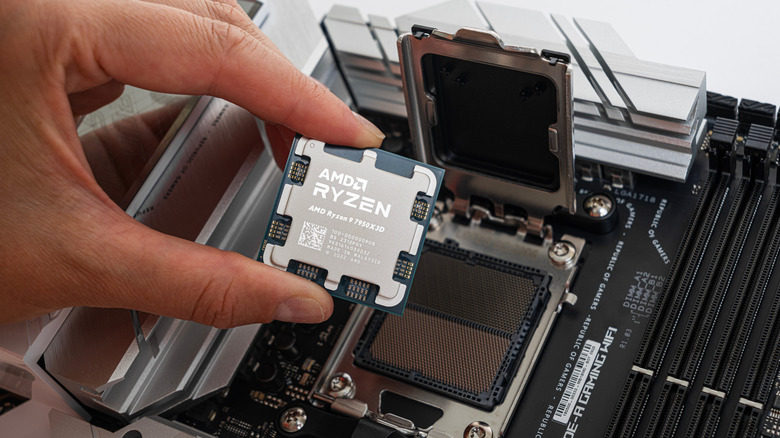
Underlying this shift is a fundamental transformation in semiconductor manufacturing. Decades ago, broad variance across fabrication lines forced chipmakers to set conservative clock speeds to ensure functional stability across the weakest production batches. Modern automated silicon binning and refined lithography nodes allow semiconductor designers to categorize silicon quality with extreme precision, leaving negligible untapped performance on the table.
Because processors already operate near their electrical thresholds, cooling has replaced clock multipliers as the primary performance bottleneck. Factory heatsinks demonstrate this limitation clearly: an entry-level AMD Wraith Stealth cooler paired with a Ryzen 7600 frequently reaches 85 to 90 degrees Celsius under heavy computational loads, eliminating the thermal leeway required for automatic boosting.
Resolving that bottleneck no longer requires exotic liquid nitrogen or custom cooling loops. Budget dual-tower air coolers such as the Thermalright Peerless Assassin 120 deliver high-efficiency heat dissipation for under $50, granting automated boost engines the lower temperatures needed to sustain top-tier frequencies.
That dynamic has redirected the enthusiast community toward undervolting and efficiency tuning rather than raw frequency increases. With modern architectures pulling substantial wattage under full load, computer hardware optimization has shifted from squeezing out marginal clock gains to dropping operating temperatures and reducing power consumption.









