

Why 120-Volt Outlets Fall Short for Larger EVs
When a household outlet can no longer keep up with an EV
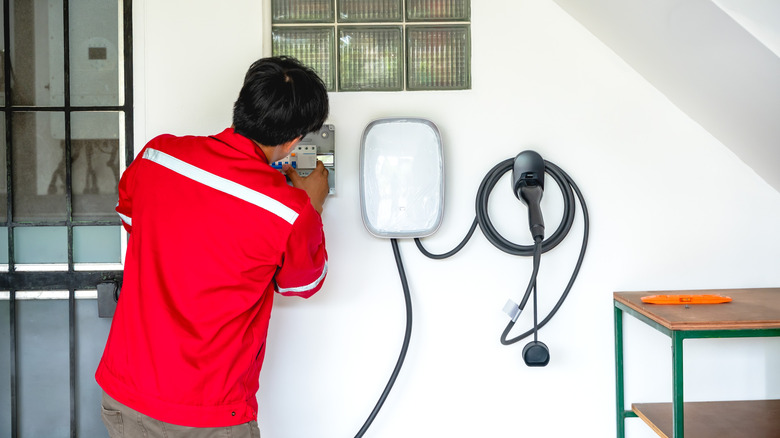
Standard household outlets remain practical for plug-in hybrid electric vehicles (PHEVs) and low-mileage commuter cars, but the expanding battery capacities of long-range battery electric vehicles (BEVs) are pushing more homeowners toward dedicated 240-volt Level 2 charging equipment.
In the United States and Canada, residential systems typically provide single-phase 120-volt AC power through 15-amp circuits. That produces a maximum output of approximately 1.8 kilowatts (kW). Under National Electrical Code (NEC) standards, vehicle charging is treated as a continuous electrical load and limited to 80 percent of a circuit’s rated capacity, leaving roughly 1.44 kW for the vehicle’s onboard charging system.
The effect depends heavily on daily driving. The U.S. Federal Highway Administration says the average American driver travels approximately 37 to 40 miles per day. Someone using less than 15 kWh each day—about 50 miles of travel—can recover that energy overnight through a standard 120-volt connection.


Smaller battery packs can also make low-rate charging workable. The Toyota Prius Prime has a 14-kilowatt-hour (kWh) battery and the Toyota RAV4 Prime has an 18 kWh pack; either can fully replenish its energy reserves from a standard outlet in under 10 hours. A compact city EV such as the 38 kWh Fiat 500e needs approximately 21 hours to charge from zero state of charge.
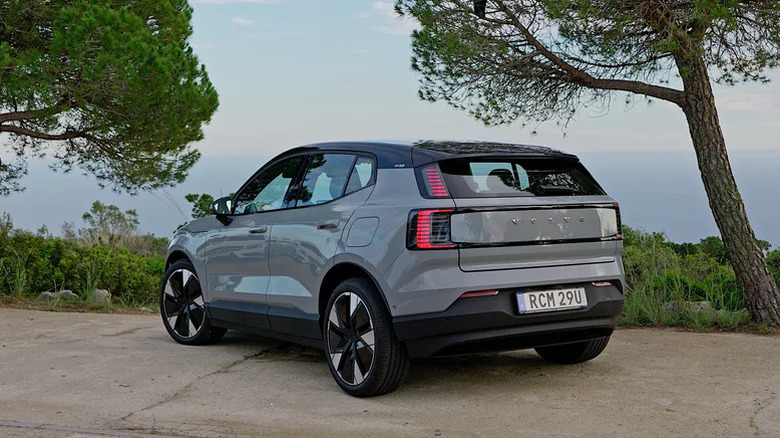
Longer commutes change that calculation. Using 40 percent of a Tesla Model 3 battery represents approximately 32 kWh, or about 100 miles of highway driving, and takes roughly 18 hours of continuous 120-volt charging to replace. Across successive workdays, the resulting deficit cannot be offset by a standard outlet.
Battery size also lengthens the time required for a full charge. The 69 kWh Volvo EX30 and 79 kWh Tesla Model 3 each need about 43 hours on standard household power. With its 155 kWh battery pack, the GMC Sierra EV can require as much as 86 hours—more than 3.5 consecutive days.
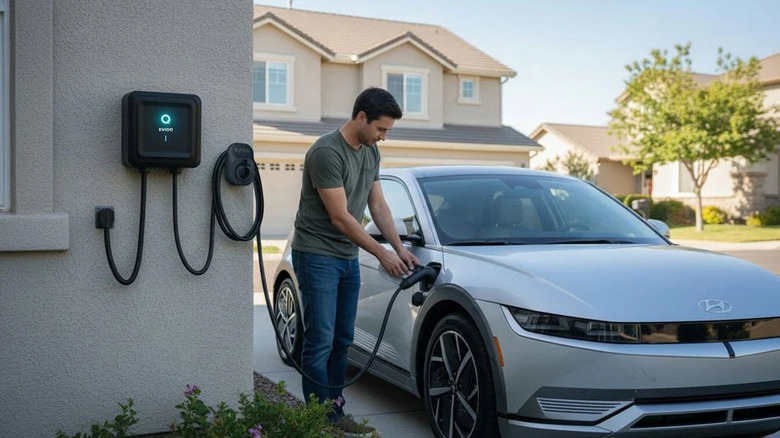
Level 2 equipment uses 240-volt AC circuits, doubling the system voltage and multiplying the available electrical current. Residential units generally provide between 3.3 kW and 11.5 kW, depending on circuit amperage.
An entry-level 16-amp, 240-volt unit supplies 3.5 kW, twice the charging speed of a 120-volt circuit. A 32-amp system produces 7.4 kW, a fourfold increase over a standard household outlet. At that rate, a Tesla Model 3 can charge from empty to full in approximately 11 hours, while the 155 kWh GMC Sierra EV needs roughly 22 hours.
High-output 48-amp Level 2 chargers use 60-amp dedicated breakers and deliver up to 11.5 kW of continuous AC power.
Whether a home can support that equipment depends on its electrical service. Modern houses with 200-amp main service panels typically have enough capacity for dedicated 40-amp or 50-amp Level 2 circuits. Older homes with 100-amp or 60-amp main breaker panels often need upgrades to handle the high continuous current draw.
Existing 240-volt receptacles can simplify the installation. Homes with NEMA 14-50 or NEMA 6-50 outlets—previously installed for electric clothes dryers, cooking ranges, or recreational vehicles—can use portable or plug-in Level 2 units without structural electrical modifications, subject to inspection by a certified electrician.
Hardware for a single vehicle generally costs $250 to $700, depending on amperage, cable length, and integrated smart software. Licensed electrician installation can add several hundred dollars to multiple thousand dollars, based on the distance between the main breaker panel and parking spot, conduit routing, and any panel-capacity upgrade.
Qualifying installations in designated non-urban or low-income census tracts may be eligible under federal tax law for the Alternative Fuel Vehicle Refueling Property Credit, IRS Section 30C. The credit covers 30 percent of hardware and installation costs, up to $1,000.
The vehicle’s onboard charger (OBC), the internal power-electronics assembly that converts incoming AC grid electricity into direct current (DC) for the high-voltage battery, determines the maximum Level 2 charging rate.
The Toyota Prius Prime is limited to 3.5 kW of AC input, while the Toyota RAV4 Prime accepts up to 7.0 kW. The Nissan Ariya, MG4, and Kia e-Niro each have onboard chargers capped at 7.4 kW AC input.
The Tesla Model 3 and Model Y can accept up to 11.0 kW of AC input on high-power Level 2 circuits.
Residential charger connections also vary. Non-Tesla EVs in North America traditionally use the 5-pin SAE J1772 connector for Level 1 and Level 2 AC power. Tesla vehicles and newer models using the North American Charging Standard, standardized as SAE J3400, use a unified 5-pin NACS interface for both AC charging and high-voltage DC fast charging.
Dedicated Level 2 EV Supply Equipment (EVSE) adds safety features beyond those found in basic household outlet connections. These units include integrated ground-fault circuit interrupter (GFCI) protection, Protective Earth Neutral (PEN) fault detection, direct current leakage detection, and continuous thermal monitoring.
Advanced units can also provide active load management, tracking real-time household energy consumption and dynamically adjusting charging current to prevent main panel overloads.
Residential electricity remains the primary cost-saving mechanism for EV adoption across North American energy markets. Based on national average utility rates, powering an EV at home costs approximately one-third as much as fueling an equivalent internal combustion engine vehicle with gasoline or diesel.
Utility time-of-use (TOU) plans allow owners to schedule Level 2 charging during off-peak overnight hours, when kilowatt-hour rates are lower, while avoiding public DC fast-charging networks with higher commercial energy tariffs.









