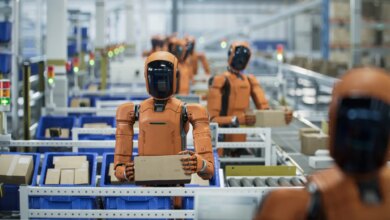
U.S. Robotics Gap With China Threatens Manufacturing Revival
Severe skilled labor shortages and Chinese industrial dominance force American factories to scale AI-driven automation

American manufacturers are turning down orders they cannot fill. Across shipbuilding, defense contracting, energy infrastructure and data center construction, companies report massive backlogs constrained not by demand but by an inability to staff production lines. The bottleneck is accelerating a shift toward industrial robotics, driven less by cost-cutting ambitions than by the mathematical impossibility of hiring enough skilled tradespeople to meet current needs.
The shortage is most acute in welding. The American Welding Society has projected a deficit of hundreds of thousands of professionals by the end of the decade as veteran welders retire faster than vocational programs can replace them. Simultaneously, the buildout of artificial intelligence data centers, naval expansion and grid modernization requires unprecedented volumes of precision metalwork. Heather Carroll, chief revenue officer at Ohio-based Path Robotics, said manufacturers routinely report having the order volume to run second or third shifts but lacking the personnel to execute them.
Rather than replacing human labor, emerging automation models reposition experienced workers as operators. A single certified welder can now oversee multiple autonomous robotic welding cells, handling complex custom joins while machines execute repetitive high-volume seams. This multiplier effect addresses immediate capacity constraints without requiring years of apprenticeship for every new hire.


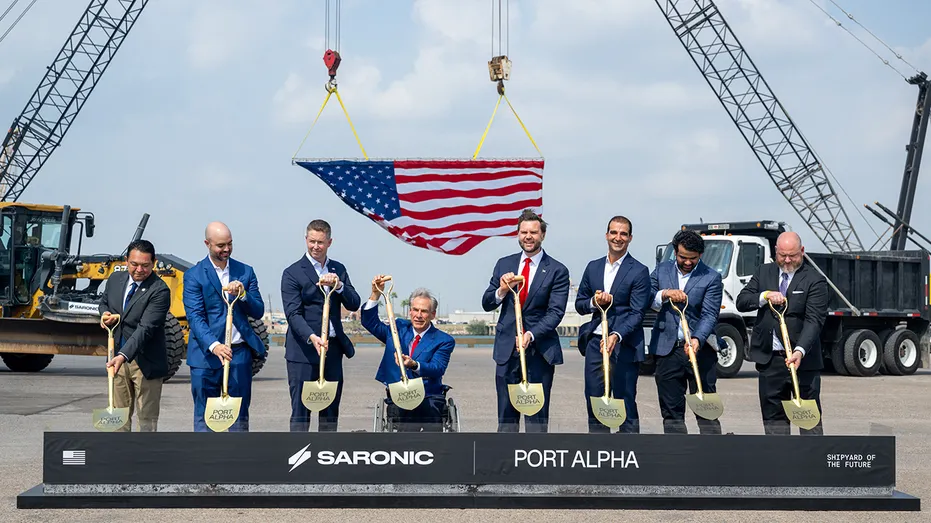
Saronic Technologies’ Port Alpha shipyard in Brownsville, Texas, illustrates how this model scales. The $3.2 billion facility, which broke ground last month with Vice President JD Vance in attendance, plans to employ 10,000 workers producing autonomous vessels for the U.S. Navy and commercial fleets. Integrating heavy automation from inception allows the shipyard to target production volumes that would be unattainable relying solely on traditional manual shipbuilding techniques in a region already competing for Gulf Coast industrial labor.
The urgency extends beyond domestic logistics into geopolitical competition. China’s industrial policy over the past decade systematically integrated government subsidies, state-directed financing and manufacturing mandates to flood its factories with automated systems. According to the International Federation of Robotics, China installs more industrial robots annually than the rest of the world combined, dominating sectors from electric vehicles to electronics assembly. Carroll noted that the United States lacks a comparable coordinated national strategy, creating a widening adoption gap that threatens broader efforts to reshore supply chains.
Domestic manufacturers attempting to automate face distinct structural barriers absent in China’s state-backed model. Mid-sized American firms often struggle to secure capital for multi-million-dollar robotic deployments. Uncertainty over long-term demand cycles makes executives hesitant to commit to fixed automation costs, and a parallel shortage of robotics integration technicians complicates installation.
Recent advances in machine learning are beginning to lower those technical barriers. Traditional industrial robots required extensive manual programming and rigid environmental controls to function. AI-driven systems utilizing computer vision and reinforcement learning can adapt to variable parts and unstructured environments dynamically. This reduces reliance on specialized robotics engineers, allowing standard factory technicians to deploy and maintain sophisticated hardware.
Federal procurement is increasingly reinforcing this transition. Defense contracts now routinely favor suppliers demonstrating advanced automated manufacturing capabilities, recognizing that production speed directly correlates with military readiness. Startups securing Pentagon backing signal a broader alignment between national security imperatives and industrial technology investment, pushing automation deeper into the defense supply chain.
The core challenge remains workforce adaptation. While automation eliminates certain repetitive manual tasks, it generates demand for robot operators, maintenance technicians and systems integrators. Vocational training infrastructure has lagged behind technological deployment, leaving many displaced workers without clear pathways into advanced manufacturing roles. Industry leaders emphasize that scaling robotics requires simultaneous investment in upskilling programs to ensure existing tradespeople transition into supervisory and technical positions rather than exiting the sector entirely.
Path Robotics continues expanding deployments across heavy industry clients in the Midwest and South, targeting facilities where manual welding capacity has physically capped revenue growth.