Tokenized Stocks Trade Mostly After Wall Street Closes
U.S. investors remain restricted from major platforms even as FASB weighs stablecoin accounting changes and Strive adds 3,311 BTC to its treasury.
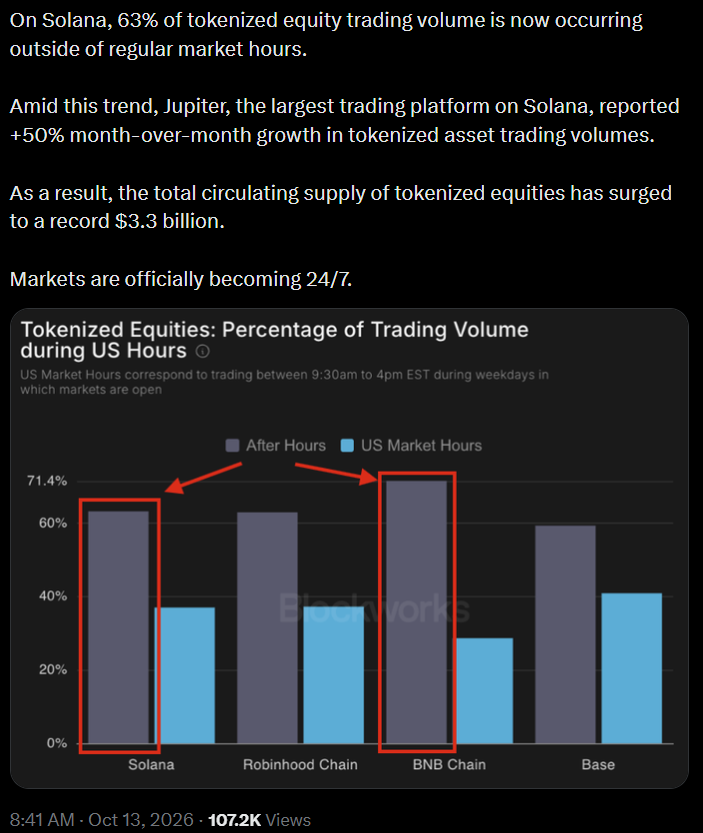
More than 70% of tokenized stock trading volume on BNB Chain now occurs outside the traditional 9:30 a.m. to 4 p.m. Eastern session, according to Blockworks data cited by The Kobeissi Letter. Solana and Base show similar patterns, with off-hours activity accounting for 63% and nearly 60% of volume, respectively.
The shift reflects demand from investors in Asia, Europe and other regions who previously had to wait for American exchanges to open or rely on less liquid derivative products to gain exposure to U.S. equities. Tokenized stocks represent fractional ownership of underlying shares held by a custodian, allowing blockchain-based settlement without altering the corporate structure of the issuing company.
Total value locked in tokenized equities has climbed 15% over the past 30 days to nearly $3.3 billion, according to RWA.xyz. Decentralized exchange aggregator Jupiter reported a 50% month-over-month increase in tokenized asset trading volume during the same period.

Despite the growth, U.S. investors remain largely excluded. Platforms such as xStocks and Ondo Global Markets restrict American users due to Securities and Exchange Commission regulations governing unregistered securities offerings. The SEC recently introduced an innovation exemption that could allow qualifying platforms to trade tokenized U.S.-listed stocks on public blockchains, provided they meet disclosure and shareholder protection requirements. No platform has yet received approval under the framework.
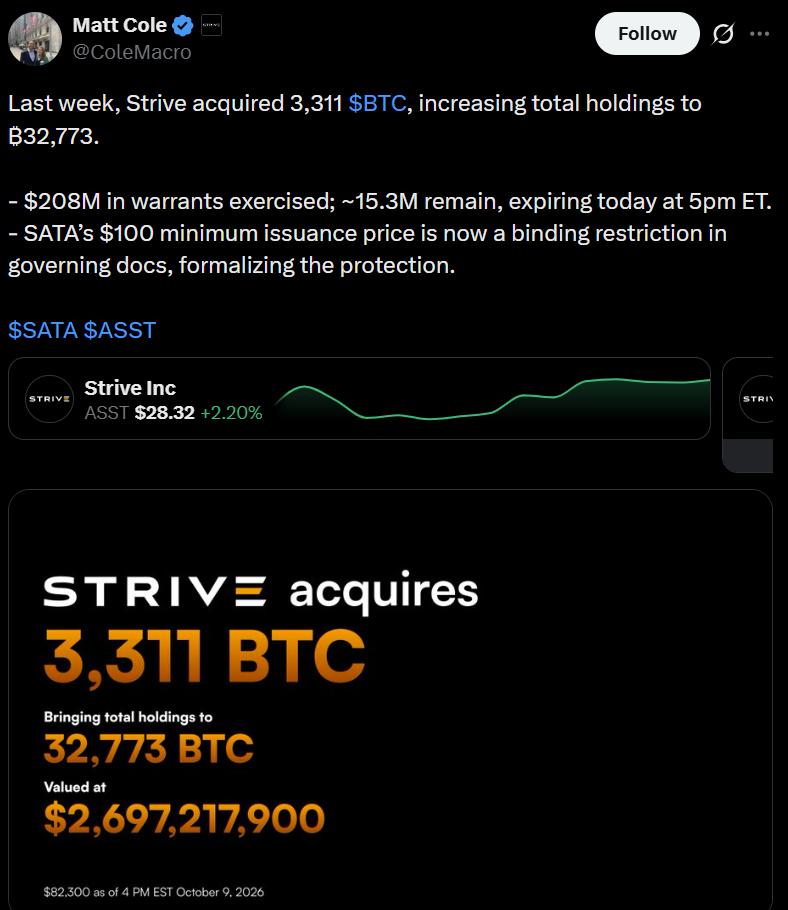
Strive expanded its Bitcoin reserves by 3,311 BTC last week, purchasing at an average price of roughly $84,500 per coin. The acquisition, funded through $208 million in exercised investor warrants, brings the company’s total holdings to 32,773 BTC. Strive now ranks as the fifth-largest publicly traded corporate Bitcoin holder globally, trailing only MicroStrategy, Marathon Digital, Tesla and Coinbase in disclosed reserves. About $15.3 million in warrants remained outstanding ahead of their Tuesday expiration. Chief Executive Matt Cole confirmed the company amended its governing documents to establish a binding $100 minimum issuance price for SATA preferred shares, which were trading at $99.40. Bitcoin traded near $83,300 following the purchases, while Strive common stock, ASST, was little changed at $27.52.
Bitcoin mining firms pivoting toward artificial intelligence infrastructure face sharply diverging borrowing costs. IREN secured $3.65 billion in financing in June at a blended interest rate of 6%, then raised another $2.4 billion in August at a fixed 9% rate. A June analysis by BlocksBridge Consulting, citing VanEck estimates, calculated that publicly traded miners require approximately $50 billion to fund AI data center ambitions. IREN alone faced a $21.1 billion funding gap, followed by Riot Platforms at $7.2 billion and HIVE Digital Technologies at $4.6 billion. Lenders are pricing risk based on specific customer contracts and project completion timelines rather than treating mining companies as uniform borrowers.
Corporate treasuries may soon gain clearer guidance on holding stablecoins. The Financial Accounting Standards Board proposed rules allowing qualifying tokens to be classified as cash equivalents on balance sheets, potentially improving reported liquidity ratios and easing loan covenant compliance. Under current practices, stablecoin holdings often fall outside cash definitions regardless of dollar backing. The proposal requires companies to maintain direct redemption rights with issuers; purchasing USDC through a secondary exchange would not automatically qualify. Coinbase already classified USDC and other payment stablecoins as cash equivalents in its 2025 annual report, relying on its redemption arrangement with Circle. The comment period closes Nov. 19.