Young Voters Split on Gun Control Despite Shared Fear of Shootings
Survey of 1,700 young adults reveals fear of mass shootings drives opposing policy demands based on gender and political affiliation.
Mass shootings account for roughly 1% of all firearm deaths in the United States, yet they exert a disproportionate grip on the political attitudes of the country’s youngest voters. As Generation Z approaches its peak electoral influence, new research reveals that a shared dread of mass violence is not forging a unified front on gun policy. Instead, fear is fracturing young Americans along partisan and gender lines, producing diametrically opposed legislative demands from the same generation.
A national survey of nearly 1,700 adults between the ages of 18 and 29 found that more than 60% experience moderate to high levels of fear that they or someone close to them will become a victim of a mass shooting. About 17% fall into the highest tier of anxiety. But when researchers examined how that fear translates into policy preferences, the consensus evaporated. Among young women, Democrats and political liberals, heightened fear correlated directly with stronger support for stricter firearm regulations. For young men, Republicans and conservatives, the exact opposite occurred: the more terrified they were of mass shootings, the more firmly they rejected gun restrictions.
This polarization explains why the assumption held by many political strategists—that younger demographics aging into the electorate will automatically deliver sweeping federal gun control—has repeatedly failed to materialize. Youth-led organizations like March for Our Lives, founded by survivors of the 2018 Marjory Stoneman Douglas High School massacre in Parkland, Florida, dominate media coverage of youth activism. Yet conservative youth networks advocating for expanded Second Amendment rights and campus carry laws have grown simultaneously, fueled by the same underlying terror of active shooters.


The lived reality driving this data has intensified sharply over the past year. When a gunman opened fire at Brown University in December 2025, investigators noted that at least two students caught in the attack had already survived a school shooting before arriving on the college campus. Four months earlier, in April 2025, students who lived through the Parkland massacre found themselves trapped inside another active shooter scenario at Florida State University. The recurrence of trauma among the same individuals underscores a demographic reality unique to modern American youth: multiple mass casualty events are no longer statistical anomalies within a single lifetime.

Despite these overlapping traumas, broad majorities of young adults still agree on specific baseline policies. Roughly two-thirds believe individuals should need a permit to carry a firearm in public and that guns should be prohibited on college campuses. Six in 10 reject the premise that higher rates of civilian gun ownership make communities safer, and a similar proportion disagree that gun control legislation violates the Constitution.
These aggregate numbers, however, mask deep fractures that state legislatures are currently testing. Criminological research consistently complicates the argument that armed civilians deter mass casualties. A comprehensive 2021 study demonstrated that mass shootings occur more frequently in states with higher overall gun ownership rates, while gun homicides are statistically more common in jurisdictions with permissive concealed carry laws. Still, federal firearms policy remains largely static. The Bipartisan Safer Communities Act of 2022 marked the first significant federal gun legislation in nearly three decades, but it stopped short of implementing universal background checks or banning specific weapon categories.
With Congress gridlocked, the electoral battleground has shifted entirely to the states, where young voter turnout can alter outcomes. Massachusetts voters this fall face a referendum on whether to preserve or repeal a 2024 law requiring firearm registration, expanding mandatory safety training for license applicants and broadening the state’s prohibition on assault-style weapons. In Arkansas, voters will decide on a constitutional amendment designed to explicitly protect the right to own ammunition and firearm components, moving beyond standard Second Amendment language to preempt future state-level restrictions.
Meanwhile, local bans passed in jurisdictions like Connecticut and Cook County, Illinois, are facing coordinated legal challenges rooted in the Supreme Court’s 2022 New York State Rifle & Pistol Association v. Bruen decision. That ruling established a historical-tradition test for evaluating gun laws, forcing lower courts to strike down modern regulations unless they can find direct analogues in 18th- or 19th-century American history—a standard that has thrown dozens of state and local statutes into legal limbo.
The psychological toll of navigating this landscape has forced the medical community to adapt. Nearly 80% of Americans reported in a 2019 American Psychological Association survey that the threat of mass shootings causes them significant stress, and one-third admitted to avoiding certain public venues because of it. Clinicians have since developed specialized screening tools specifically designed to diagnose and treat mass-violence anxiety, recognizing it as a distinct psychological burden rather than generalized panic.
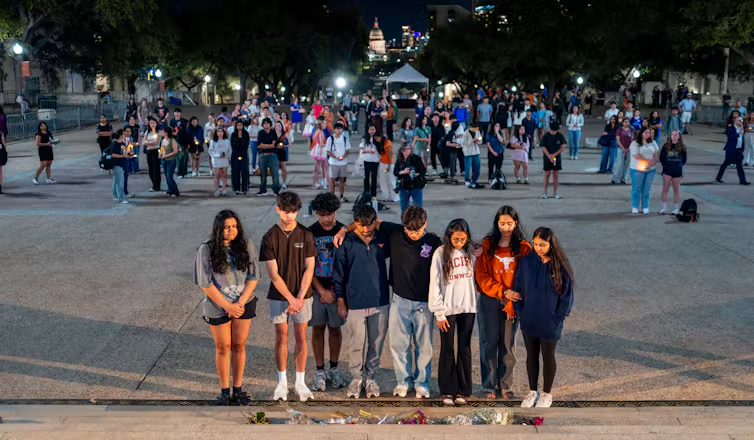
In March 2026, students at the University of Texas at Austin held a candlelight vigil for victims of a mass shooting at a downtown bar, marking yet another instance where young adults mobilized around sudden, localized gun violence.