
Trump Promises Whiskey Tariff Reversal and $1.29 Trillion Payout From Ireland
Whiskey tariffs, Irish reunification and a $1.29 trillion U.S. pledge dominate Trump’s Ireland visit
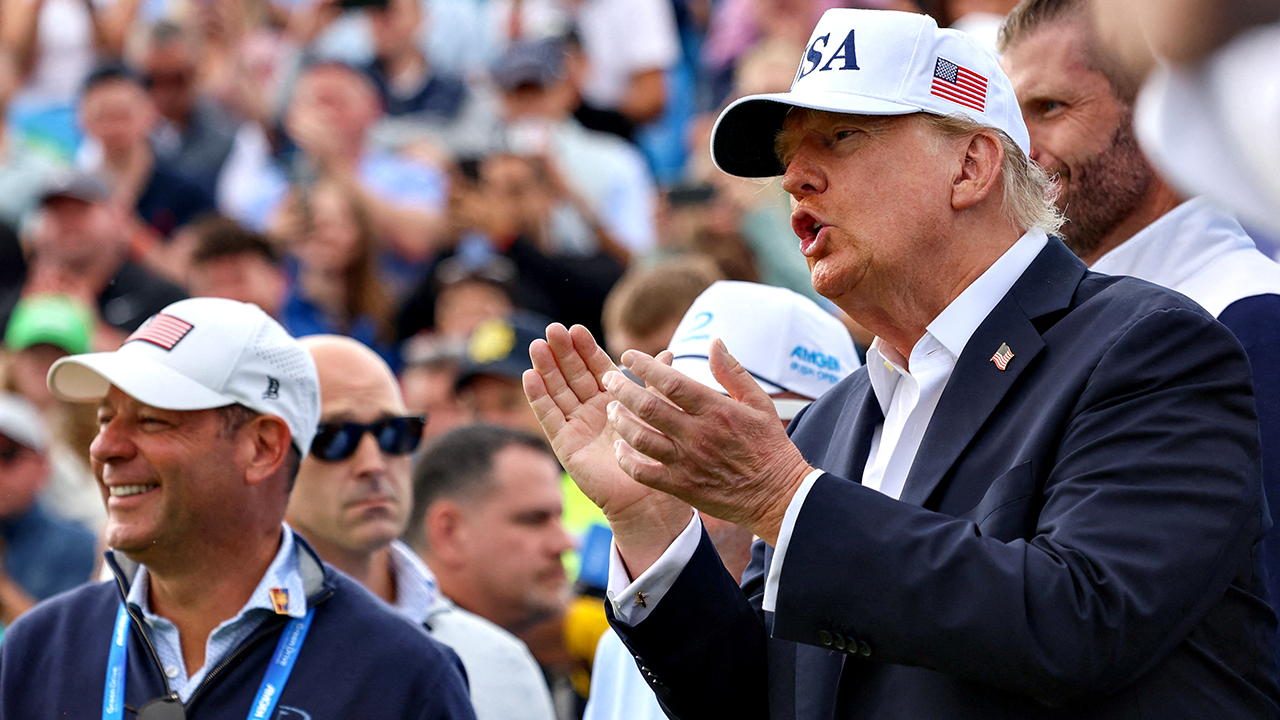
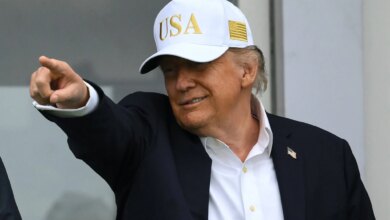
DOONBEG, Ireland — President Donald Trump used the award podium at his private golf resort on Ireland’s Atlantic coast to make a series of consequential announcements, ranging from Irish whiskey tariffs and Irish reunification to a $5,000 domestic campaign pledge. His appearance reflected his characteristic style of personal diplomacy during an overseas visit.
The Trump Organization purchased the Doonbeg property, originally designed by Greg Norman, in February 2014 for an estimated $20 million. The resort was later renamed Trump International Golf Links & Hotel Ireland. Its links course sits along the crescent-shaped Doughmore Bay and has become a central asset in Trump’s international hospitality portfolio.
Trump changed his travel itinerary on Saturday night, making a last-minute decision to remain at the County Clare property and watch Irish golfer Shane Lowry secure a dominant 11-shot victory at the Irish Open. The weekend’s sports and business activities preceded the president’s policy pronouncements.


At the trophy ceremony for the Irish Open, held at the Trump International Golf Club in Doonbeg, Trump unilaterally declared an end to U.S. tariffs on Irish whiskey. Spectators at the resort responded with cheers and chants of “USA.”
“Everybody’s been bugging me, saying, would you do me a favor? It’s so unfair what’s going on. Could you possibly take the tariffs off of Irish whiskey?” Trump said during his address. “And I said, on behalf of the United States of America, I am going to take the tariffs off of Irish whiskey.”
The whiskey dispute originated in a protracted, 17-year conflict at the World Trade Organization concerning state subsidies provided to European aviation giant Airbus and its American competitor, Boeing. In 2019, the WTO authorized the United States to impose retaliatory tariffs on $7.5 billion worth of European goods.
The Trump administration later imposed a 25% tariff on single-malt Irish and Scotch whiskies. The measure significantly affected distillers and exporters that depended on the lucrative U.S. market.
Trump’s multi-day tour also created diplomatic friction with neighboring Great Britain. After meeting Irish Prime Minister Micheál Martin in Dublin on Saturday, Trump publicly endorsed unification between the Republic of Ireland and Northern Ireland.
“I don’t want to cause any problems, but I will tell you, I’d love to see it unified,” Trump said while sharing a stage with Martin. “I have friends on both sides, great people. They’re Irish people. How can they be bad, right? I’d like to see a unified country. I think it would be a great feather in everybody’s cap if that happened. It’s going to happen eventually.”
Trump acknowledged that the British government “will have something to say about it obviously.” British Prime Minister Andy Burnham rejected the prospect of a near-term border poll, telling reporters in Parliament, according to Reuters: “I am not aware that there is majority public support for another referendum, and until that changes, there will not be one.”
The island of Ireland has remained politically divided since the early 20th century. The Anglo-Irish Treaty of 1921, signed after the Irish War of Independence, established Northern Ireland as part of the United Kingdom. The rest of the island became the independent Irish Free State in 1922 and later transitioned into the Republic of Ireland.
The 1998 Good Friday Agreement ended decades of sectarian conflict known as the Troubles. Under its terms, a referendum on Irish reunification can be called only by the UK’s Secretary of State for Northern Ireland, and only if it appears likely that a majority of voters would support a united Ireland.
Trump also focused on U.S. domestic politics while abroad. On Sunday, he doubled down on a campaign promise to issue $5,000 cash payments to every American adult if the Republican Party wins majorities in the upcoming midterm elections.
Answering critics who questioned whether the proposal was fiscally feasible, Trump said the country could “easily” afford the massive cash outlay. “I always keep my pledge,” he declared.
Approximately 258 million adults currently reside in the United States, making a flat $5,000 payment to each person worth roughly $1.29 trillion to the federal government. That amount exceeds the combined cost of the direct economic impact payments distributed during the COVID-19 pandemic under the 2020 CARES Act and the 2021 American Rescue Plan, which provided up to $1,200 and $1,400 per eligible individual, respectively.