Three Named Storms Batter Western Europe as Central Regions Bask in Record October Sun
Storms Adam, Austin and Boelo caused 150,000+ outages as Central Europe logged 25% above-average solar irradiance

Western Europe absorbed three named storms in nine days during October 2026, even as a persistent high-pressure ridge delivered the continent’s strongest October solar resource in years to Central Europe and the Baltics. The split pattern — violent Atlantic lows pounding France, Spain and the British Isles while clear skies dominated from Prague to Riga — produced a month of contradictions that tested energy infrastructure and exposed the limits of seasonal forecasting.
Storm Adam arrived first, named by Spain’s meteorological agency on October 16. It stalled over the western Mediterranean for 36 hours, dumping 632 millimeters of rain on Pego, Alicante — nearly a full year’s precipitation. At least seven people died, four in France and three in Spain. The Spanish military’s Emergency Intervention Battalion deployed to Valencia region as hundreds of thousands were ordered to shelter in place. In southern France, the storm triggered a classic “épisode cévenol,” the autumn phenomenon where warm Mediterranean moisture collides with cold air over the Cévennes mountains. Météo-France data shows these episodes now occur twice as often and with greater intensity than in the 1960s.


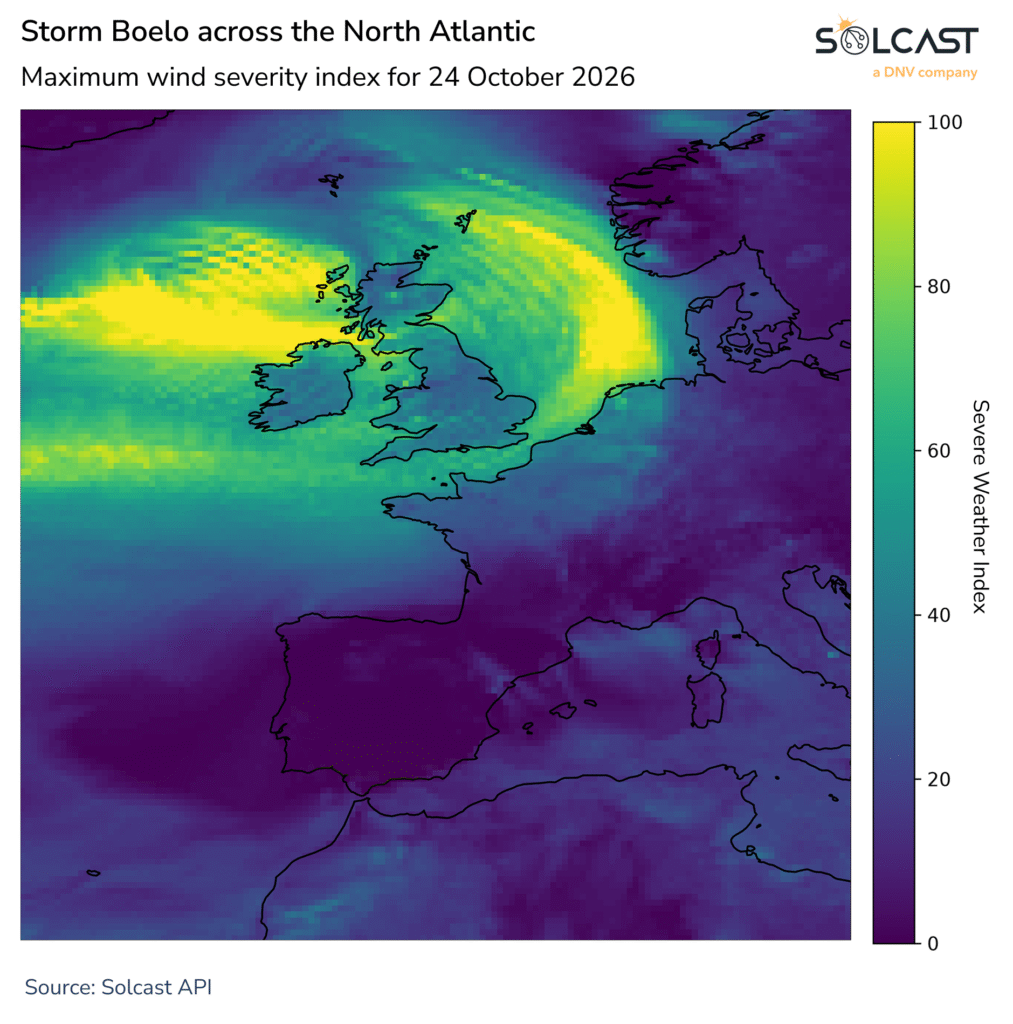
Before cleanup began, Storm Austin made landfall in Brittany on October 23 with gusts reaching 161 km/h at Pointe du Raz. The system cut power to nearly 300,000 French customers, half of them in Brittany alone. Jersey and Guernsey airports closed. Paris airports canceled scores of flights. Two days later, Storm Boelo raked Scotland and Northern Ireland with a 179.9 km/h gust recorded in Inverness-shire — the strongest UK wind speed since 2015. The combined outages from Boelo topped 150,000 homes across Britain, France and Germany. A falling tree killed one man in western Scotland.
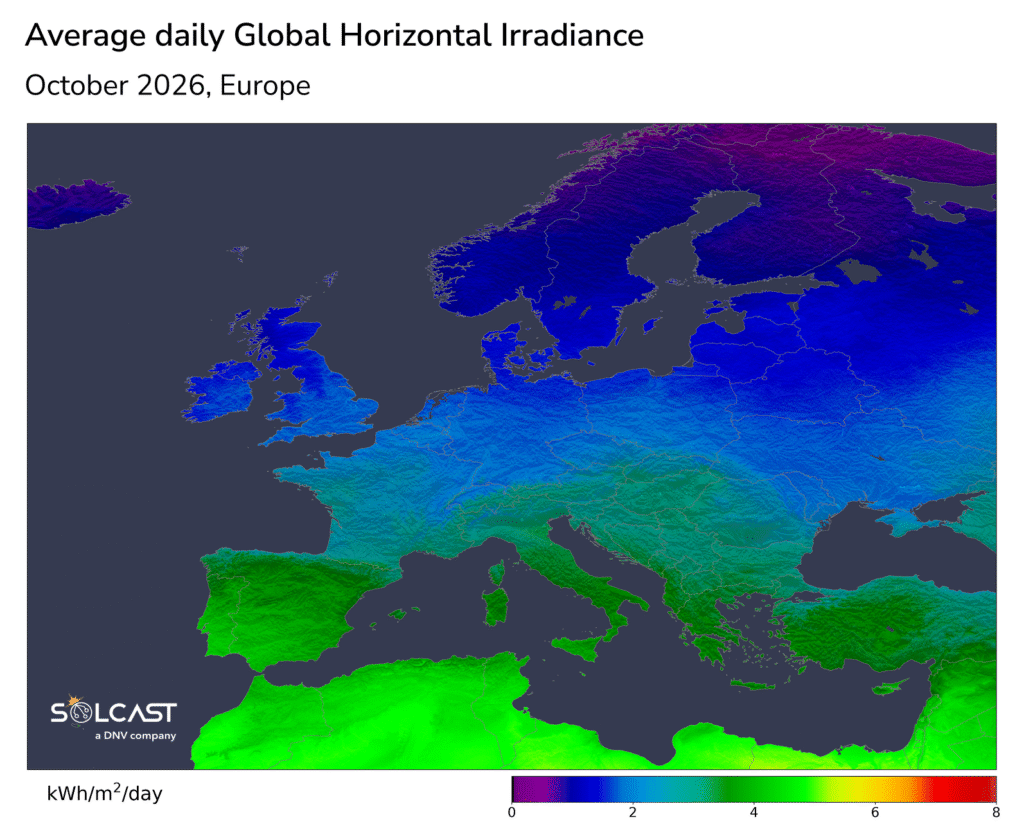
Meanwhile, 1,500 kilometers east, solar operators logged exceptional output. Czechia, Slovakia and Hungary recorded irradiance 25 percent above the October norm. The Baltic states saw similar percentage gains, though shorter days limited daily totals to roughly 1.3 kWh/m². The driver was a strongly positive North Atlantic Oscillation phase that locked high pressure over Central Europe from late September through October. Solcast‘s satellite-derived data, used by 350 companies managing 350 GW of solar assets, confirmed the anomaly across its 1-2 km resolution grid.
Southern France, Ukraine and Moldova missed out entirely. Irradiance ran 5 to 10 percent below average under recurrent low-pressure troughs and frontal cloud bands. The same systems that blocked sunlight over the Black Sea region fed moisture into the Mediterranean storms hammering Spain and France.
The storms’ high winds drove wind generation to levels that briefly crashed wholesale power prices in France and Germany. SolarPower Europe calculated that solar alone displaced €40 billion in EU gas imports between March 1 and October 15. The figure underscores how renewable capacity is reshaping energy security calculus — even as the grid struggles with the volatility of a climate that delivers record sun and hurricane-force winds in the same month.
Forecast models had signaled a mild, dry autumn for Central Europe. They did not anticipate three named storms in nine days. The gap between seasonal outlooks and sub-seasonal reality remains the operative challenge for grid operators, insurers and emergency managers heading into winter.