

Rooftop Solar Is Driving Utilities Toward a Death Spiral
Cheap Solar Is Reshaping Power Networks and Utility Revenues
The cost of bypassing the electricity grid has become highly compelling for heavy industry. In Pakistan, Bestway Cement has integrated solar generation into its manufacturing facility in Chakwal, where it currently operates 26 megawatts of solar capacity and is on track to add another 6.34 megawatts by the end of this year. Abdul Waheed, the plant’s general manager, said on-site solar has become a baseline requirement for economic survival, adding that the company’s direct competitors have already taken similar measures.
That industrial shift is part of a broader change in which millions of businesses and households are moving from passive consumers to self-generating producers. The transformation is disrupting the century-old model of centralized power grids and producing what the energy sector calls the “utility death spiral.”
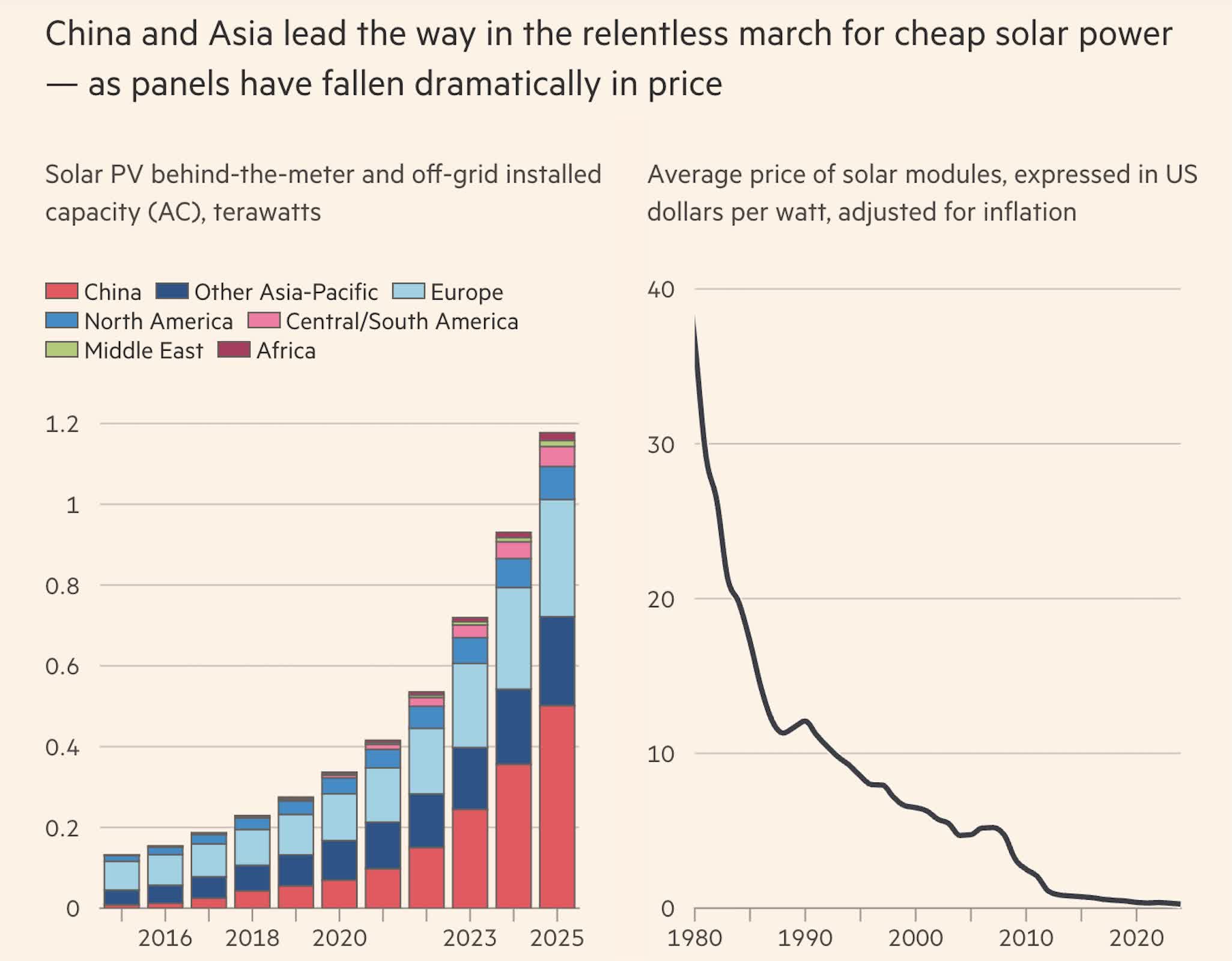
China’s manufacturing expansion has driven the change. Over the past two decades, industrial subsidies and massive factory scaling in China have turned solar panels into a cheap, mass-market commodity. Data from the energy think tank Ember shows that panels priced at $5 to $6 per watt around the year 2000 now cost approximately 12 cents per watt.


India is actively accelerating the decentralized shift. In February 2024, the country launched the PM-Surya Ghar: Muft Bijli Yojana, a national initiative backed by substantial government subsidies to help households install solar and receive free electricity. Praveer Sinha, chief executive of Tata Power, said the program has already placed solar panels on more than 5 million homes and is adding roughly 500,000 new households each month. He described the development as a fundamental “democratization of the use of electricity.”
The manufacturing boom has also created substantial overcapacity. Wood Mackenzie estimates that Chinese solar manufacturing capacity has reached roughly 1.36 terawatts, far exceeding global demand. Meanwhile, global small-scale solar capacity—including rooftop and on-site commercial systems—reached nearly 1.2 terawatts by the end of 2025, according to the Energy Institute’s Statistical Review of World Energy. Because solar systems do not produce electricity at full capacity around the clock, installed capacity is now roughly three times the size of the world’s active nuclear generation fleet.
In Pakistan, the financial effects are widening existing economic divisions. K-Electric, the utility serving the megacity of Karachi, has seen solar arrays spread rapidly across the rooftops of the affluent Defence Housing Authority neighborhood. Syed Muhammad Taha, K-Electric’s chief executive, called the trend both “a curse and a blessing.” Solar adoption is a clean energy milestone, but it also removes the utility’s highest-paying and most reliable customers.
Those customers reduce their daytime purchases from the grid while continuing to depend on the network at night, during prolonged cloudy weather, or when battery storage runs low. Utilities must still maintain transmission lines, substations, and reserve power plants even as revenue comes from a shrinking pool of customers.
In Karachi’s working-class Lyari district, K-Electric reports losing between Rs30 and Rs40 ($0.31 to $0.42) for every Rs100 ($1.04) spent delivering electricity. Power theft and non-payment are chronic in impoverished areas, making it harder for the utility to subsidize operations there. Azem Baloch, a mechanic renting a flat in Lyari, said utility costs now consume more than half of his monthly income.
A related fiscal pressure is unfolding in South Africa. State-owned Eskom has faced systemic generation shortages for more than a decade, resulting in scheduled rotational blackouts known locally as “load-shedding.” Rising electricity tariffs and chronic unreliability have encouraged businesses and wealthy homeowners to pursue energy independence.
During the fiscal year ending in March, Eskom recorded an 11.7 terawatt-hour decline in total electricity sales. The utility estimates that rooftop solar and commercial battery storage installations accounted for approximately 7 percent of that drop. Shoprite, Africa’s largest food retailer, has installed solar panels across supermarkets and distribution centers in South Africa and Namibia since 2015. It now has roughly 43 megawatts of peak solar capacity and is exploring large-scale battery storage to further isolate itself from grid dependency.

The pressure is not limited to Africa or South Asia. In the Philippines, rooftop solar capacity nearly doubled during the 12 months ending in April. Meralco, the country’s largest private sector electricity distributor, reported that consumer-owned rooftop systems generated 372 gigawatt-hours during the first half of the year. Ember’s market analysis says residential solar installations in the Philippines can now recover their initial capital costs in just over three years, making the move attractive to middle-class households.
For utilities, the problem is also technical. Traditional grids send electricity in one direction, from centralized coal, gas, hydro, or nuclear stations to end consumers. Rooftop solar reverses that flow, sending power from neighborhood distribution lines back into high-voltage transmission networks. The resulting increase in local grid voltage can exceed safe limits, damage equipment, and force utilities to restrict how much solar households export.
Australia, the world leader in per-capita rooftop solar adoption, faces these conditions as an everyday operational reality. Pierluigi Mancarella, a professor of electrical power systems at the University of Melbourne, warned that weather patterns can introduce severe volatility. A large cloud formation moving over an area with dense rooftop solar coverage can cause local production to fall so sharply and suddenly that the effect replicates the immediate loss of a major utility-scale nuclear power plant.
Another challenge is the extreme midday supply surge known as the “duck curve.” Solar generation can push net grid demand close to zero during peak daylight hours, making it difficult to operate the traditional baseline thermal power plants still needed to stabilize the system when the sun sets and evening demand rises.
Utilities are responding with forecasting technology and new pricing systems. UK Power Networks recently carried out a £389,000 ($523,992) project to analyze and map unregistered solar installations across its network. Forecasting companies such as Amperon are retraining computer models every hour to give utilities real-time predictions of solar output based on moving weather fronts.
Regulators are also revising rate structures. Many grid operators are replacing flat-rate billing with “Time-of-Use” (TOU) tariffs that charge more for electricity consumed during evening peaks and offer ultra-cheap rates during midday periods of high solar production. Some regions are adding fixed grid-connection charges and demand fees so that even self-sufficient solar owners continue paying for the physical network they use as a backup.
As wealthier customers and large commercial operations reduce grid purchases, utilities increasingly raise tariffs on people who cannot afford solar installations. The same dynamic shifts infrastructure costs onto lower-income populations and leaves grid operators urgently overhauling their pricing and engineering strategies.









