Record Solar Irradiance in Western Europe Summer 2026 Driven by Persistent Heat Domes
Persistent heat domes delivered a 16% irradiance surge to England and Wales while driving the driest July on record.
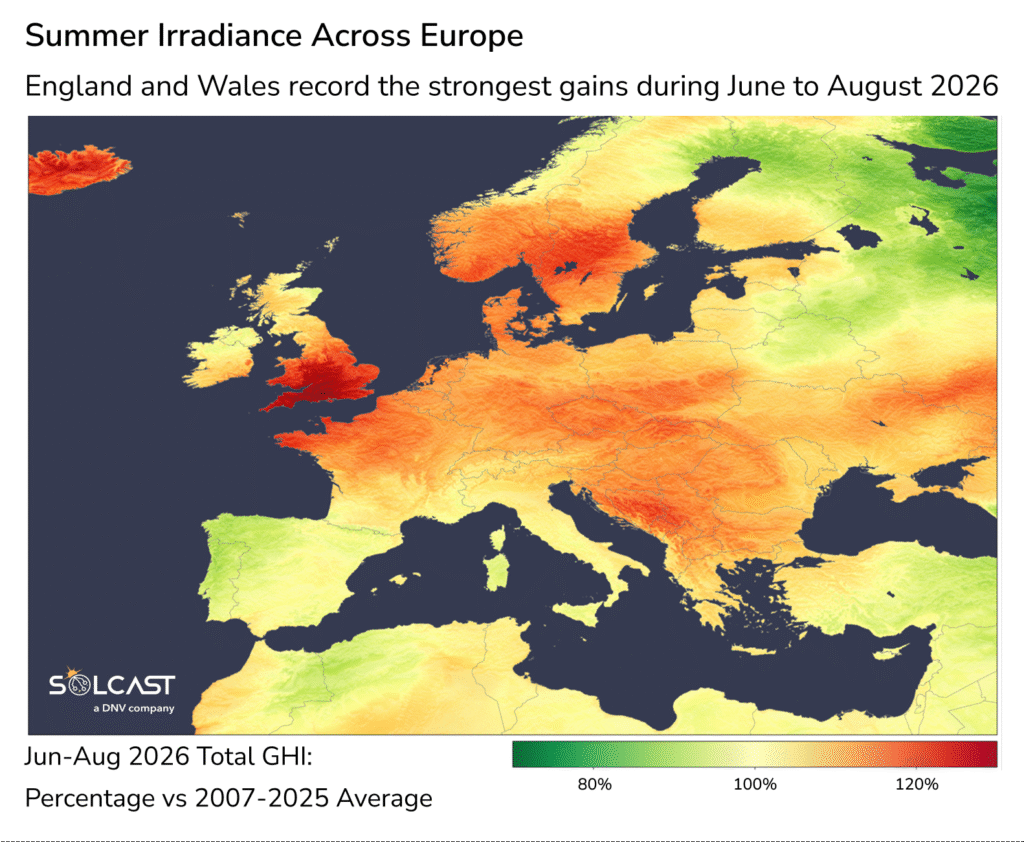
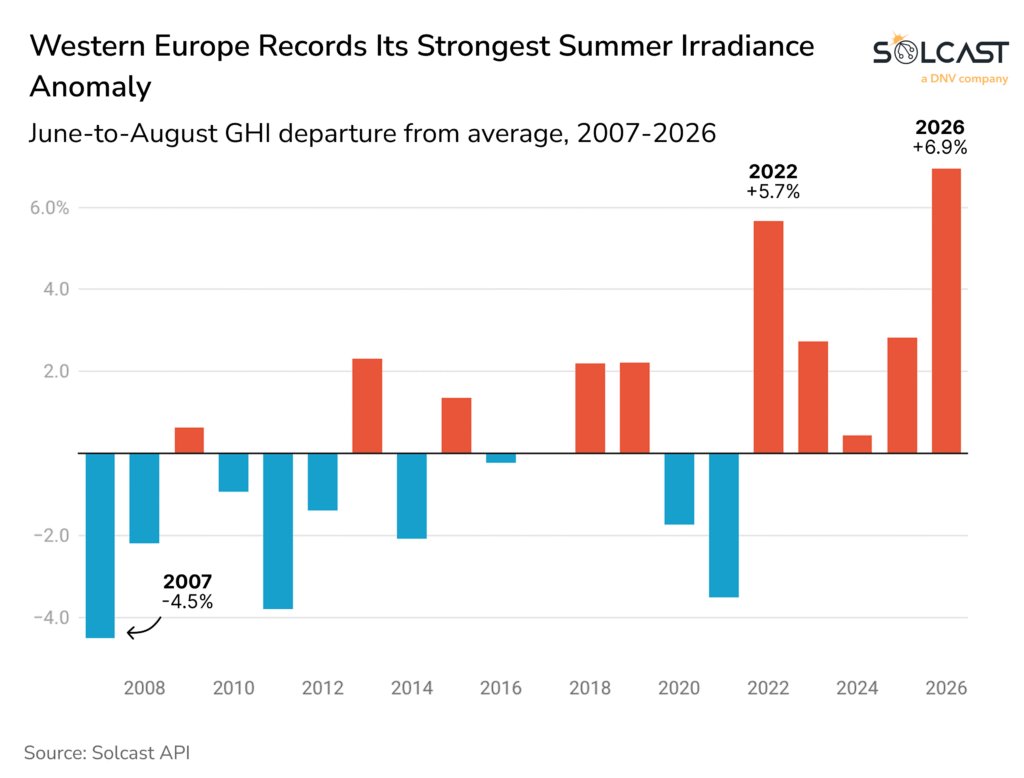
Western Europe’s solar energy sector captured unprecedented sunlight between June and August 2026, driven by a persistent atmospheric pattern that simultaneously triggered historic droughts across the region. Global Horizontal Irradiance (GHI) across western Europe reached 6.9% above the 2007–2025 average, surpassing the previous benchmark set during the extreme European summer of 2022.
The seasonal surge was not uniform. England and Wales recorded the sharpest gains, with GHI climbing nearly 16% above the long-term baseline. The Paris metropolitan area followed closely at approximately 15% above average. Across the broader European continent, irradiance finished 3.4% above normal, with 81% of the landmass experiencing above-average solar exposure.
This concentration of solar resource over the British Isles and northern France traces directly to repeated heat dome formations throughout the season. Heat domes occur when strong high-pressure systems trap hot air near the surface while forcing clouds away through subsidence — the downward movement of air that suppresses convection and prevents moisture from condensing into cloud cover. For solar operators, this meteorological phenomenon translates directly into higher capacity factors and increased wholesale electricity generation during peak demand hours for cooling.
The UK currently operates over 17 gigawatts of installed solar capacity, much of it concentrated in southern England where these clear-sky anomalies were most pronounced. Because photovoltaic output scales linearly with irradiance under optimal temperature conditions, a 16% increase in GHI represents a substantial revenue boost for asset owners participating in day-ahead power markets or operating under legacy feed-in tariffs. However, ambient temperatures more than 2°C above average across all three summer months introduce a thermodynamic trade-off: standard silicon solar panels lose roughly 0.3% to 0.5% of their efficiency for every degree Celsius above 25°C. Even so, the sheer volume of additional sunlight far outweighed the thermal efficiency penalty.
The same atmospheric blocking patterns that maximized solar yields devastated regional hydrology. ERA5 reanalysis data confirmed rainfall deficits of 18% below average in June, plummeting to 70% below average in July before recovering slightly to 17% below average in August. July proved catastrophic for water resources. England and Wales recorded just 10.3 millimeters of precipitation against a historical average of 78.1 mm, marking the driest July in the observational record. The European Commission’s Joint Research Centre formally classified widespread drought conditions across the continent in its July 2026 assessment.
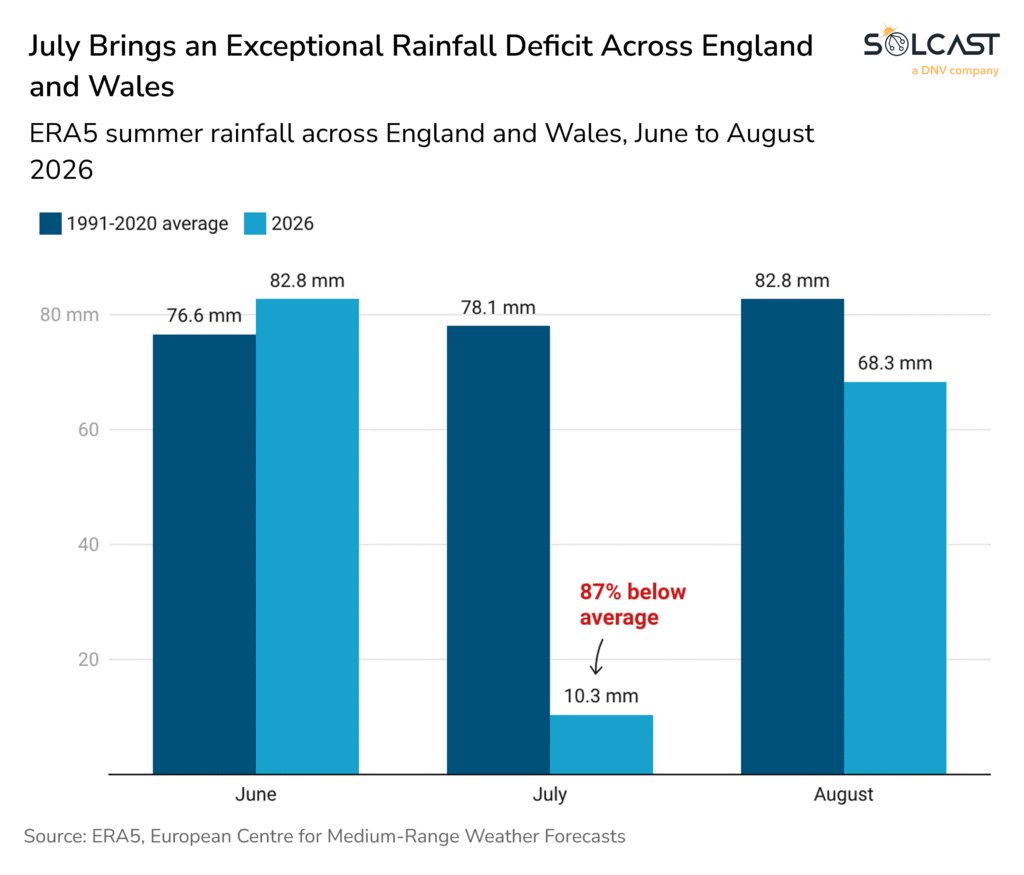
These extremes expose the compounding vulnerabilities within integrated European energy grids. While solar farms operated at peak potential, hydropower reservoirs in regions like the Alps and Scandinavia faced severe drawdowns due to lack of inflow. Furthermore, thermal power plants — including nuclear facilities in France that rely on river water for cooling — frequently face mandatory curtailments when river levels drop and water temperatures rise, as occurred extensively during the 2022 crisis. The 2026 data suggests grid operators had to lean even heavier on the wind and solar fleet precisely when conventional baseload flexibility was constrained by drought.
Irradiance tracking for the season relied on satellite-derived modeling capable of resolving cloud and aerosol movements at 1-to-2 kilometer resolution globally. Solcast, which processes this data using machine learning algorithms to achieve typical bias rates below 2%, supplied the analysis. The firm’s models currently support more than 350 companies managing over 350 GW of solar assets worldwide, reflecting how granular atmospheric data has become foundational infrastructure for modern energy trading and grid balancing.
European climate monitoring agencies continue to evaluate whether the frequency of summer blocking patterns is accelerating beyond natural variability, a question central to long-term capacity planning for both renewable developers and national water authorities.