The Only Dish That Can Command Voyager 1 Went Quiet for Ten Months
The farthest spacecraft humans operate answers to a single 70-metre dish. Its power, its instruments and its October silence all run through that one path.
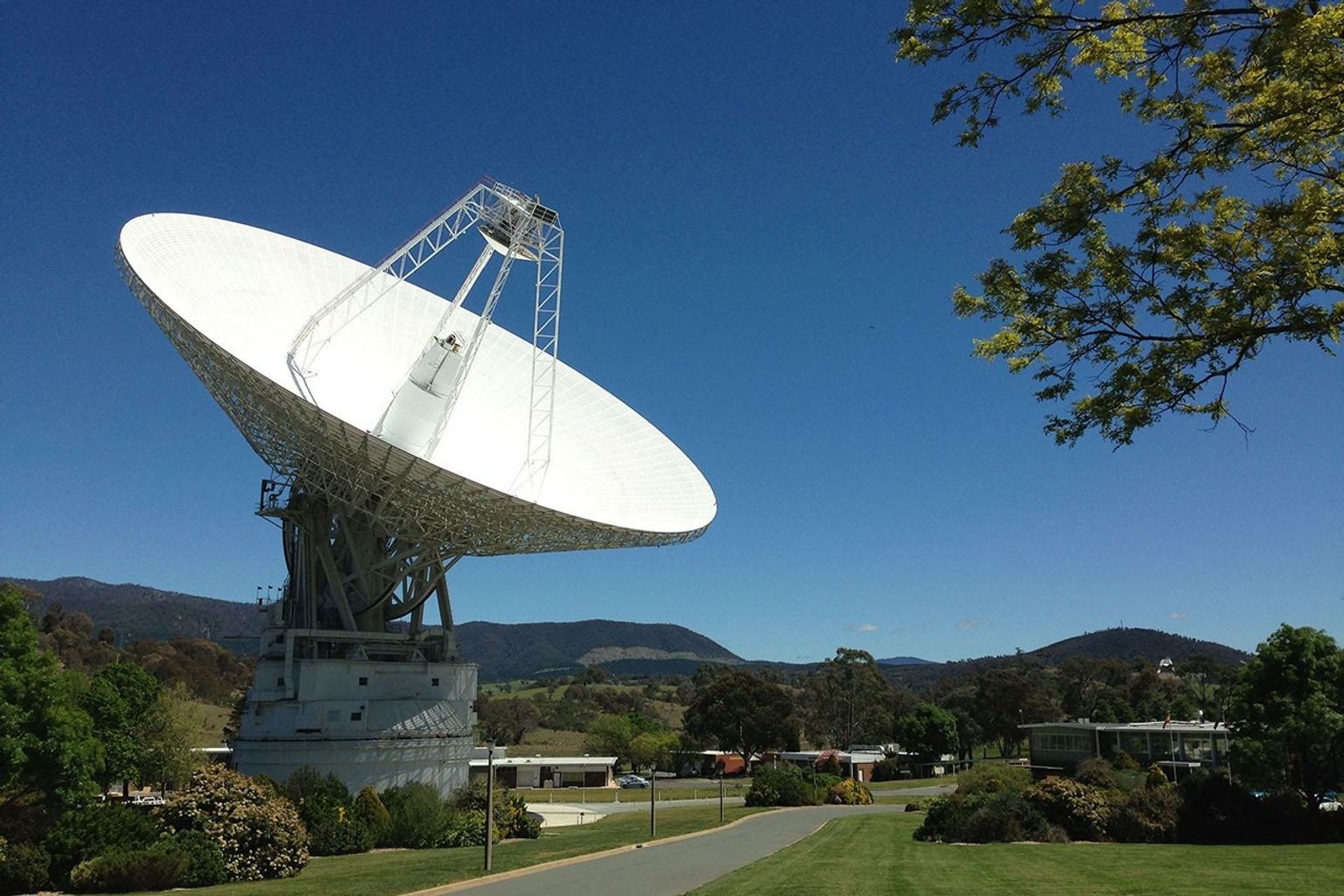
Deep Space Station 43 stands in the hills near Canberra, a white dish 70 metres across, and it holds a job no other antenna on Earth holds. Voyager 1 sends its data down to NASA’s complexes at Madrid and Goldstone as well as to Canberra, but it can only receive commands through Canberra. NASA put it that way itself in April 2025: the probe’s data comes down in three places, and its orders go up in one.
The dish was scheduled to go quiet for most of ten months. From May 4, 2025, through February 2026, DSS-43 was scheduled to be offline for upgrades, working only in brief windows in August and December. The Jet Propulsion Laboratory, which runs the mission, said DSS-43 was the only dish with enough signal power to send commands to the Voyagers. Engineers at JPL finished one repair in March 2025 because the deadline was coming: a set of roll thrusters on Voyager 1 that had been considered inoperable since 2004, revived so they would be available when the dish came back briefly in August, by which time the thrusters in use might have clogged completely.
On Oct. 18 and Oct. 19, 2026, the Deep Space Network could not detect Voyager 1’s signal during two scheduled contacts, 24 hours apart. The signal reappeared on Oct. 20. NASA’s report on Oct. 29 said the loss resolved itself after 48 hours, before the team sent any commands to troubleshoot it. The cause was still under investigation. What the team had established was narrower: one group of the spacecraft’s thrusters had gone offline and the backups had switched on by themselves, the automatic response NASA calls fault protection, which puts Voyager 1 in a safe configuration and pauses normal operations while engineers work out what happened.
“This is the first time we’ve seen the spacecraft do something like this, but we are also at a point in the mission where we have to expect the unexpected,” Kareem Badaruddin, the Voyager mission manager at JPL, said in the report. “We’re relieved to be back in contact with Voyager 1 and are eager to understand what happened.” The distinction from the last two scares matters, because in both of those the ground team did the fixing. In November 2023 Voyager 1 began sending unreadable data, and engineers spent five months tracing the fault to a damaged memory chip, then sent up replacement code in pieces until readable health data came back on April 20, 2024. In October 2024 a heater command tripped the same fault protection, the main X-band transmitter switched off, and the team worked through a backup transmitter that had not been used to talk to Earth since 1981 before restoring normal operations on Nov. 26. In October 2026, no troubleshooting command had been sent when the signal came back. The cause was still under investigation when NASA published its report on Oct. 29.
In early September, engineers completed a months-long effort NASA nicknamed the Big Bang: three devices on Voyager 1 were turned off at once and replaced with three lower-power alternatives, because the six devices involved had to be swapped together to keep heat distributed properly across a spacecraft running on decaying plutonium. The same swap had been done on Voyager 2 about six weeks earlier. Each Voyager loses about 4 watts of power a year, and without the Big Bang, NASA said, Voyager 1 would have needed to turn off another science instrument as early as summer 2027.
The instrument shutdowns follow a list the science and engineering teams agreed on years ago, and the April entry on that list shows how thin the margin had become. During a routine roll maneuver on Feb. 27, 2026, Voyager 1’s power levels fell unexpectedly, and any further drop could have triggered the undervoltage fault protection, an automatic shutdown with a lengthy recovery. On April 17, engineers sent commands to shut down the Low-energy Charged Particles experiment, which had been measuring ions, electrons and cosmic rays almost without interruption since the 1977 launch. The command took about 23 hours to arrive. One small part stayed on: the motor that spins the instrument’s sensor, using 0.5 watts, kept running so the instrument might one day be switched back on if extra power is found. “While shutting down a science instrument is not anybody’s preference, it is the best option available,” Badaruddin said at the time. Seven of the ten identical instrument sets each Voyager carries have now been shut off. Two science instruments remain on Voyager 1, one listening to plasma waves and one measuring magnetic fields.
DSS-43 itself is older than the mission it now serves alone. It was built between 1969 and 1973 as a 64-metre dish and enlarged to 70 metres in 1987, for Voyager 2’s encounter with Neptune. Its reflector is made of 1,272 aluminium panels with a total surface area of 4,180 square metres, and the structure weighs more than 3,000 tonnes. NASA is building a new dish at Canberra, DSS-33, a 34-metre antenna due online in 2029. It is the last of six dishes built under a programme to add capacity for current and future missions.
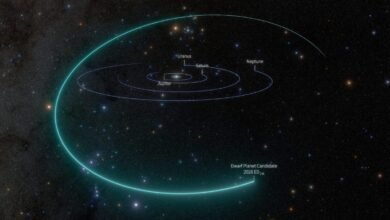
At 5:16:07 a.m. EST on Nov. 18, 2026, Voyager 1, the most distant human-made object, will be one light-day from Earth: 16,094,799,096 miles (25,902,068,356 kilometres) away, after 49 years, two months and 11 days in flight. A light-day is the distance light travels in 24 hours, and the crossing is timed to the second because it is measured from Earth, which is also moving. Earth circles the Sun at about 30 kilometres a second, faster than Voyager 1 is pulling away, so the gap between the two grows and shrinks through the year; a live count kept from NASA’s figure puts the moment a sent command takes a full day to arrive on Nov. 17, the exact one-light-day distance on Nov. 18, and the moment a signal leaving the probe takes a full day to reach Earth on Nov. 19. After Nov. 18 the distance keeps growing until January, dips slightly until April, and then grows for good. Measured from the Sun instead of from Earth, the same mark comes around Feb. 3, 2027. “If you want to say ‘hello’ to Voyager, you send your message and then you go home and you wait two days before you finally get a response,” Suzanne Dodd, the Voyager project manager at JPL, said. Nothing aboard the spacecraft changes when it passes the mark. Voyager 2 took the longer route, past Uranus and Neptune, and NASA puts its own one-light-day crossing in November 2035. The change is on the ground: every question and every answer now takes two days, at minimum, and the one dish that can ask the question spent most of 2025 unable to ask anything.
The people who answered NASA’s Oct. 30 posts about the silence and the overhaul did not write like engineers writing a report. Bernard Netherclift, posting on X as @Bernard1963, read a cause into the silence that NASA had not confirmed: “Reading between the lines! Comms lost due to loss of attitude control due to thruster failure. CCS & AACS managed to recover S/C. Now using what I think is the last set of operational thrusters with little life left in them 😢” David Hansen, posting as @investDRH, answered 49 years of survival with six words: “They don’t build them like they used to.” Holland Branch Glen, posting as @HBG_Dani, treated Nov. 18 as a date to mark rather than a measurement to note: “We need to have an amazing celebration on Nov 18!” And a poster calling himself mild man, @byebyejack1, measured the whole journey against the speed it is named for: “Would have reached the same distance on Sept 6 1977 if it were traveling at the SPEED OF LIGHT. We are currently at molasses speed.”
NASA’s account leaves the cause open, the investigation running and the milestone itself without effect aboard the spacecraft. The readers filled the gaps the report left, each in a different direction, and all four posts were replies to NASA’s Oct. 30 posts, written within hours of the report appearing.
The two instruments still working on Voyager 1 send back magnetic-field and plasma-wave readings from interstellar space, a region no other human-made craft has sampled directly. The Deep Space Network’s three complexes take turns listening as Earth turns, and the readings arrive a day after they were taken.