Perseverance Rover Sets Mars Distance Record at 28.1 Miles
Autonomous navigation allowed the nuclear-powered rover to eclipse Opportunity's 15-year mileage total in roughly five and a half years.
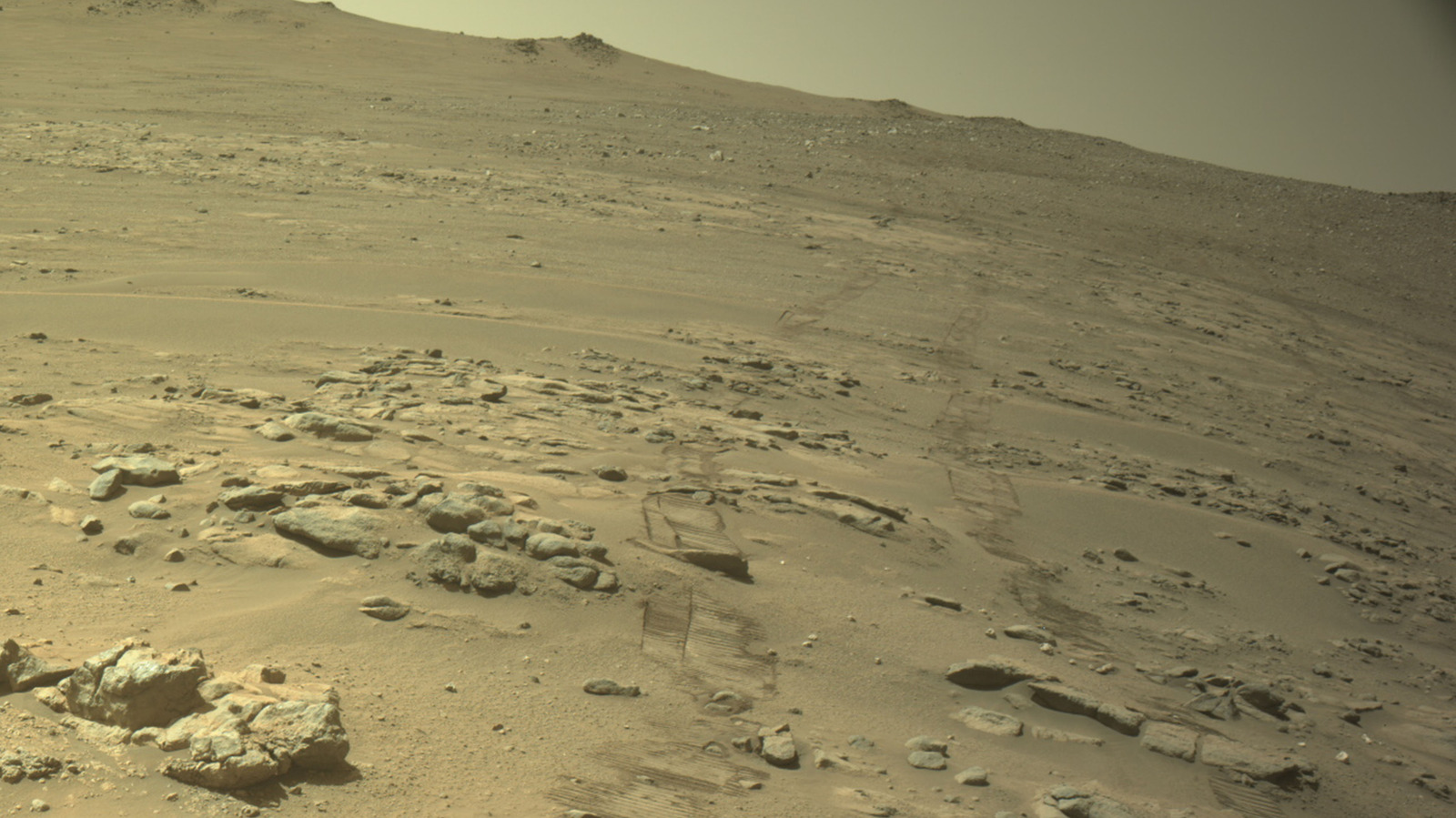
NASA’s Perseverance rover has driven farther than any vehicle in history on another planetary surface, surpassing the all-time extraterrestrial distance record previously held by the Opportunity rover for nearly a decade.
Telemetry confirmed on Oct. 11 that the nuclear-powered explorer reached 28.10 miles (45.22 kilometers) across Jezero Crater and its surrounding terrain. The milestone eclipses the 28.06-mile mark set by Opportunity before it fell silent during a global Martian dust storm in June 2018. While Opportunity required almost 15 years to accumulate its total mileage following its 2004 landing, Perseverance achieved the new benchmark roughly five and a half years after touching down on Feb. 18, 2021.
The disparity in timelines reflects fundamental differences in how the two machines operate. Perseverance relies heavily on AutoNav, an onboard autonomous navigation system capable of processing 600,000 topographic measurement points per scan to identify hazards and plot routes without waiting for instructions from Earth. More than 90 percent of the rover’s total distance has been covered autonomously. By contrast, Opportunity depended largely on daily commands uploaded by engineers at the Jet Propulsion Laboratory in Pasadena, California, who analyzed stereo images sent back by the rover before approving each driving sequence—a process limited by the speed of light, which imposes communication delays ranging from four to 24 minutes depending on orbital alignment.


A recent software update further accelerated Perseverance’s progress. The patch allows the 2,260-pound vehicle to drive straighter lines with fewer steering corrections, reducing mechanical wear on its actuator assemblies. The same update enables the rover to cross-reference its position against orbital maps mid-drive rather than stopping to localize itself.
The record-breaking odometer reading coincides with the rover’s arrival at Idubi, a region containing geological formations among the oldest ever examined in the solar system. The science team is currently targeting a feature designated “Lac de Charmes” to search for evidence of ancient hydrothermal systems. Because Mars lacks active plate tectonics—unlike Earth, where crustal recycling continuously destroys ancient rock—these terrains preserve chemical signatures dating back billions of years. Finding mineral deposits altered by heated water could provide critical data regarding whether early Mars harbored environments capable of supporting microbial life, the primary objective of the $2.7 billion Mars 2020 mission.
Despite its maximum ground speed of approximately 0.1 mph, Perseverance recently crossed the marathon threshold of 26.2 miles earlier this year. Engineers are now working to resolve camera glare caused by direct sunlight reflecting off the Martian landscape, a persistent issue that forces the navigation cameras to halt operations during certain hours. Eliminating this visual interference would extend the rover’s daily driving windows significantly.
Perseverance is not the only American robot still accumulating miles on the Red Planet. Curiosity, which landed inside Gale Crater in August 2012 using a similar sky-crane descent system, continues to operate and has logged 23.7 miles (38.15 kilometers). Beyond robotic explorers, the farthest distances traveled by humans on another world remain the records set during the Apollo program. The Lunar Roving Vehicle deployed during Apollo 17 in December 1972 holds the crewed record at 22.21 miles (35.74 kilometers), followed by the rovers used during Apollo 15 and Apollo 16.
As of mid-October 2026, Perseverance continues to drill core samples at Lac de Charmes, caching them in sealed titanium tubes on the Martian surface for potential retrieval by a future joint NASA-European Space Agency sample return architecture currently under review by agency leadership.